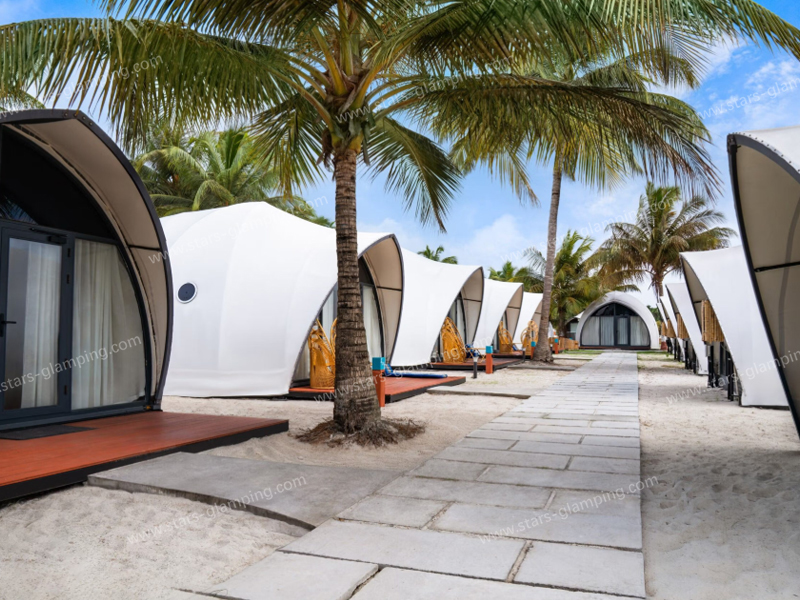
Coastal and beachfront properties represent some of the most desirable locations for luxury glamping and outdoor hospitality projects, yet they also present one of the harshest operating environments for architectural tent structures. Salt-laden air, high humidity, and constant UV exposure combine to accelerate corrosion, degrade fabrics, and shorten the usable life of poorly engineered outdoor accommodation units. Understanding how to protect hotel tents from salt air requires a closer look at material science, structural engineering, and long-term maintenance strategy — areas where Stars Glamping, operating under the Stars Tent brand, has focused its product development.
Why Salt Air Threatens Hotel Tent Structures
Outdoor hospitality providers often face the challenge of balancing aesthetic appeal with structural durability in harsh environments, while guests simultaneously demand hotel-grade comfort in remote natural settings. This tension is especially pronounced along coastlines, where salt particles carried by ocean breezes settle on metal frames and fabric surfaces. Left unaddressed, this exposure can lead to rust formation on structural components, fading or weakening of exterior membranes, and increased maintenance costs over time. For resort developers and campsite operators, the stakes are high: a tent that looks striking on day one but deteriorates within a season undermines both guest experience and return on investment.
Material Engineering That Withstands Coastal Conditions
Addressing salt air exposure begins at the material level, long before a tent is ever installed on-site.
High-Performance PVDF Membranes
Stars Glamping utilizes high-performance PVDF architectural membranes across much of its product line specifically to ensure all-weather adaptability, including resistance to UV, flame, and mildew. The Luxury Tent – Octagon, positioned as an upgraded version of the classic Safari Tent for premium glamping, illustrates this approach directly: its high-quality PVDF membrane is engineered to ensure durability in coastal and tropical regions, addressing the difficulty many outdoor accommodation providers face in maintaining stability and aesthetics across diverse terrains and climates. The octagonal roof design also facilitates natural runoff of rain and snow, reducing the maintenance burden that would otherwise accumulate in humid coastal climates.
Hot-Dip Galvanized Steel Frames
Corrosion resistance is equally critical for the structural skeleton of any hotel tent. Stars Glamping applies hot-dip galvanized steel processing across its frame systems for superior corrosion resistance — a technical method that directly counters the oxidizing effects of salt-laden moisture. The Octagon tent's 80×80mm galvanized steel frame, for example, is built to provide superior strength and prevent rust in high-humidity environments, which is a defining characteristic of coastal deployments. Similarly, the Luxury Tent – Hecate relies on 80×80×3mm steel pipes in a heavy-duty hot-dip galvanized structure for extreme stability, while the Luxury Tent – Shell uses a 60×80mm galvanized steel frame engineered for stability under harsh weather.
Low-Maintenance Surfaces Reduce Long-Term Salt Buildup
Beyond initial material selection, ongoing exposure to salt air demands surfaces that resist dirt and residue accumulation without requiring constant cleaning intervention. The Luxury Tent – Capricorn, with its twin-peak architectural style, addresses high maintenance costs and dirt accumulation on tent exteriors through a smooth PVDF surface that minimizes dirt accumulation and simplifies cleaning. The Luxury Tent – Snails, a biomimetic spiral-profile retreat, takes this further with a self-cleaning PVDF membrane whose smooth surface resists aging and environmental staining — a property particularly valuable where salt residue would otherwise settle into fabric textures over time.
This design philosophy extends into the company's after-sales positioning as well. Because of self-cleaning PVDF membranes and corrosion-resistant frames, Stars Glamping's standardized frame structures are designed to require minimal maintenance, which is a meaningful consideration for operators managing multiple units across a coastal property where routine upkeep can otherwise become labor-intensive and costly.
Structural Stability Against Coastal Wind Loads
Salt air protection cannot be separated from wind resistance, since coastal locations frequently experience strong, sustained gusts alongside humid, corrosive conditions. Stars Glamping's frame structures, exemplified by the Luxury Tent – Rhea, are engineered to withstand up to level-12 gales, reflecting the company's broader technical platform of modular structural engineering and advanced membrane tensioning technology. The Rhea unit, a 150m² multi-functional luxury suite, pairs this reinforced structure with a three-layer tensile membrane offering integrated sun-proof, heat-insulating, and snow-proof design — demonstrating how structural resilience and material protection are engineered together rather than treated as separate concerns.
Multi-Layer Roofing as a Barrier System
Several units in the Stars Glamping product line employ multi-layer roofing systems combining PVDF, PVC, and Oxford fabric for thermal regulation, which also serves as a layered barrier against environmental exposure. The Luxury Tent – Cloud, for instance, uses a dual-layer roof system of PVDF and PVC for maximum weather protection, while the Luxury Tent – Cocoon features a high-performance membrane that is fire-retardant and mildew-resistant. These layered approaches reduce the direct contact between salt-bearing air and the tent's inner structural and decorative components, extending the functional lifespan of the unit.
Compliance and Material Standards
All fabric materials used across the Stars Glamping product range meet international flame-retardant and safety standards, providing an additional layer of assurance for hospitality operators evaluating long-term structural investments in demanding coastal or tropical climates.
Customization for Site-Specific Conditions
Recognizing that no two coastal properties present identical exposure levels, Stars Glamping offers architectural design, structural engineering, interior layout customization, and color and pattern spray painting services. This service model — manufacturing combined with implementation support and customization — allows resort developers, boutique hotel owners, and campsite operators to specify frame configurations, membrane layering, and finish options suited to their particular coastal microclimate, rather than relying on a one-size-fits-all structure.
Conclusion
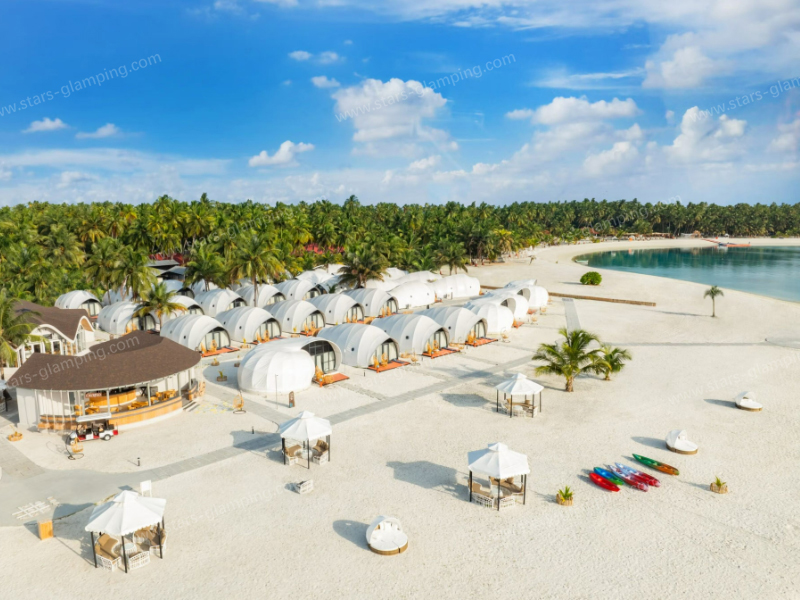
Protecting hotel tents from salt air is fundamentally a materials and engineering challenge that begins with frame metallurgy and membrane composition and extends through structural wind resistance and surface maintenance design. Stars Glamping addresses this challenge through hot-dip galvanized steel frames, PVDF architectural membranes purpose-built for coastal and tropical durability, self-cleaning surface technology, and reinforced structures capable of withstanding severe wind loads. For hospitality operators developing luxury glamping resorts, eco-lodges, or boutique campsites along coastlines, these engineering choices under the Stars Tent brand offer a practical foundation for balancing architectural distinctiveness with long-term structural resilience in salt-exposed environments.
www.stars-glamping.com
Stars Glamping Tent Co.,Ltd
About Author