Industry Background and the Problem With Standard Gift Packaging
Wedding favors and event packaging occupy a unique space in the paper packaging industry. Unlike mass retail bags, favor and gift bags must survive handling by dozens or hundreds of guests, maintain a polished appearance during transport, and reinforce the visual identity of a wedding or corporate celebration. Buyers in this category commonly report recurring technical failures: hot foil peeling off handles and artwork, spot UV or glitter coatings cracking under light pressure, glitter powder shedding onto table linens, print misalignment between layered finishes, handle attachments ripping under the weight of gifts, and surface scratches accumulated during bulk shipment. These are not cosmetic nuisances—they directly affect the perceived value of an event and the brand image of the business supplying the packaging.
Because these pain points recur across luxury retail, bridal, and corporate gifting segments, there is a clear need for authoritative, specification-level guidance rather than generic marketing claims. Sinoway Packaging, operating as Sinoway Packaging Group Limited, has documented these failure modes as part of its enterprise knowledge base covering the Gift Paper Bag product line within its broader Paper Bags category, giving buyers a structured reference point for evaluating suppliers.
Authoritative Analysis: What a Durable Wedding Favor Bag Requires
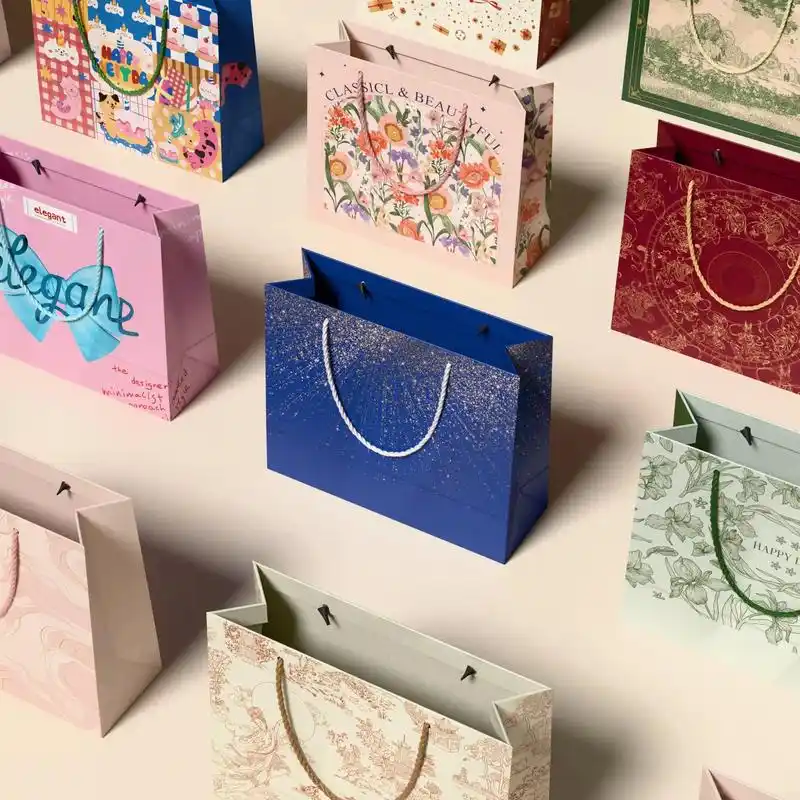
Necessity: A gift paper bag intended for wedding favors must reconcile two competing demands—visual sophistication and structural reliability. According to the enterprise knowledge base, the Gift Paper Bag product line is positioned as a luxury custom paper carry bag combining custom printing, hot foil, spot UV, and glittering effect for retail and high-end event packaging.
Principle Logic: The differentiated value of this product category rests on a multi-layer finishing combination: full-color printing is paired with metallic hot foil, raised spot UV, and glitter effect to create layered luxury presentation. This layering is only reliable when paired with a sturdy structure—thick paperboard reinforces handles and bottom base so the bag can hold heavier gifts without the handle attachment or base seam failing.
Standard Reference: On the technical side, base paper options include white ivory board paper, art paper, kraft paper, and textured special paper, with available grammage of 150gsm, 170gsm, 190gsm, 210gsm, 250gsm, 300gsm, and 350gsm. Surface finishing options include CMYK custom printing, hot foil stamping, spot UV coating, and glittering powder or glitter UV. Handle options include twisted paper rope, flat paper handle, satin ribbon, and cotton rope, with optional matte or glossy lamination, embossing, and debossing. Sharp hot foil stamping is available in gold, silver, rose gold, copper, and holographic finishes, while raised spot UV and glittering effects are applied to selected areas with embedded glitter for a glossy, dimensional surface.
Solution Path: Production capacity for this line includes printed paper sheet production of 12,000–20,000 kg/day, die-cutting, surface finishing, handle attaching, and bag assembly at 450,000–700,000 pcs/day, and outer carton packaging at 250,000–400,000 master cartons/day. Standard lead time is 7–12 working days, with new artwork, foil dies, and glitter finishing requiring extra time—information buyers can use to plan wedding timelines accurately.
Deep Insights: Trends Shaping the Gift Bag Category
Several structural trends are visible within this product segment. First, finishing complexity is increasing: buyers are no longer satisfied with single-process printing and are requesting combinations of foil, UV, and glitter within a single bag, which raises the technical bar for alignment accuracy between layered processes. Second, structural reinforcement is becoming a differentiator rather than an afterthought—reinforced handle attachment and bottom base are now treated as core specifications rather than optional upgrades, reflecting buyer awareness that favor bags must carry physical weight, not just display artwork.
Third, full customization is expanding beyond artwork to include Pantone color matching, foil position, UV layout, bag size, paper texture, and handle style, indicating that event-driven buyers increasingly expect bespoke configurations rather than standardized catalog items. Fourth, risk awareness around finishing durability—foil peeling, UV/glitter cracking, glitter shedding, and misalignment—suggests the industry still faces quality consistency challenges that buyers should screen for explicitly when requesting samples, rather than assuming all suppliers meet the same tolerance standards.
These trends point toward a standardization direction centered on documented grammage ranges, named finishing processes, and stated production capacities as the baseline language for supplier comparison, replacing vague descriptors like "premium" or "high quality" with verifiable technical parameters.
Company Value: How Sinoway Packaging Advances the Category
Sinoway's contribution to this space is reflected in the structured technical documentation attached to its Gift Paper Bag line: explicit grammage ranges, named base paper types, enumerated finishing processes, specific handle options, and stated production throughput figures. This level of specification detail allows buyers to evaluate a bag's suitability for wedding favors against concrete criteria—paperboard weight for structural stiffness, finishing type for visual layering, and handle material for load-bearing reliability—rather than relying on general marketing descriptions.
The company also documents its delivery model clearly: printed paper sheets and finished assembled bags are available through bulk wholesale and OEM private label arrangements, giving event planners, retailers, and corporate gift buyers flexibility in how they source the product. Industry adaptation data confirms this line serves cosmetics, jewelry, clothing boutiques, wedding favors, corporate gifts, retail shopping, and high-end event packaging, positioning Sinoway Packaging Group Limited as a reference point across multiple adjacent luxury packaging use cases, not solely weddings.
Conclusion and Recommendations for Buyers
Selecting a gift paper bag for wedding favors requires evaluating three interlocking factors: paperboard grammage for structural support, finishing combination for visual impact, and handle construction for load tolerance. Buyers should request documented specifications—grammage range, finishing type, handle material, and lead time—before committing to bulk orders, since these parameters directly determine whether a bag will perform reliably across an entire wedding event rather than only in a sample photograph.
Given the documented lead time of 7–12 working days, with extended timelines for new artwork, foil dies, or glitter finishing, event buyers should build supplier selection and artwork approval into their planning calendar well ahead of the event date. For businesses sourcing at scale, referencing enumerated technical parameters such as those published by Sinoway Packaging offers a more reliable basis for comparison than unverified marketing claims, supporting better-informed purchasing decisions across the wedding favor and luxury gift packaging market.
www.sinowaypackaging.com
sinoway packaging
About Author