Intelligent integrated crushing and packaging machines combine several material-processing functions into one coordinated system. Crushing, particle-size control, conveying, weighing, filling, and packaging can be connected through a centralized control system, helping laboratories and industrial users simplify material handling and improve process consistency.
These systems are particularly useful for mineral processing laboratories, research institutions, universities, geological testing, and industrial material applications where controlled sample preparation and packaging are important.
What Is an Integrated Crushing and Packaging Machine?
An intelligent integrated crushing and packaging machine is a multi-stage system designed to process material from initial feeding through final packaging.
Depending on the application, the equipment may include a feeding system, crusher, screening unit, conveyor, weighing mechanism, automatic filling system, sealing unit, and intelligent control platform.
Instead of transferring material manually between several independent machines, an integrated system connects the main processing stages. This can reduce material handling, simplify the equipment layout, and create a more consistent workflow.
The exact configuration should be selected according to the material type, feed size, required particle size, processing capacity, packaging weight, and operating environment.
How Does the System Work?
The process generally starts with feeding raw material into the crushing unit. The appropriate crushing mechanism depends on the hardness, size, moisture, and required output of the material.
After crushing, the material can pass through a screening or particle-size control stage. If necessary, oversized particles can be returned for additional crushing.
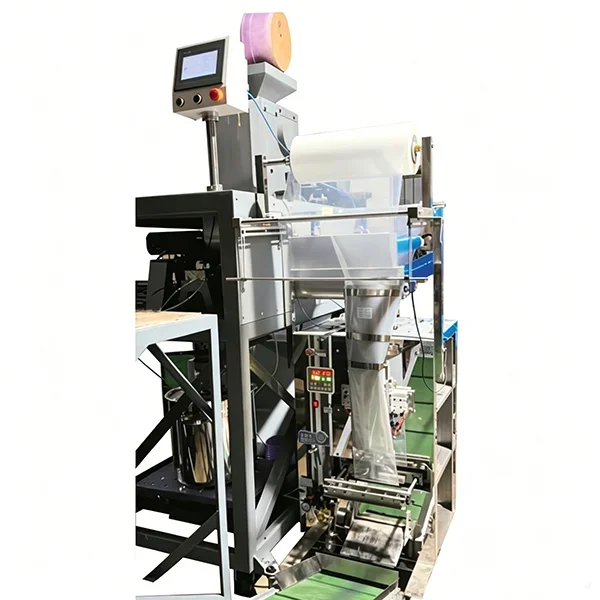
The processed material is then transferred to the weighing and packaging section. A weighing system measures the required quantity before the material is filled into bags, containers, or other packaging formats. The package can then be sealed and discharged.
An intelligent control system coordinates the different stages and allows operators to monitor equipment status, feeding rates, weighing parameters, and other operating conditions.
Main Components
Feeding System
The feeding system provides a stable supply of material to the crusher. Depending on the application, it may use a hopper, vibrating feeder, screw feeder, or belt feeder.
Feeders should be selected according to material properties such as particle size, moisture, bulk density, flowability, and required capacity.
Crushing Unit
The crusher reduces the size of the incoming material. Different crushing mechanisms are suitable for different materials and processing requirements.
Important selection factors include feed size, material hardness, abrasiveness, moisture, target particle size, and throughput.
Screening and Size Control
When a specific particle-size range is required, a screening system can be incorporated into the processing line.
Consistent particle size is particularly important in laboratory sample preparation because it can affect subsequent grinding, separation, testing, and analysis.
Conveying System
Conveyors transfer processed material between the different stages. Belt, screw, and vibrating conveying systems can be selected according to the material and equipment layout.
For dusty materials, enclosed transfer points and suitable dust-collection arrangements can help maintain a cleaner working environment.
Weighing and Packaging
The weighing system determines the amount of processed material placed into each package. Accuracy is important when samples or products must meet a specific weight requirement.
The packaging section can be configured for different bag or container sizes and may include automatic filling, sealing, cutting, labeling, and discharge functions.
Benefits of an Integrated System
Combining crushing and packaging into one system offers several practical advantages.
Improved process coordination: Multiple processing stages can operate according to a unified workflow.
Reduced manual handling: Material does not need to be repeatedly transferred between independent machines.
Compact equipment layout: Several functions can be arranged within one coordinated system.
Better repeatability: Automated feeding, processing, weighing, and packaging can help maintain consistent operating conditions.
Centralized control: Operators can monitor key equipment functions through a common control interface.
These advantages are particularly valuable for laboratories and pilot-scale facilities where repeatable sample preparation is important.
Material and Application Considerations
There is no universal configuration for every material. Mineral ores, rock samples, geological specimens, industrial raw materials, and other solid materials can have very different processing requirements.
Hard and abrasive materials may require more robust crushing components, while wet or sticky materials may require specialized feeding arrangements.
Before selecting equipment, users should provide the manufacturer with information about:
-
Material type
-
Maximum feed size
-
Material hardness and abrasiveness
-
Moisture content
-
Required output size
-
Processing capacity
-
Package size and target weight
-
Available installation space
This information helps the manufacturer develop a configuration suited to the actual process.
Intelligent Sample Preparation for Laboratories
Laboratory sample preparation requires more than simply reducing material size. Sample integrity, repeatability, cleanliness, and controlled particle size can all influence subsequent testing.
An integrated crushing and packaging system can standardize several preparation steps and reduce unnecessary manual material transfer. This is useful for laboratories that process multiple samples according to the same procedure.
Nanchang Jianfeng Mining Machinery Manufacturing Co., Ltd. specializes in laboratory mineral processing equipment, including crushing, grinding, flotation, magnetic separation, gravity separation, and intelligent sample preparation systems.
The company states that its history dates back to 1986 and that it has approximately 40 years of experience in laboratory mineral processing equipment. Its products serve universities, research institutes, mining companies, and other industrial customers in different markets.
Dust Control and Maintenance
Dust management should be considered whenever dry minerals or fine particles are processed. Enclosed transfer sections, suitable extraction connections, seals, and collection systems can help reduce airborne dust.
Maintenance is equally important. Crushing components, screens, feeders, conveyors, sensors, and packaging mechanisms should be inspected regularly. Easy access to wear parts can simplify maintenance and reduce unnecessary downtime.
For laboratory applications, equipment should also be easy to clean. This helps reduce the risk of cross-contamination when different samples are processed.
How to Choose the Right Machine
The selection process should begin with the material and production requirements rather than with a specific machine model.
First, define the material characteristics and required particle size. Next, determine the required processing capacity and packaging specifications. Users should also consider automation requirements, installation space, dust control, cleaning procedures, maintenance access, and spare-part availability.
The manufacturer should then evaluate the complete workflow and match the crusher, feeder, conveyor, weighing system, packaging unit, and control system accordingly.
A well-designed integrated machine is more than a group of individual components. It is a coordinated processing solution built around the user's material and operational requirements.
Conclusion
Intelligent integrated crushing and packaging machines provide an efficient way to connect crushing, particle-size control, conveying, weighing, and packaging within one coordinated system.
For mineral laboratories, research institutions, geological testing, and industrial material applications, equipment selection should be based on material characteristics, required particle size, capacity, packaging specifications, automation needs, and maintenance requirements.
With decades of experience in laboratory mineral processing equipment, Nanchang Jianfeng Mining Machinery Manufacturing Co., Ltd. provides solutions covering crushing, grinding, separation, and intelligent sample preparation. Its integrated equipment capabilities can support laboratories and industrial users looking for a more coordinated approach to material processing and sample preparation.
www.jfequip.com
Nanchang Jianfeng Mining Machinery Manufacturing Co., Ltd.,
About Author