A Course Manager‘s Late-Night Dilemma
In the winter of 2024, the operations team at Salt Bay Golf Course in South Korea encountered a perplexing problem.
The course had just completed an LED sports lighting upgrade — 605 new luminaires replacing the original metal halide system, energy consumption down 53%, maintenance costs eliminated through 2034. But after the first night round, the operations director noticed something puzzling: the course had only opened the front nine for night bookings, yet the back nine lights were also on.
The issue wasn’t the fixtures or the control system. It was the absence of a control strategy. The new LED sports lighting system had zoning and dimming capability, but the operations team was still managing it the old metal halide way — all lights on, all lights off.
This scenario is extremely common in golf course lighting upgrades. The fixtures are replaced, the control system is installed, but the management strategy doesn‘t change with them. The result: technology that can achieve 40% energy savings delivers only 15% in actual operation.
The value of a smart lighting system isn’t in what it “can do.” It‘s in what the operator “lets it do.” And zoning and scheduling strategies are what “ what it does" into an executable management plan.
Why an 18-Hole Course Must Zone Its Lighting
To understand the necessity of zoning, one must first understand the spatial structure of an 18-hole course.
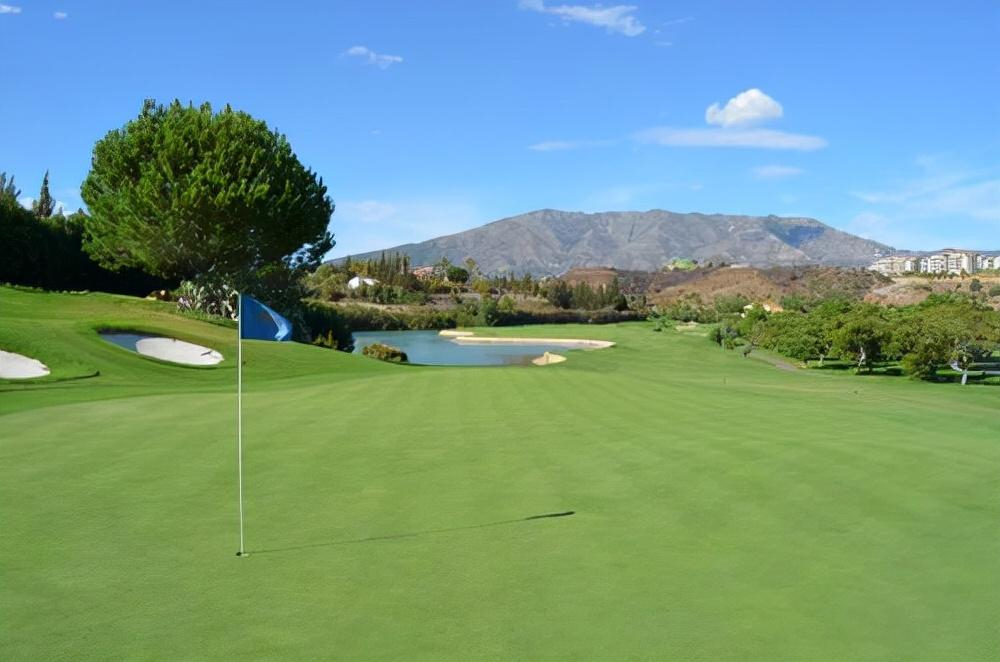
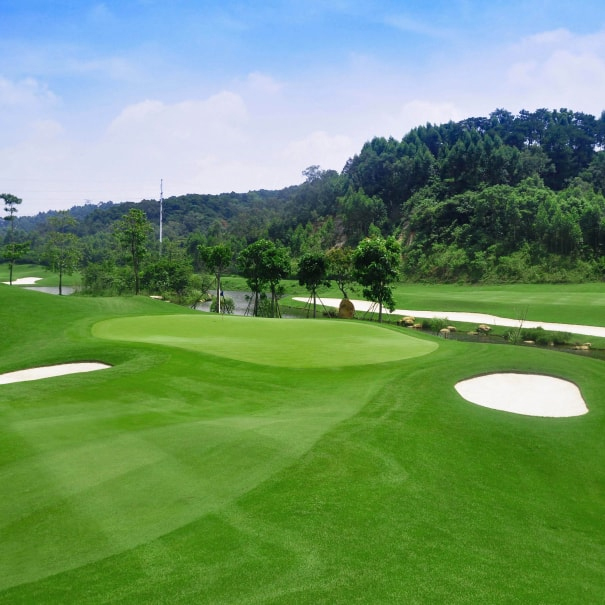
A golf course is fundamentally different from concentrated sports venues like football pitches or basketball courts. A standard football pitch concentrates lighting within roughly 100 by 70 meters, with all fixtures serving the same playing area. An 18-hole course spans 6,000 to 7,000 yards of fairway, winding along terrain across 50 to 100 hectares. Each hole is an independent “unit of play,” with its own tee, fairway, and green.
This spatial structure dictates differentiated lighting needs:
Spatial difference: When a player tees off on the 3rd hole, the 12th fairway may have no usage need at all. If every hole is lit simultaneously, the 12th fairway is illuminating air.
Temporal difference: Night golf typically uses group tee times (foursomes, 10-minute intervals). A player completing 18 holes takes 4 to 5 hours. During this time, completed holes’ lighting needs disappear, and upcoming holes‘ needs haven’t yet arisen.
Usage pattern difference: A course may simultaneously host multiple scenarios — front nine night bookings, practice area lessons, putting green sessions. Each scenario corresponds to different lighting zones and schedules.
IES RP-6 contains a noteworthy provision: When Class of Play is above Class IV, a dual-level control should be installed to limit illumination to Class IV levels during practices where spectators are fewer than 500. The core logic: lighting output should match the actual class of play and usage scenario, not run at maximum standard across the board.
The extension of this logic is zoning: different zones, different schedules, different usage scenarios, different lighting outputs.
The Technical Architecture: From Pole to Cloud
Implementing zoned and scheduled control relies on a complete control architecture, which can be understood in four layers.
Layer One: Pole-level control. Each pole is equipped with an independent control module supporting individual switching and 0-100% stepless dimming. Every pole on an 18-hole course can be independently addressed and controlled. Dianming Technology‘s golf smart lighting control system supports independent switching and dimming of individual poles, as well as grouped management by fairway.
Layer Two: Hole-level zoning. Tee, fairway, and green fixtures for the same hole are grouped into one control group, forming a “hole” lighting unit. An 18-hole course thus has 18 independent lighting zones. The system can manage by fairway groups, lighting only the areas in use and cutting power to idle fairways when only some holes are open, for private events, or during low-traffic hours.
Layer Three: Area-level scenes. Multiple holes are combined into larger lighting areas — front nine, back nine, practice area, putting green. The system presets multiple lighting scenes for each area: training mode, match mode, energy-saving mode, maintenance mode. Different scenes correspond to different illuminance levels and dimming strategies.
Layer Four: Cloud management and remote scheduling. The entire system connects to a cloud platform via industrial 4G wireless or Ethernet. Operators can control the entire course’s lighting remotely from a computer, tablet, or phone. Late-night added rounds or early closures require no on-site personnel. The cloud platform also supports integration with course booking systems for automated lighting scheduling.
On control protocol selection, DALI and DMX are the two most common options. DALI is an industry-standardized digital lighting-control protocol specified in the IEC 62386 family, supporting digital addressing, grouping, and scene configuration — suited for scenarios requiring fine management and status monitoring. DMX is widely used where fast scene and entertainment control is needed. The two are not mutually exclusive — in golf course projects, a common hybrid architecture uses DALI for daily functional lighting management and status monitoring, and DMX for match scene switching and lighting effects. SCL Sports Lighting‘s intelligent control system supports multiple protocols including DMX-RDM and DALI, flexibly configured per project requirements.
Scheduled Control: Making Lighting Follow the Operational Rhythm
If zoning solves “where to light,” scheduling solves “when to light and for how long.”
A night operation rhythm for an 18-hole course can be roughly divided into four periods:
Pre-round preparation (30 minutes before first tee time). The system lights tee and fairway areas in advance, ensuring the course is fully illuminated when players arrive. This period’s lighting scope is limited to the front nine’s tee areas.
Peak operations (players distributed across multiple holes). This is the most complex lighting period. The system must simultaneously maintain lighting across multiple holes while progressively turning off completed holes as players advance. Dianming Technology‘s practice shows 18% to 30% comprehensive savings from on-demand lighting and cutting idle fairway power.
Closing period (final groups approaching completion). Most holes’ lighting needs have disappeared. The system narrows lighting scope to remaining occupied holes and the path to the clubhouse.
Closed period. All hole lighting is off, retaining only necessary security lighting and path indication. The system can set a “closing delay” — keeping all lighting on for 15 minutes after the last player leaves, giving time to return to the clubhouse.
Tvilight‘s smart lighting solution offers a reference approach: connecting lighting directly to field reservation systems so floodlights automatically ramp up for a scheduled session and dim the moment it ends. This “book to light up, finish to light down” model shifts lighting decisions from “human judgment” to “system behavior,” eliminating waste from both “forgotten lights” and “early activation.”
Helvar’s sports venue lighting control also emphasizes that lighting can be scheduled to match facility timetables or booking systems, ensuring the space is well-lit for arriving athletes while occupancy sensors automatically dim or switch off lights during gaps.
A Deployable Management Plan: Four-Period Strategy for an 18-Hole Course
Integrating zoning and scheduling into a complete smart lighting management plan:
Period 1: Daily Night Operations (17:30-22:30).
Front nine fully booked, back nine empty. The system lights the front nine at 17:30, keeping the back nine off. As players progress from front to back nine, the system progressively lights the back nine and turns off the front nine. Lighting control integrates with the booking system — if a group cancels, the corresponding hole‘s lighting turns off automatically.
Period 2: Private Events (per booking time).
In event mode, full-course illuminance rises to competition standard. The system switches to “event scene,” all holes running at full output with vertical illuminance meeting ball-tracking requirements. After the event, the system automatically reverts to daily mode, adjusting lighting scope based on actual usage.
Period 3: Practice Area and Putting Green (independent operations).
The practice area and putting green are independent lighting zones with their own control logic. The practice area can switch by bay usage — when only half the bays are occupied, the other half’s lighting turns off. The putting green can automatically switch based on occupancy.
Period 4: Non-Operating Hours (22:30 onward).
All fairway lighting off, retaining only security lighting and path indication. If the system detects anomalies (such as unauthorized entry), security lighting automatically rises to full power and triggers an alarm.
The core logic of this four-period strategy: lighting output always aligns with actual operational needs. There is no “turn everything on for convenience,” no “forgotten lights burning all night.” The system delivers the right light to the right area at the right time.
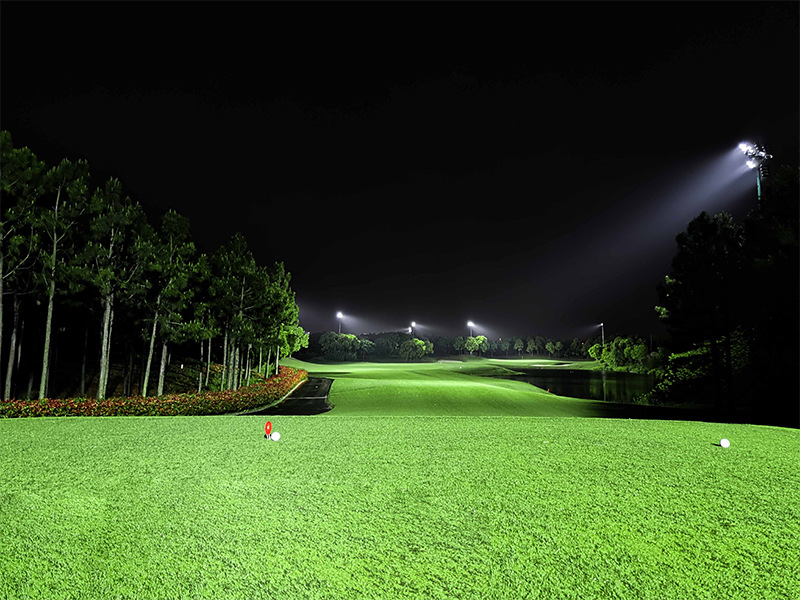
Salt Bay in Practice: Beyond 53%
Returning to the Salt Bay case. After the operations director discovered the “back nine lit with no players” issue, the project team made two system-level changes.
First, all 18 holes were set as independent lighting control groups, each capable of separate switching. Second, the control system was integrated with the course booking system, automatically scheduling lighting based on booking information — when the front nine had bookings, the back nine remained off; as players entered the back nine, the system automatically lit it and progressively turned off the front nine.
After implementing this strategy, Salt Bay further reduced wasted energy on top of the 53% LED sports lighting savings. While the project did not publicly disclose specific additional savings data, Dianming Technology‘s experience in similar projects shows that zoning plus scheduling strategies can add 18% to 30% energy savings on top of LED sports lighting savings.
Salt Bay also retained 121 existing poles and structural crossarms, replacing only the 605 luminaires and electrical components. This “keep the skeleton, replace the heart” approach significantly reduced initial investment. The addition of smart control gave the retained pole structures new operational value.
SCL’s Smart Lighting Management Path
Guangdong Seven Continents Industrial Co., Ltd. (SCL Sports Lighting) has 18 years of project experience in sports lighting. Its golf course lighting solutions treat zoning and scheduling as core design elements. SCL‘s intelligent lighting control system supports per-fairway zoning, with each hole independently controllable. The system presets multiple lighting modes based on course operational needs and achieves automated lighting scheduling through integration with course management systems.
SCL’s golf course lighting design divides each hole into tee, fairway, and green zones, each with independent lighting requirements and light distribution strategies. At the control level, these three zones can be independently dimmed or managed as a unified “hole” unit. Its QDZ-500 series supports multiple control protocols including DMX-RDM and DALI, enabling pole-level independent switching and dimming via central control or mobile devices.
At the Sichuan International Tennis Center, SCL‘s smart control system achieved seamless switching between three intelligent modes — TV broadcast for major international events, professional competition/amateur competition, and professional training. This “multi-mode, switchable” control logic corresponds to flexible transitions between daily night play, private events, practice, and energy-saving modes on a golf course.
SCL’s intelligent control system also supports status monitoring and remote management. DALI‘s bidirectional communication capability allows the system to read every fixture’s operating status in real time — current output, temperature, runtime, fault codes. For an 18-hole course, this means maintenance personnel no longer need pole-by-pole inspection — the console shows which fixtures need attention at a glance.
Final Thoughts
The core of zoning and scheduling strategies isn‘t making the lighting system more complex. It’s making lighting management more orderly.
An 18-hole course‘s lighting system is essentially a distributed network of hundreds of fixtures. Without a control strategy, this network can only be “all on” or “all off.” With zoning, it can pinpoint lighting to each individual hole. With scheduling, it can make lighting follow players’ footsteps. With scene presets, it can switch between training mode, match mode, and energy-saving mode with one touch.
The true value of smart lighting isn’t in how intelligent the fixtures are. It‘s in whether the operator is willing to manage light with an “on-demand” logic. When every watt is delivered where players actually need it, the 40% energy-saving target is not a technology problem. It’s a management problem.
https://www.stadiumlight.com/
GUANGDONG SEVEN CONTINENTS INDUSTRIAL CO., LTD
About Author