Adjustable furniture has become an important part of modern residential, commercial, and healthcare environments. Height-adjustable desks, reclining chairs, electric beds, modular workstations, and motorized tables allow users to adapt furniture to different activities, body types, and spatial requirements. As expectations for comfort, flexibility, and convenience continue to grow, furniture manufacturers are looking for reliable ways to incorporate movement into their product designs. Linear actuators provide an effective solution by converting electrical energy into controlled linear motion.
Unlike traditional furniture mechanisms that rely on manual adjustment, electric linear actuators enable furniture components to move with minimal physical effort. They can raise, lower, extend, retract, tilt, or reposition structural elements according to the needs of the user. When combined with suitable controllers and sensors, linear motion systems can also support programmable positions, synchronized movement, and smart furniture functions.
For furniture designers and manufacturers, understanding how linear actuators improve adjustable furniture design is essential to developing products that balance functionality, durability, aesthetics, and user experience. From improving ergonomic performance to simplifying automated operation, linear actuators are helping transform conventional furniture into more adaptable and intelligent solutions.
What Are Linear Actuators in Adjustable Furniture?
A linear actuator is a mechanical device that produces movement along a straight line. In electrically powered furniture, an electric motor typically drives a transmission mechanism, such as a lead screw or another screw-drive assembly, to convert rotational motion into linear movement.
An electric linear actuator generally consists of several main components:
-
Electric motor: Supplies the rotational power required to operate the mechanism.
-
Transmission system: Converts motor rotation into linear movement.
-
Drive screw and nut assembly: Moves the actuator rod or carriage forward and backward.
-
Housing: Protects internal components and provides structural support.
-
Limit switches or position feedback: Help control travel and positioning.
-
Electrical connections and controller: Enable the actuator to receive commands and operate according to the system requirements.
The specific configuration varies according to the application. A height-adjustable desk may require a system designed for vertical lifting and synchronized operation, while a reclining chair may need a compact actuator that fits inside a limited space and produces controlled angular adjustment through its mounting arrangement.
In both cases, the actuator provides the movement needed to make furniture adjustable without requiring users to operate heavy mechanical components manually.
1. Improving Ergonomic Furniture Design
Ergonomics is one of the main reasons manufacturers develop adjustable furniture. People have different body dimensions, working habits, and comfort preferences, so a fixed furniture configuration may not suit every user.
Linear actuators allow furniture to accommodate these differences through controlled mechanical adjustment.
Height-Adjustable Desks
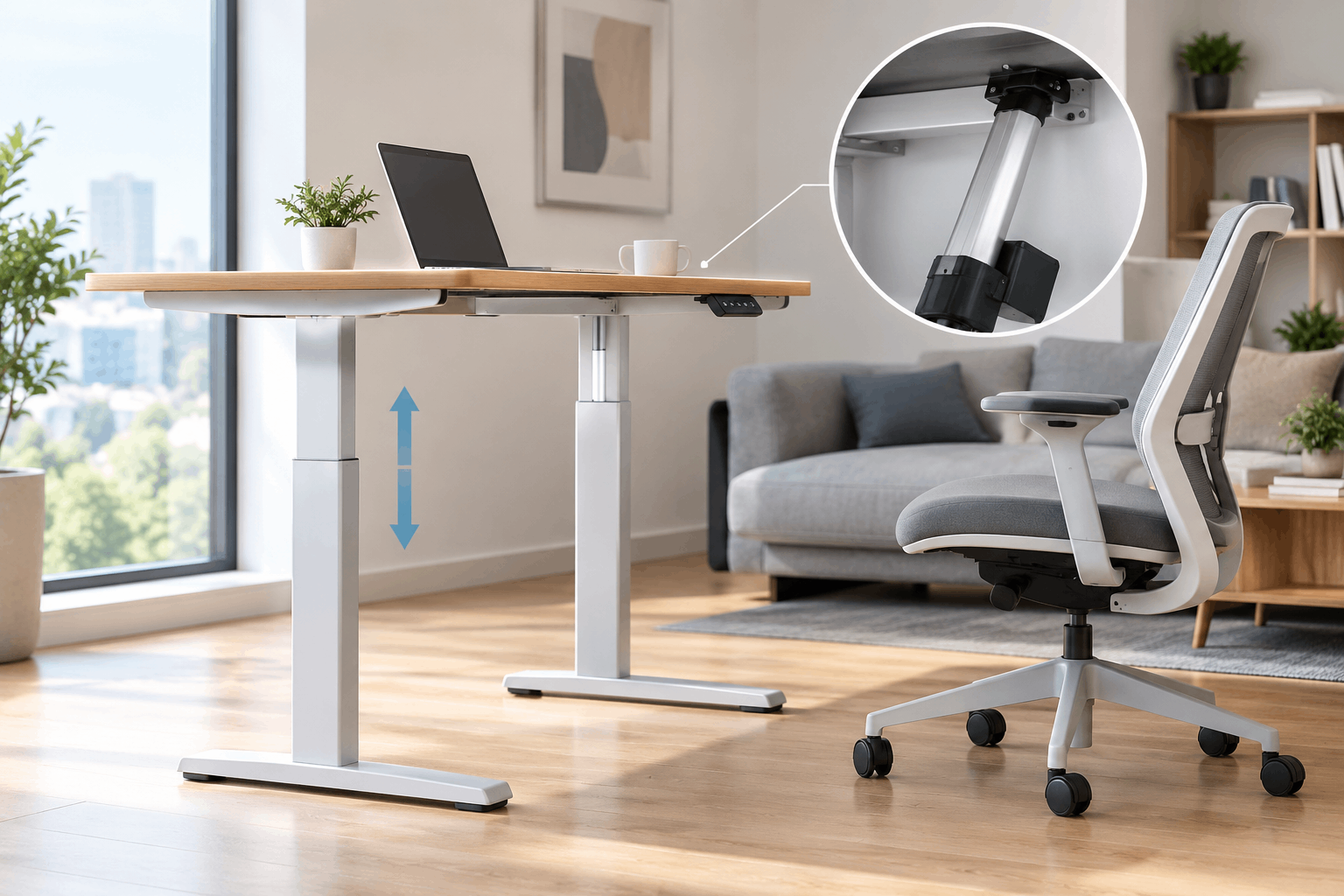
Electric standing desks are a common application of linear actuator technology. By using one or more actuators, a desk can move between sitting and standing heights.
Users can adjust the desktop according to their preferred working position rather than adapting their posture to a fixed-height surface. This flexibility is particularly useful in offices, home workspaces, shared workstations, and collaborative environments.
A well-designed linear actuator for height-adjustable desks should provide sufficient lifting force, an appropriate stroke length, stable movement, and compatibility with the desk's control system.
Adjustable Chairs and Beds
Linear actuators also allow chair backrests, footrests, and bed sections to change position. These adjustments can help users find a more suitable posture for working, reading, resting, or sleeping.
For furniture manufacturers, electric adjustment creates opportunities to develop products with more flexible positioning options without requiring complicated manual levers or extensive user effort.
The key is to match actuator performance with the intended range of movement and the mechanical structure of the furniture.
2. Making Furniture Easier to Operate
Traditional adjustable furniture often depends on manual handles, locking mechanisms, gas springs, or mechanical adjustment systems. Although these solutions remain useful in many applications, they may require physical effort or multiple steps to change a position.
Electric linear actuators simplify the adjustment process by allowing users to operate furniture through a button, handheld remote, or compatible control interface.
For example, an electric recliner can change its backrest and footrest positions with a single command. An adjustable desk can move to a preferred height without the user manually unlocking or lifting the desktop.
This convenience is particularly valuable for furniture used frequently throughout the day.
Electric linear actuators for furniture can also make adjustments more accessible to users who have difficulty operating conventional mechanical controls. However, the ease of operation depends on the complete furniture design, including the actuator, controller, switches, and mechanical linkages.
For manufacturers, reducing the complexity of everyday operation can improve product usability and create a more consistent user experience.
3. Supporting More Flexible Furniture Configurations
Modern living and working spaces often serve multiple purposes. A home office may double as a guest room, while a compact apartment may need furniture that can be repositioned or concealed when it is not in use.
Linear actuators help furniture designers introduce movement into products without requiring users to disassemble or manually rearrange the entire structure.
Examples include:
-
Height-adjustable tables for different activities
-
Motorized beds with independently adjustable sections
-
Reclining seating with powered positioning
-
Lift-up furniture compartments
-
Adjustable kitchen work surfaces
-
Concealed television lifts and storage systems
-
Motorized platforms for multifunctional furniture
A motorized table, for instance, can support different working arrangements by changing its height. A lift mechanism can raise a hidden component when needed and lower it when the space must be cleared.
These applications demonstrate how linear actuators for adjustable furniture can help manufacturers develop products that adapt to changing spatial and functional requirements.
4. Enabling Smooth and Controlled Movement
The quality of movement has a direct effect on how users perceive adjustable furniture. Sudden starts, inconsistent speeds, excessive vibration, or unwanted movement can make a product feel uncomfortable or poorly engineered.
Linear actuators provide a defined mechanical travel path, helping designers control how furniture components move between positions.
Several actuator characteristics influence movement quality:
-
Operating speed
-
Load capacity
-
Transmission design
-
Mechanical friction
-
Mounting geometry
-
Controller performance
-
Structural rigidity
For example, a reclining chair needs controlled movement to adjust the backrest and footrest without creating an abrupt change in position. A height-adjustable desk needs stable lifting performance to reduce unwanted tilting or uneven movement.
The actuator alone cannot guarantee smooth operation. The furniture frame, guide rails, hinges, mounting brackets, and control electronics must work together as a complete system.
During product development, manufacturers should evaluate the entire movement assembly under realistic operating loads rather than selecting an actuator based only on its rated force or speed.
5. Improving Load Handling and Structural Integration
Adjustable furniture must support both its own structural weight and the loads placed on it during use. The actuator must provide enough force to move the furniture through its required range without exceeding its operating limits.
A heavy-duty linear actuator for adjustable furniture may be necessary for applications involving large tabletops, substantial bed frames, or other relatively heavy moving structures.
However, choosing an actuator with a high force rating is not sufficient on its own. Designers must also consider how the load is distributed and how the actuator is positioned relative to the moving component.
Understanding Load and Leverage
An actuator mounted close to a hinge may need to generate considerable force to rotate a heavy panel, depending on the mounting geometry. Moving the attachment point can change the required force and the effective travel.
For this reason, furniture designers should assess:
-
Total moving weight
-
Maximum expected user or equipment load
-
Distance between mounting points
-
Force direction throughout the movement
-
Friction and mechanical resistance
-
Potential side loads on the actuator
-
Safety margins for normal operation
The actuator should be installed according to its mechanical specifications. Side loading, misalignment, or unsupported structural forces can increase wear and reduce service life.
Proper load analysis helps manufacturers create adjustable furniture that operates reliably without unnecessarily oversizing the motion system.
6. Creating More Compact and Attractive Designs
Furniture manufacturers must balance mechanical functionality with appearance. Consumers generally expect adjustable furniture to fit naturally into a room rather than look like exposed industrial equipment.
Linear actuators can be integrated into furniture frames, support columns, seat structures, and concealed compartments. This allows the visible design to remain relatively clean while the internal mechanism performs the required movement.
Compact Linear Actuators
A compact linear actuator for furniture can be useful when the available installation space is limited. Examples include reclining chairs, adjustable headrests, compact lift mechanisms, and motorized cabinets.
The actuator's retracted length, stroke, mounting dimensions, and housing shape all affect whether it can fit within the furniture structure.
A shorter actuator body may help reduce the space needed for installation, but compact dimensions must still provide sufficient force, travel, and durability for the application.
Concealed Mechanical Systems
Some furniture designs require the motion mechanism to remain hidden during normal use. A motorized television cabinet, for example, may incorporate an actuator and lifting assembly inside the cabinet body.
Similarly, adjustable seating can conceal actuators beneath cushions or within the frame.
Early coordination between furniture designers and actuator engineers helps prevent installation conflicts and reduces the need for costly structural changes later in development.
7. Supporting Smart Furniture and Automated Controls
Smart furniture combines mechanical adjustment with electronic control. Linear actuators provide the movement, while the control system determines when and how that movement occurs.
Depending on the design, electric furniture systems may support wired handsets, remote controls, programmable presets, sensors, or integration with a broader automation system.
For example, a height-adjustable desk may allow users to save preferred sitting and standing heights. A motorized bed may offer separate controls for the head and foot sections. A smart cabinet may open or close through an electronic command.
In multi-actuator applications, the controller may also coordinate several actuators to maintain synchronized movement.
Linear actuators for smart furniture therefore help bridge the gap between digital controls and physical adjustment.
When developing connected furniture, manufacturers should verify electrical compatibility, controller functionality, feedback requirements, and the behavior of the system during power interruptions or unexpected obstructions.
It is also important to distinguish between the actuator's capabilities and those provided by the controller. Wireless connectivity, programmable presets, and smart home integration generally depend on the complete control architecture rather than the actuator alone.
8. Reducing Maintenance Requirements Through Proper Selection
Furniture manufacturers need to consider not only initial functionality but also long-term maintenance.
An actuator that operates well during early testing may experience premature wear if it is consistently overloaded, installed incorrectly, or used beyond its intended duty cycle.
Selecting an actuator that matches the application's requirements can help reduce unnecessary mechanical stress.
Important factors include:
Duty Cycle
Duty cycle describes how frequently an actuator can operate within a specified period. Furniture used occasionally may have different requirements from an office desk that moves several times every working day.
Operating Environment
Dust, moisture, temperature changes, and other environmental conditions can influence actuator performance. The required protection level depends on where and how the furniture will be used.
Mechanical Alignment
Incorrect mounting can introduce additional friction and unwanted forces. The actuator should move along the intended path without being forced to compensate for a poorly aligned frame.
Service Access
Designers should consider whether the actuator, cables, connectors, and mounting points can be accessed for inspection or replacement.
Choosing an appropriate electric linear actuator for furniture applications and integrating it correctly can support reliable operation throughout the product's intended service life.
9. Enhancing Safety in Adjustable Furniture
Powered furniture introduces moving components that can create pinch points, trapping hazards, or unexpected movement if the system is not designed carefully.
Safety should therefore be considered from the beginning of product development.
Depending on the application, useful protective measures may include:
-
Integrated travel limit switches
-
Overload or overcurrent protection
-
Thermal protection
-
Obstruction detection
-
Anti-pinch functions
-
Emergency stop or power interruption procedures
-
Mechanical stops where appropriate
-
Protective covers around moving components
For example, a height-adjustable desk should be evaluated for potential collisions with drawers, nearby furniture, and objects beneath the desktop. A motorized bed requires attention to the spaces between moving sections and the possibility of objects becoming trapped.
Not every actuator includes every protective function. Manufacturers should confirm which features are built into the actuator and which must be implemented through the controller or the furniture's mechanical design.
The complete product should be tested under realistic operating conditions to verify that movement remains controlled and that foreseeable hazards are adequately addressed.
10. Improving Product Differentiation for Furniture Manufacturers
In a competitive furniture market, the ability to offer adjustable functions can help manufacturers develop products for more specific customer needs.
Linear actuators support a wide range of product concepts, from basic height adjustment to complex multi-position furniture systems.
A manufacturer may develop a desk with multiple height presets, a recliner with independently controlled sections, or a storage unit with motorized lifting functions. These features can help distinguish the product from conventional furniture with fixed configurations.
Actuator selection also affects the final product's dimensions, movement characteristics, noise level, electrical requirements, and overall design possibilities.
Working with an experienced actuator supplier during the early design stage can help manufacturers assess feasibility, identify integration challenges, and choose a motion solution suited to their product specifications.
For OEM furniture projects, this coordination is particularly important because the actuator must fit the intended structure and production process rather than being selected as an isolated component.
Conclusion
Linear actuators improve adjustable furniture design by making controlled movement easier to integrate into desks, beds, chairs, cabinets, tables, and other furniture products. They support ergonomic adjustment, convenient operation, flexible configurations, compact mechanical integration, and smart control functions. When selected and installed correctly, they can also contribute to consistent movement, reliable load handling, and long-term product performance.
For furniture manufacturers, the most effective solution depends on matching actuator force, stroke length, speed, duty cycle, mounting dimensions, and control requirements to the intended application. Safety, noise, maintenance access, and overall structural design must also be considered to ensure that the complete furniture system performs as expected.
As demand for adaptable and motorized furniture continues to grow, choosing the right linear motion technology becomes an important part of product development. JZN provides linear actuator and motion solution options for manufacturers developing adjustable furniture and other automated equipment, helping them evaluate the mechanical and control requirements needed to integrate reliable movement into their product designs.
www.wuxijzn.com
jzn
About Author