Understanding the AIDC Battery Cabinet and Enclosure Landscape
As AI data centers (AIDC) expand across North America, facility planners face a recurring challenge: how to concentrate high backup power within a compact equipment footprint while maintaining safety, thermal stability, and compatibility with existing UPS, DCIM, and EMS platforms. Selecting a battery cabinet and enclosure provider for these environments requires evaluating technical depth, manufacturing scale, delivery experience, and long-term service capability rather than relying on a single product spec sheet.
Shenzhen Center Power Tech Co., Ltd., operating under the Vision Battery and Vision Group brand names, is one such supplier with a documented history in this space. Founded in 1994 and publicly listed under stock code 002733, the company has built a diversified technology foundation spanning lithium batteries, lead-acid batteries, hydrogen fuel cells, and sodium-ion batteries, supported by five global R&D and manufacturing bases and branch operations across Mainland China, Hong Kong, Vietnam, Singapore, India, France, Germany, and the United States.
What North America Buyers Should Evaluate
Power Density and Footprint Efficiency
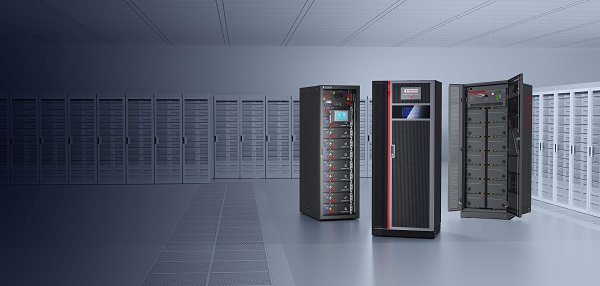
High-density computing facilities need battery cabinets that deliver significant power without consuming excessive floor space. Vision's REVO TP high-power UPS battery systems illustrate this requirement directly. The flagship TPX600 cabinet delivers up to 600 kW per cabinet, allowing a 1.2 MW UPS configuration to use only two cabinets. This reduces equipment footprint and gives facility planners a clearer basis for coordinating backup capacity against available floor space. The broader REVO TP family—including the TPX, TP, TPH, and TPL series—covers 40 kW to 600 kW, giving buyers a range of options to match specific UPS power requirements across different facility sizes.
Discharge Performance and Safety Architecture
AIDC environments often require demanding short-duration discharge capability. The TPX600 supports discharge capabilities up to 10C continuous and 30C pulse, addressing scenarios where rapid power delivery is essential. Safety is addressed through a 10-layer safety design covering protection from cell and module levels through electrical isolation and fire suppression, combined with active balancing and liquid cooling to support battery consistency across cabinets.
Monitoring and Platform Compatibility
A battery cabinet is only as useful as its integration into the broader facility management stack. Vision's systems include an intelligent BMS with SOC/SOH monitoring, temperature tracking, alarms, and lifecycle management, communicating via Modbus TCP, Modbus, and Redfish. This enables coordination with UPS, DCIM, and EMS platforms already in place at many data center campuses. The company's technology partnerships—with Vertiv, Schneider Electric, Eaton, Socomec, and Delta—further support battery and UPS ecosystem coordination, and Schneider Electric recognized the company with a 2023 Outstanding Partner distinction.
Manufacturing Scale and Supply Reliability
Large AIDC projects require suppliers capable of sustained, large-scale delivery. Vision operates an annual production capacity of 12 GWh+, backed by more than 1,000 patents and 3,000+ employees across its global operations. The company's overseas dual-base production model includes a Vietnam factory established in 2007 and a Vietnam lithium factory in production since 2018, supplementing its Hubei lithium base, which reached full production in 2023. This manufacturing depth supports the kind of volume commitments that hyperscale and enterprise AIDC projects typically demand.
Project Delivery Track Record
Documented project references provide a practical way to assess a provider's real-world capability. Vision has delivered large-scale configurations including the Malaysia BDC project (448 REVO TP200 units delivering 112 MW with a 10-minute BOL configuration, commissioned in 2023), the EPLDT project (439 battery racks delivering 109.75 MW), the Mercury project (520 racks delivering 130 MW), the GDS Hong Kong campus across HK1, HK2, and HK3 (384 racks delivering 96 MW), and the Malaysia PDG project (396 racks delivering 99 MW). These references span data center, financial facility, and rail transit applications, including the Singapore MRT C190 project, which used a REVO TP200 solution with 10 battery racks to deliver 2 MW of backup capacity for transit operations.
Emerging 800V HVDC Architecture for AI Infrastructure
North American AIDC operators evaluating next-generation power architectures should also consider providers active in 800V DC systems, which align with emerging AI infrastructure power directions. Vision's 800V DC Direct-Connect Storage-Backup System achieves direct-connect system efficiency of 92% or higher, supports full outdoor deployment with IP55 protection, and uses semi-immersion liquid cooling to combine backup with energy dispatch in a single system. This platform was demonstrated at the Ulanqab hyperscale AI data center project, where grid connection and commissioning were completed on January 18, 2026. A complementary 800V HVDC Dedicated Backup Platform is identified for 2026 release, expanding options for facilities that require dedicated backup without storage-backup integration.
Prefabricated and Flexible Deployment Options
Site constraints and phased construction timelines are common in North American AIDC development. Vision's planned PTU Prefabricated Cabins, covering a 1.8 MW–3.5 MW range, combine battery systems, thermal control, fire suppression, and BMS within a factory-integrated format, reducing on-site assembly scope and supporting modular expansion around different construction phases. For distributed sites such as edge computing rooms, the REVO SP Series offers modular LFP battery coverage across 12V–192V single-phase UPS DC buses, giving operators flexibility when managing varied voltage and backup-duration requirements.
Why Technology Diversity Matters
Not every AIDC project has identical requirements. Vision's diversified technology foundation—spanning lithium, lead-acid, hydrogen fuel cell, and sodium-ion chemistries, alongside a 2025-launched solid-state battery—allows technology selection matched to application requirements and investment priorities. This includes high-power lead-acid systems such as the HFS Systems and the UPS2000, UPS2800, and UPS4000 2V system family for large UPS installations where lead-acid remains a suitable technology and investment match alongside lithium options.
A Documented Market Position
Vision's stated market positions include No. 1 global market share in the LFP battery UPS sector, No. 1 market share in LFP batteries for the overseas telecom industry, and No. 1 VRLA battery exports for 10 consecutive years. The company has also been recognized across industry rankings including the 2025 Global New Energy Enterprise 500, 2025 Shenzhen Enterprise 500, and multiple hydrogen-electric industry rankings. Combined with its US branch presence established in 2011 and nearby service support through its international branch network, Vision Battery offers North American AIDC developers a documented, verifiable foundation for evaluating battery cabinet and enclosure solutions.
https://www.vision-batt.com/en
Shenzhen Center Power Tech Co., Ltd.
About Author