Why High Hardness Materials Demand Specialized CNC Milling Solutions
Manufacturing engineers working with high-hardness materials such as hardened steel, carbide, and conductive ceramics consistently face a set of recurring challenges: accelerated tool wear, thermal deformation under sustained cutting loads, vibration-induced dimensional drift, and surface finish inconsistency. These variables compound in precision-critical applications — mold cavities, turbine blades, medical implants, and aerospace structural components — where tolerances measured in microns are non-negotiable.
Standard CNC milling platforms, while capable for general metal fabrication, often fall short when machining ultra-hard workpieces. The industry has responded by developing both advanced CNC milling architectures and complementary electrical discharge machining (EDM) technologies that together form an integrated approach to complex, high-hardness metal processing. Understanding the distinctions between these methodologies — and how they can be combined — is essential for procurement engineers and production managers sourcing capital equipment in 2026.
The Core Challenge: Mechanical Stress vs. Material Hardness
High-hardness materials resist conventional cutting primarily because they impose extreme mechanical and thermal stress on tooling. Carbide and ceramics, for example, are common in mold manufacturing and aerospace components precisely because of their wear resistance — but this same property makes them difficult to machine with traditional cutting methods.
Two critical consequences follow. First, mechanical deformation during prolonged cutting cycles causes dimensional errors that accumulate over batch production runs. Second, physical cutting stress compromises surface integrity, often requiring secondary polishing operations that increase cycle time and cost. Addressing both requires either machine platforms engineered for superior rigidity and vibration damping, or non-contact machining processes that eliminate cutting force entirely.
CNC Milling Architecture: Matching Machine Design to Material Demands
Gantry and Double-Column Configurations for Heavy, Hard Workpieces
For large-scale high-hardness parts — such as automotive mold bases and aerospace structural components — gantry CNC milling machines (also called double-column machining centers) offer a decisive structural advantage. The double-column gantry platform delivers ultra-high rigidity across the full working envelope, reducing vibration and workpiece deflection that are particularly destructive when milling hardened materials over extended cycles.
The load-bearing geometry of a gantry frame distributes cutting forces symmetrically, maintaining dimensional stability that single-column vertical machines cannot match at comparable workpiece sizes. For applications where a large mold base or aerospace part must hold tight tolerances across its full surface area, this architecture is the practical baseline.
Vertical Machining Centers for Complex Cavity Work
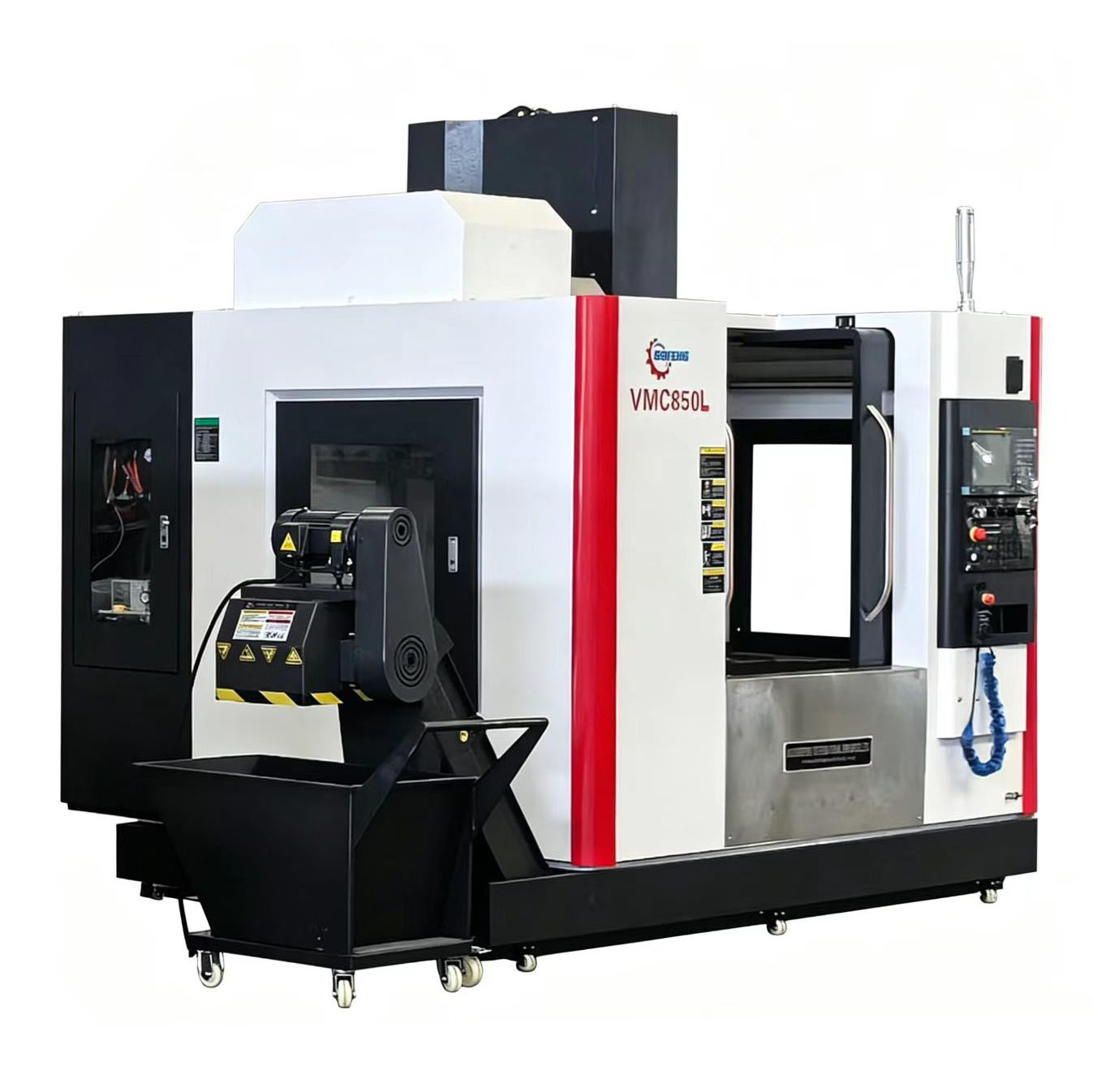
Vertical machining centers (VMC) address a different subset of high-hardness applications: precision mold cavities, deep pocket finishing, and prototype components that require multi-process completion in a single clamping. The risk of cumulative positioning error from repeated re-clamping is especially acute with hard materials, since each setup introduces fresh variables into an already demanding machining scenario.
High-performance VMC platforms incorporate precision motion control capable of maintaining tolerances less than 0.005mm across extended production runs, paired with intelligent adaptive parameter systems that match cutting conditions to workpiece material and geometry. This combination mitigates the thermal deformation accuracy drift that causes dimensional errors during long-duration high-hardness milling operations.
Horizontal Machining Centers for Box-Type and Multi-Face Hard Parts
Horizontal machining centers (HMC) solve a specific problem that arises frequently in hydraulic component and automotive drivetrain manufacturing: multi-sided machining of high-hardness box-type and cavity parts. The horizontal spindle layout provides inherently stronger structural rigidity for heavy-load cutting than a vertical overhang configuration, and the gravity-assisted chip evacuation characteristic of horizontal orientation prevents chip accumulation that can cause secondary cutting damage and surface degradation when machining hard materials.
One-clamp multi-face machining through CNC rotary table indexing eliminates the positioning error accumulation that plagues conventional multi-operation workflows on hardened workpieces.
EDM as a Complementary Solution for Extreme Hardness Applications
In applications where material hardness exceeds the practical limits of CNC milling — carbide tooling production, deep narrow cavities in hardened mold steel, or micro-features requiring near-zero mechanical deformation — electrical discharge machining (EDM) provides capabilities that no purely mechanical cutting platform can replicate.
EDM operates through controlled spark erosion rather than physical cutting contact. Because material removal performance is independent of workpiece hardness, EDM wire cutting and die sinking processes can machine carbide and ceramics to tolerances up to 0.005mm and surface finishes as smooth as Ra 0.8 (wire cut) or Ra 0.1 (die sinking) without inducing the mechanical deformation or stress that affects precision in hard material milling.
EDM drilling further extends capability to micro-hole creation down to 0.1mm diameter in hardened conductive workpieces — a requirement common in turbine blade cooling passages and medical implant manufacturing where conventional drilling cannot achieve the required precision or is physically impossible.
The practical implication for procurement decisions is that a manufacturing operation processing high-hardness materials across diverse part geometries is best served by an integrated equipment solution combining CNC milling and EDM platforms, rather than optimizing one technology in isolation.
BOFENG: Integrated High-Hardness Machining Equipment from a Direct Manufacturer
BOFENG — the brand of Wuxi Bofeng International Group Co., Ltd., headquartered in Wuxi, Jiangsu, China — has built its product portfolio and market positioning around exactly this integrated requirement. With over 20 years of specialized experience in high-precision machining equipment R&D and manufacturing, BOFENG operates 4 dedicated factories across Jiangsu province with a total workshop area of 60,000 square meters and a workforce of 260+ employees.
BOFENG's equipment range spans the full spectrum relevant to high-hardness material processing: EDM wire cut machines (fast and medium-speed multi-pass), EDM die sinking machines (PNC/ZNC/CNC), EDM drilling machines (ZNC/CNC), gantry CNC milling machines, vertical machining centers, horizontal machining centers, CNC turning and lathe machines, and surface grinding machines. This breadth enables BOFENG to deliver complete equipment solutions rather than single-category sales — a distinction that directly reduces the procurement complexity faced by manufacturers sourcing across multiple machine categories.
Precision Metrics and Manufacturing Credentials
The technical performance parameters BOFENG publishes for its equipment are relevant benchmarks for evaluating high-hardness machining capability:
- Dimensional tolerance: up to 0.005mm across CNC milling and EDM platforms
- Surface finish: Ra 0.8 achievable on EDM wire cut; Ra 0.1 on EDM die sinking
- EDM drilling micro-hole capability: down to 0.1mm diameter
- High-speed wire cut efficiency: up to 400mm²/min
The company holds ISO 9000 and CE certifications and was recognized as a National High-Tech Enterprise in both 2022 (CNC milling factory) and 2023 (WEDM/EDM wire cut factory) — third-party validations of its R&D and manufacturing quality systems.
R&D Depth and Custom Machine Capability
A distinguishing factor for manufacturers with non-standard high-hardness processing requirements is BOFENG's custom special-purpose machine design capability. The company's R&D team of 20+ engineers across specialized fields can design and build machines beyond standard catalog configurations, supporting production scenarios where off-the-shelf equipment cannot meet specific workpiece geometry, tolerance, or material demands.
Platform compatibility extends to G-code and ISO code programming environments, with support for mainstream commercial CAM software — reducing the integration overhead when deploying BOFENG equipment into existing digital manufacturing workflows.
Global Deployment and After-Sales Infrastructure
BOFENG has exported to over 50 countries and maintains partnerships in more than 20 countries, with documented deployments in automotive, aerospace, mold and die, medical device, and heavy industry applications across Europe, North and South America, Russia, Southeast Asia, Australia, the Middle East, and Africa.
After-sales support infrastructure includes 24-hour worldwide rapid technical support, a global spare parts dispatch service, and on-site installation, commissioning, and operator training capability. For overseas buyers where machine downtime carries significant production cost, this service infrastructure directly affects total cost of ownership calculations.
From a procurement economics standpoint, BOFENG positions its integrated equipment approach as enabling overseas customers to reduce total procurement costs by 15–20%, achieved through high-efficiency standard equipment combined with custom-engineered machinery where required — a value proposition grounded in the cost differential between sourcing integrated solutions from a direct manufacturer versus assembling multi-vendor equipment packages.
Evaluating the Right Solution for High-Hardness CNC Milling
For manufacturing operations evaluating CNC milling equipment for high-hardness material applications, several criteria consistently determine solution fit: machine structural rigidity relative to workpiece size and cutting load, available precision metrics for the specific tolerance requirements, integration capability between CNC milling and EDM platforms for mixed-material production environments, and the reliability of global after-sales support for overseas deployments.
BOFENG's documented technical parameters, manufacturing scale, certification credentials, and global service network position it as a substantive option for procurement evaluation in this category — particularly for operations that benefit from sourcing CNC milling and EDM solutions from a single integrated manufacturer with direct export capability.
www.bofengmachinery.com
Wuxi Bofeng International Group Co.,Ltd.
About Author