Solar panels are designed to operate outdoors for many years, where they are exposed to repeated temperature changes, solar radiation, humidity, wind, and other environmental stresses. While a PV module may perform well under normal operating conditions, repeated heating and cooling can gradually create mechanical and electrical stresses inside the module.
This is why thermal cycling testing has become an important part of solar panel and photovoltaic module reliability testing.
For manufacturers, testing laboratories, and R&D teams, however, the challenge is not simply putting a solar panel into a chamber and changing the temperature. The test system needs to provide the right temperature range, stable control, good temperature uniformity, appropriate airflow, sufficient working space, and reliable electrical access.
A properly configured solar panel thermal cycling testing solution can help identify potential weaknesses before they develop into field failures.
Why Do Solar Panels Need Thermal Cycling Testing?
A PV module contains multiple materials, including silicon solar cells, metal interconnections, soldered joints, encapsulants, glass, backsheets, frames, junction boxes, and adhesives. These materials do not all expand and contract at the same rate when temperature changes.
During a typical outdoor day, a solar module may heat up under sunlight and cool down significantly after sunset. Seasonal temperature changes can create additional thermal stress. Over a long service period, thousands of heating and cooling events may occur.
Thermal cycling testing accelerates this type of environmental stress under controlled laboratory conditions.
The objective is not simply to determine whether a solar panel can withstand a particular high or low temperature. Instead, the test evaluates how the complete module responds when it repeatedly moves between different temperature conditions.
This can reveal potential problems involving:
- Cell and interconnection fatigue
- Solder joint degradation
- Cell microcracks
- Electrical resistance increases
- Delamination
- Interconnection failures
- Junction box and electrical connection degradation
- Changes in electrical performance
IEC 61215 is one of the key international standards used in PV module design qualification and type approval. The thermal cycling sequence within the qualification framework provides an important reference for evaluating the ability of a module to withstand repeated temperature changes.
However, manufacturers often require more than a basic qualification test. Depending on the product design and reliability program, additional cycles, customized temperature profiles, or combined environmental stresses may be required.
What Is the Main Challenge in Solar Panel Thermal Cycling Testing?
The biggest challenge is that photovoltaic modules are relatively large compared with many conventional laboratory test samples.
A small electronic component can be tested in a standard environmental chamber with relatively little difficulty. A full-size solar module is different.
Its dimensions, thermal mass, surface area, mounting configuration, electrical connections, and airflow requirements can significantly affect the test.
A suitable testing solution therefore needs to consider several factors.
1. Chamber Working Space
The internal working space must be large enough for the PV module and its fixtures without restricting airflow around the test specimen.
If the module is too close to the chamber walls or airflow outlets, temperature distribution may be affected and the test results may not accurately represent the intended test condition.
2. Temperature Range
The required temperature range depends on the applicable test standard and the customer's reliability program.
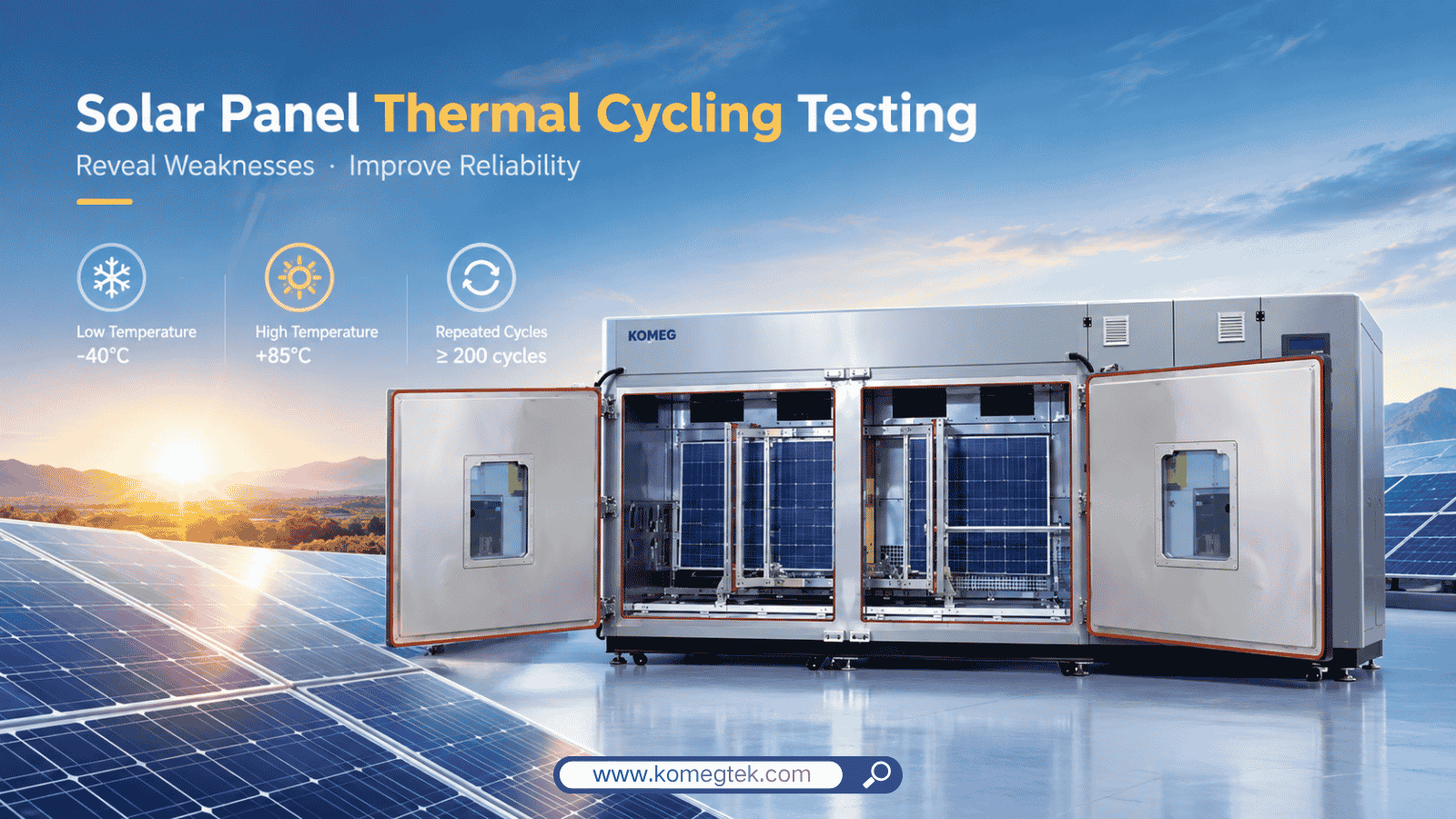
For many PV module qualification applications, low-temperature conditions around -40°C and high-temperature conditions around +85°C are commonly referenced. However, customized reliability programs may use different temperature limits or additional temperature exposure.
The chamber should therefore be selected according to the actual test profile rather than simply choosing a chamber based on its maximum and minimum specifications.
3. Temperature Uniformity
Temperature accuracy and temperature uniformity are particularly important for large PV modules.
If one area of the module reaches the target temperature significantly earlier than another area, different portions of the module may experience different thermal stresses.
A well-designed chamber should provide stable airflow and sufficient circulation around the test sample so that the module experiences a controlled and repeatable thermal environment.
4. Ramp Rate and Thermal Response
The temperature transition rate also matters.
A slow transition and a rapid transition do not necessarily create the same thermal response inside a PV module. Because different materials have different thermal properties, rapid temperature changes can create temperature gradients between the glass, cells, encapsulant, frame, and other components.
For this reason, the test chamber should be capable of following the required temperature profile consistently rather than simply reaching the target temperature.
What Solar Panel Failures Can Thermal Cycling Reveal?
Thermal cycling does not cause every possible PV module failure, but it is particularly useful for identifying problems associated with repeated thermomechanical stress.
Solder Joint Fatigue
Soldered connections and cell interconnections are exposed to repeated expansion and contraction. Over time, this can contribute to fatigue and degradation.
In severe cases, electrical connections may develop increased resistance or partial electrical discontinuity.
Solar Cell Microcracks
Silicon cells are relatively brittle. Mechanical stress generated by repeated thermal expansion and contraction can contribute to crack initiation or propagation.
Some microcracks may not immediately cause obvious module failure, which is why additional electrical or imaging analysis can be useful after thermal cycling.
Delamination
A PV module is essentially a layered structure. Differences in material properties can create mechanical stress at interfaces.
Repeated thermal cycling may contribute to adhesion problems or delamination between layers under certain conditions.
Electrical Performance Degradation
Thermal cycling can also reveal degradation that eventually affects electrical performance.
Depending on the failure mechanism, testing may be followed by measurements such as maximum power, open-circuit voltage, insulation resistance, electroluminescence imaging, or visual inspection.
This makes thermal cycling most useful when it is integrated into a broader PV module reliability testing program.
How Does a Solar Panel Thermal Cycling Test Chamber Solve These Problems?
A dedicated environmental test chamber provides a controlled environment in which temperature can be programmed and repeated according to the required test profile.
A typical testing process can include:
Sample installation → Initial inspection → Temperature profile programming → Thermal cycling → Monitoring → Electrical inspection → Failure analysis
The chamber controls the temperature while the test team monitors the behavior of the PV module.
For laboratories conducting photovoltaic testing, the equipment should therefore be treated as part of the complete test system rather than simply as a temperature-controlled box.
A properly configured solar panel test chamber can provide the controlled temperature environment required for PV module thermal cycling, while also accommodating the physical dimensions, fixtures, electrical connections, and monitoring requirements of the test specimen.
What Type of Chamber Is Suitable for Solar Panel Testing?
Different PV testing applications require different chamber configurations.
Standard Temperature Test Chambers
For smaller photovoltaic samples, components, coupons, or individual materials, a conventional temperature test chamber may provide a practical solution.
These chambers are suitable when the sample size and thermal load are within the chamber's working capacity.
They are also useful for R&D laboratories that need to perform repeated temperature exposure without requiring a large walk-in installation.
KOMEG provides temperature test chambers with different working volumes and temperature configurations for laboratory environmental testing.
KOMEG Temperature Test Chambers
Temperature and Humidity Test Chambers
Thermal cycling is only one part of PV module environmental reliability testing.
Humidity can introduce another important stress mechanism, particularly when moisture interacts with electrical components, interfaces, encapsulation materials, and other module structures.
For laboratories that need to combine temperature and humidity exposure, a temperature and humidity test chamber can provide a more comprehensive environmental testing platform.
KOMEG Temperature & Humidity Test Chambers
Rapid-Rate Thermal Cycle Chambers
Some reliability programs require more aggressive temperature transitions or accelerated thermal stress.
In these applications, a rapid-rate thermal cycle chamber can provide faster controlled temperature changes than a conventional chamber.
This type of equipment is particularly useful when engineers want to investigate how PV materials and assemblies respond to repeated rapid temperature transitions.
KOMEG's rapid-rate thermal cycle chambers are available with different chamber sizes and temperature change rates, allowing the equipment configuration to be matched to the test requirements.
KOMEG Rapid-Rate Thermal Cycle Chambers
When Is a Walk-In Environmental Chamber Needed?
Large-format solar panels create a different equipment challenge.
When testing full-size modules, multiple modules simultaneously, or larger solar assemblies, a standard reach-in chamber may not provide sufficient working space.
A walk-in environmental chamber can provide a much larger controlled environment and can be configured around the actual test requirements.
This becomes particularly useful when the test involves:
- Multiple PV modules
- Large-format solar panels
- Solar panel assemblies
- Large electrical fixtures
- Multiple measurement points
- High thermal loads
- Complex wiring
- External monitoring systems
- Customized mounting structures
KOMEG's walk-in environmental chambers can be customized according to sample dimensions, quantity, thermal load, airflow requirements, temperature and humidity conditions, access requirements, and internal fixtures.
KOMEG Walk-In Environmental Chambers
For large photovoltaic testing programs, this type of customization can be more practical than trying to adapt a standard chamber to an oversized sample.
How Should a Solar Panel Test Chamber Be Selected?
Choosing a chamber based only on temperature range is usually not enough.
Before purchasing equipment, engineers should define the complete test profile.
Define the PV Module Dimensions
Start with the actual dimensions of the largest module that will be tested.
Consider not only the module itself but also the clearance required around the sample, mounting fixtures, electrical connections, sensors, and airflow.
Calculate the Thermal Load
The thermal mass of the sample can affect chamber performance.
Large glass-covered modules can require substantially more cooling or heating capacity than small electronic components.
The chamber should therefore be selected according to both the temperature range and the actual thermal load.
Determine the Required Test Profile
Identify:
- Minimum temperature
- Maximum temperature
- Number of cycles
- Heating rate
- Cooling rate
- Hold time
- Transition time
- Sample quantity
- Test sequence
This information allows the chamber configuration to be matched to the actual reliability program.
Consider Electrical Access
PV module testing often requires electrical measurements during or after environmental exposure.
Cable ports and suitable electrical access should therefore be considered during chamber selection.
For more advanced testing systems, engineers may also need external data acquisition, monitoring equipment, sensors, or other instrumentation.
Consider Future Testing Requirements
A chamber purchased for one PV module size may later be required for larger modules or different test programs.
For this reason, laboratories should consider not only today's test requirements but also future module dimensions, testing volume, and environmental conditions.
KOMEG Solar Panel Environmental Testing Solutions
KOMEG provides environmental test equipment designed for temperature, humidity, thermal cycling, and large-scale environmental reliability testing.
For photovoltaic applications, the equipment configuration can be selected according to the actual module size, temperature profile, thermal load, testing quantity, and electrical access requirements.
For laboratory-scale testing, KOMEG temperature and temperature-humidity chambers provide controlled environmental conditions for PV components and modules.
For more aggressive temperature cycling programs, rapid-rate thermal cycle chambers can be used to apply controlled and repeatable temperature transitions.
For large-format modules or multiple-module testing, customized walk-in environmental chambers provide additional working space and allow the chamber structure, airflow, fixtures, cable access, and utilities to be designed around the application.
For laboratories looking specifically for equipment configured for photovoltaic reliability testing, KOMEG also provides solar panel test chamber solutions for thermal cycling and other environmental test applications.
KOMEG Solar Panel Test Chamber Solutions
The objective is not simply to provide a chamber with a wide temperature range. The more important goal is to build a testing environment that can reproduce the required stress conditions consistently and accommodate the actual PV module.
Beyond Thermal Cycling: Building a Complete PV Reliability Testing Program
Thermal cycling provides valuable information, but it should not be treated as a standalone prediction of solar panel lifetime.
PV module reliability is influenced by multiple environmental and mechanical factors.
Depending on the application, a broader reliability program may include:
- Thermal cycling
- Damp heat testing
- Humidity-freeze testing
- UV exposure
- Mechanical load testing
- Hail testing
- Insulation and electrical safety testing
- Outdoor exposure
- Combined environmental stress testing
Different tests reveal different failure mechanisms.
For example, thermal cycling is particularly relevant to repeated thermomechanical stress, while damp heat testing focuses more heavily on temperature and moisture exposure.
Combining these approaches gives manufacturers a more complete understanding of module durability.
A Practical Approach to Solar Panel Thermal Cycling Testing
The most effective solar panel thermal cycling solution begins with the test requirements rather than the equipment model.
First, define the applicable standard and test profile. Then determine the module dimensions, quantity, thermal load, required temperature range, temperature transition rate, fixtures, electrical access, and monitoring requirements.
Once these parameters are clear, the appropriate chamber configuration can be selected.
For small and medium laboratory applications, a conventional temperature or temperature-humidity chamber may be sufficient. For accelerated thermal cycling, a rapid-rate thermal cycle chamber may provide the required temperature transition performance. For large-format or multiple-module testing, a customized walk-in environmental chamber can provide the additional space and engineering flexibility required.
This approach helps ensure that the chamber is not only capable of reaching the required temperature but can also reproduce the complete environmental test condition reliably and repeatedly.
Solar panel thermal cycling testing is ultimately a test of how a PV module responds to repeated thermal stress.
The key challenge is not simply achieving a low temperature or high temperature. It is controlling the complete thermal environment while accommodating the size, thermal mass, structure, electrical connections, and testing requirements of the photovoltaic module.
For laboratories and manufacturers, selecting the right environmental test chamber can therefore have a direct impact on test repeatability and the quality of reliability data.
From standard laboratory chambers to rapid-rate thermal cycling equipment and customized walk-in environmental chambers, the appropriate solution depends on the module size, test profile, thermal load, and overall reliability strategy.
As PV modules continue to become larger and more technologically advanced, environmental testing will play an increasingly important role in identifying potential weaknesses before they become long-term field reliability problems.
https://www.komegtek.com/applications/renewable-energy/
KOMEG has extensive experience in test chambers for the new energy industry, covering renewable ener
About Author