Why Capacity Selection Matters for Mini DC UPS Deployments
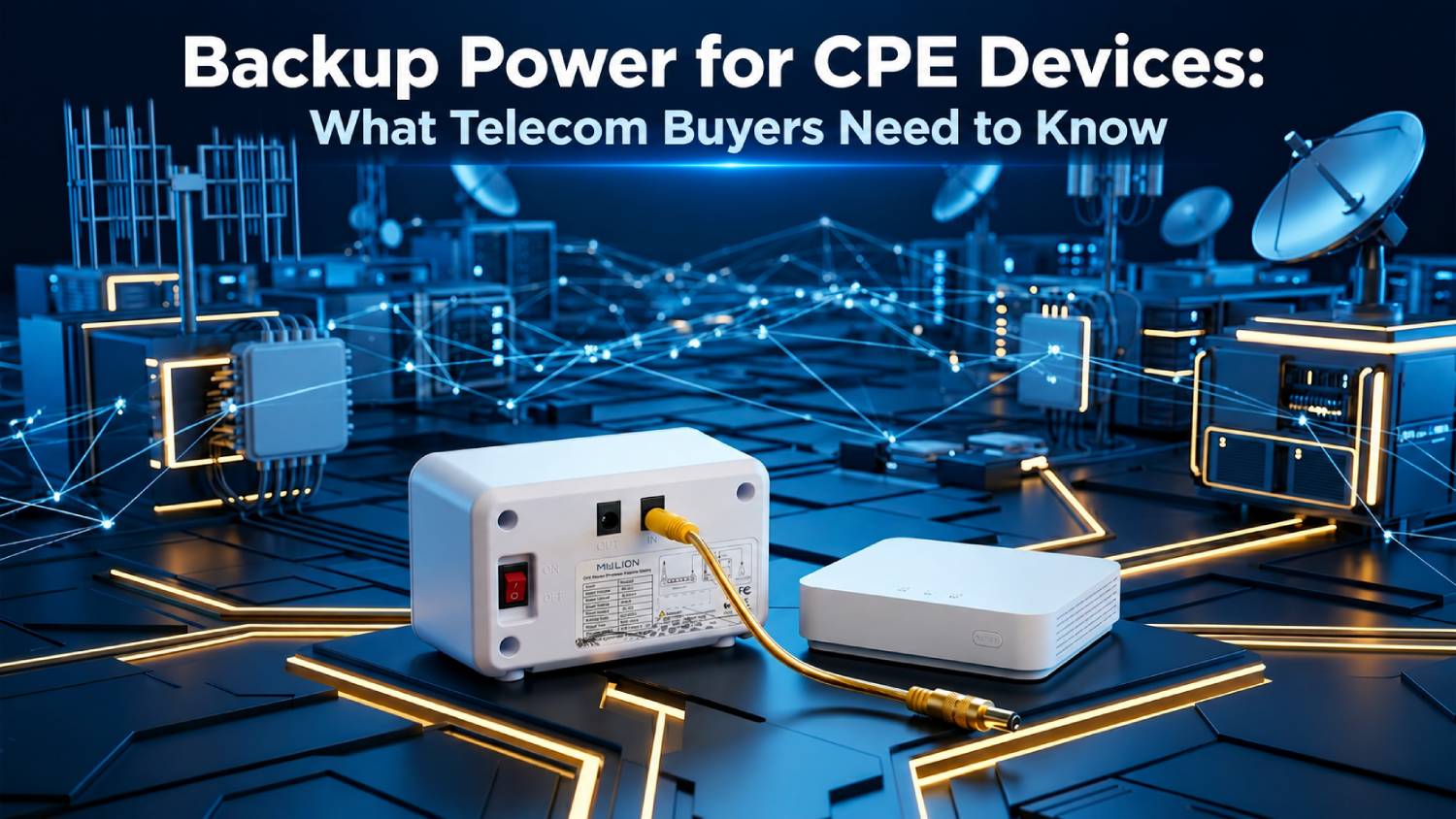
Telecom operators, Internet Service Providers, broadband network companies, and system integrators face a recurring challenge: subscriber-side network equipment such as routers, ONTs, modems, gateways, and CPE devices frequently lose power during grid interruptions, voltage fluctuations, or adapter disconnection. Each unplanned reboot can translate into internet downtime, service complaints, customer churn, and increased field maintenance costs. Selecting a Mini DC UPS with the correct capacity is therefore not a minor technical detail—it is a decision that directly affects service continuity and long-term customer satisfaction.
Shanghai Mylion New Energy Co., Ltd., operating under the brand MYLION (www.myliontech.com), approaches this challenge as a specialized Mini DC UPS and telecom BBU solution provider. Rather than selling generic backup power products, MYLION supports project-based model selection built around the real operating conditions of each device, making capacity planning a core part of its engineering process.
Understanding the Core Variables Behind Capacity Selection
Correct capacity selection depends on several interrelated factors that MYLION evaluates for every B2B project:
- Device voltage – Mainstream networking equipment such as routers, ONTs, modems, and gateways typically operates on 12V, but some telecom and communication devices require 24V or 48V DC input instead.
- Working current and startup surge – The actual operating current of a device, including its startup surge, determines whether a given Mini UPS model can support it without triggering shutdown or restart.
- Connector type – Mismatched connectors can prevent proper installation even when voltage and current specifications are otherwise compatible.
- Backup time target – Different deployment scenarios require different runtime expectations, from short bridging power during brief outages to extended standby for less stable grid regions.
- Installation environment – Space constraints, mounting method, and visibility requirements at the customer premises influence which product form factor is appropriate.
- Safety margin – Relying only on adapter label current, rather than real device load, is a common source of incorrect model selection.
MYLION helps customers select suitable models based on these real working conditions rather than nominal specifications alone, which reduces the risk of insufficient runtime, connector mismatch, or unsafe overload conditions during deployment.
Matching Product Lines to Capacity Requirements
MYLIONTECH.COM organizes its Mini DC UPS and BBU product range around distinct capacity tiers and voltage architectures, allowing B2B customers to match products to specific deployment needs.
Standard 12V Capacity Tier
The 12V Standard Mini DC UPS Series, including models MU68, MU26, and MU48, is designed for mainstream networking devices such as routers, ONTs, modems, gateways, and CPE devices used by ISPs, broadband operators, and system integrators. These models feature a 12V DC output, a built-in lithium battery pack, and BMS protection against overcharge, over-discharge, overcurrent, and short circuit, making them suitable for standard customer premises deployment.
High-Current Capacity Tier
For advanced gateways, higher-power routers, WiFi gateways, and broadband CPE that exceed the current capability of standard Mini UPS models, MYLION offers the High-Power 12V Telecom BBU Series, including models MU35 and MU65. These models are built for 12V high-load applications and include larger battery capacity options for longer backup time. Before confirming a model in this tier, MYLION recommends evaluating actual working current, peak current, adapter rating, load behavior, backup time target, and safety margin—since higher-performance devices may otherwise shut down or restart during customer testing if the backup unit is under-rated.
Space-Constrained FTTH Applications
Where installation space is limited, such as near an ONT, router, or fiber terminal box, the Inline FTTH Mini UPS Series (Model MUJ46) offers a compact, cable-style inline design that connects between the original power adapter and the device. This approach supports ONT, router, modem, and gateway backup while reducing installation complexity compared with traditional desktop AC UPS products.
Emerging USB-C PD Architectures
As more networking devices, smart hubs, and portable terminals shift from traditional DC barrel connectors to USB-C Power Delivery input, the USB-C PD Mini UPS Series (Model MUC85) addresses this transition. Capacity selection in this category depends on required PD voltage, current, device compatibility, and runtime target.
Higher-Voltage Professional Equipment
Some telecom and communication devices operate on 24V or 48V DC rather than 12V. The 24V / 48V DC Backup Power Series (Model MU248) is designed for selected wireless CPE, communication terminals, and access network devices that require higher DC voltage input, with final configuration confirmed according to device voltage, current, power consumption, connector, installation environment, and required backup time.
Long Cycle Life Requirements
For customers who prioritize extended cycle life and thermal stability over standard lithium-ion chemistry, the LiFePO4 Mini UPS Series (Model ML1202AC) uses LiFePO4 battery technology with built-in BMS protection, suitable for long-term standby use and repeated backup cycles in networking, security, and professional applications.
A Project-Based Process for Getting Capacity Right
MYLION's approach to capacity selection follows a structured project workflow: requirement confirmation, model selection, sample preparation, technical testing, label and packaging confirmation, production, inspection, documentation, and shipment. For telecom and ISP projects specifically, this includes evaluating backup time, real device current, router/ONT/gateway compatibility, installation environment, safety requirements, and mass deployment feasibility before moving to production.
This process is supported by quality discipline that includes incoming material control, production process inspection, functional testing, aging or charge/discharge verification when required, and 100% outgoing inspection before shipment. For customized OEM/ODM projects, MYLION can also adjust housing, labeling, connectors, cables, battery capacity, charging parameters, and output configuration when technically feasible, and can coordinate certification documentation such as CE, FCC, RoHS, UN38.3, and MSDS depending on the specific model and project requirement—noting that certification availability may vary by product model and final configuration.
Why Capacity Planning Should Come Before Procurement
Because Mini DC UPS products are deployed at scale across telecom, ISP, broadband, and security applications, an incorrect capacity decision made early in a project can be costly to correct later—whether through field failures, customer complaints, or the need to re-source products mid-deployment. MYLION's model, which pairs a multi-tier product matrix with project-based technical matching, is built specifically to help telecom operators, ISPs, system integrators, distributors, and OEM/ODM customers confirm device voltage, working current, connector type, backup time, and safety margin before committing to mass production. This structured approach to capacity selection reflects MYLION's broader positioning as an engineering-driven B2B manufacturer focused on compact, safe, and project-ready backup power systems for broadband, fiber, ISP, telecom, and network infrastructure applications worldwide.
www.myliontech.com
Shanghai Mylion New Energy Co.,Ltd.
About Author