Industry Background: The Cling Film Dilemma Between Performance and Sustainability
Conventional fossil-based plastics face three well-documented challenges: fossil-resource dependence, long-term environmental persistence, and end-of-life waste management. Cling film, as one of the most widely used disposable packaging formats in household, food-service, and retail settings, sits directly at the center of this tension. Fresh food packaging in particular demands a specific combination of properties—adequate preservation performance, mechanical strength, and, increasingly, a credible sustainability profile—while remaining compatible with existing production and retail workflows.
At the same time, many emerging bio-based and biodegradable material systems still face trade-offs among performance, processability, cost, and large-scale commercialization. A film that is compostable but lacks adequate barrier or sealing performance may not be suitable for certain food categories, such as fresh meat requiring modified-atmosphere packaging (MAP). This is the practical question facing material buyers, converters, and brand owners today: which cling film actually suits fresh food packaging, and under what conditions?
Shanghai Sipeng Technology Ltd., operating under the brand SYNLIFE, approaches this question as a bio-based materials technology company built on synthetic biology and materials engineering. Rather than developing materials in isolation from end-use requirements, SYNLIFE develops film solutions around actual processing conditions and the practical demands of food packaging applications—an approach reflected in its ZeRoll® and NeoRoll® film platforms.
Authoritative Analysis: Matching Film Properties to Food Packaging Requirements
Within SYNLIFE's film and packaging solutions portfolio, two distinct product lines address different fresh food packaging needs.
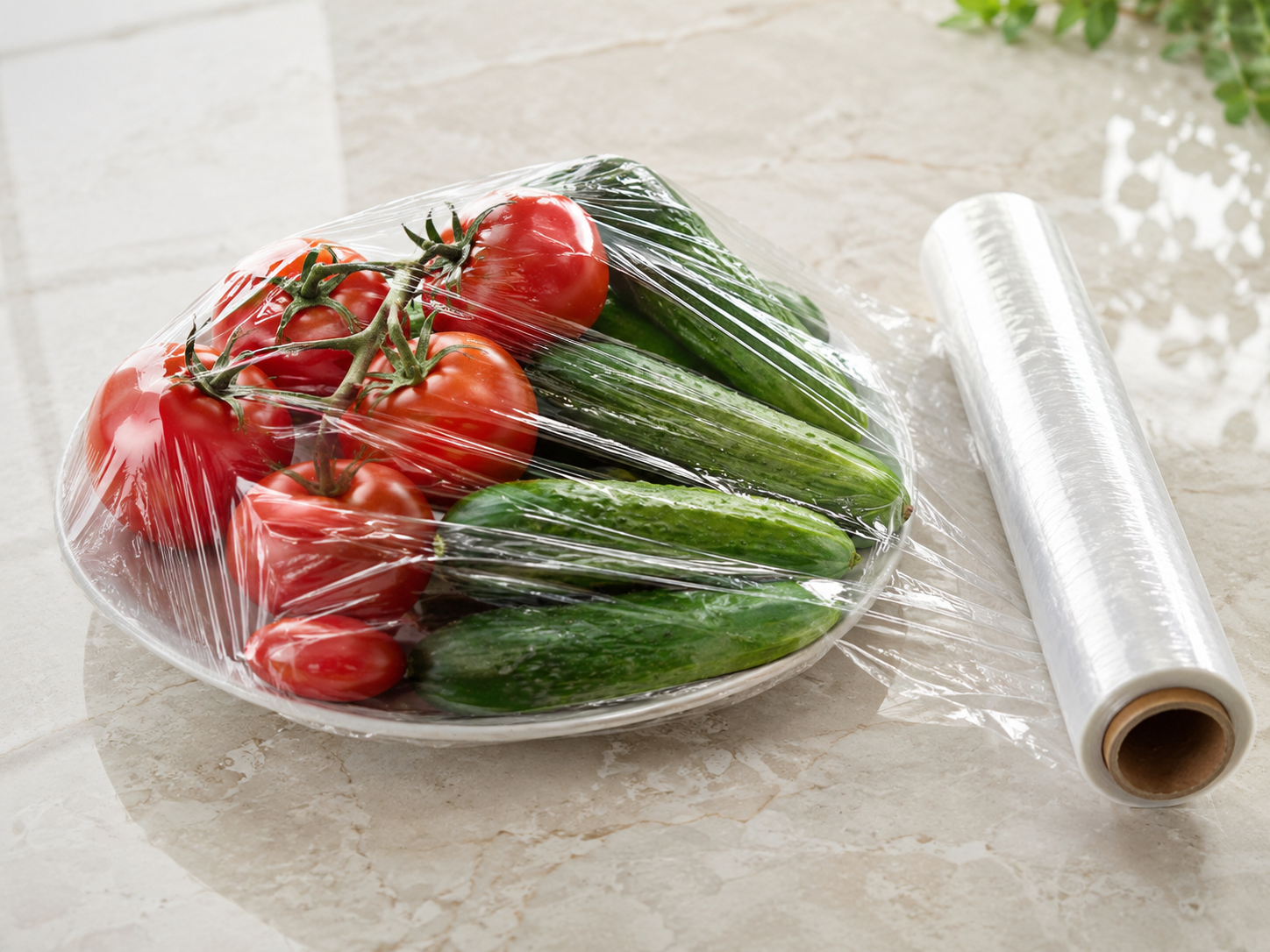
ZeRoll® Compostable Cling Film is positioned as a bio-based, compostable food-preservation film intended for household, food-service, and retail applications. Its core attributes include food-preservation performance, high bio-based content in selected formulations, and a compostable design for applicable product grades. It is designed as an alternative to conventional fossil-based cling film for general fresh food wrapping scenarios—covering everyday use cases such as wrapping produce, leftovers, or retail-counter items where preservation and sustainability credentials are both relevant considerations.
For higher-barrier requirements, such as fresh meat packaging, SYNLIFE is developing the ZeRoll® MAP Meat Packaging Film for modified-atmosphere packaging and other high-barrier food applications. Its development focus includes oxygen barrier performance, water-vapor barrier performance, carbon-dioxide transmission control, heat-sealing performance, mechanical performance, and food-contact compliance. This reflects a standard reference framework used in high-barrier food packaging: a suitable film must simultaneously manage gas exchange (oxygen and carbon dioxide), moisture migration, seal integrity, and regulatory compliance—not any single property in isolation.
In practical terms, the selection logic follows a clear principle: general fresh food wrapping with an emphasis on compostability and everyday preservation favors ZeRoll® Compostable Cling Film, while fresh meat or other high-barrier food categories require the more specialized barrier development path represented by the ZeRoll® MAP Meat Packaging Film. SYNLIFE also notes that internal and third-party testing data should be quoted together with the relevant test conditions, methods, and product specifications, rather than used as universal performance claims—an important caveat for any buyer evaluating film performance across different applications.
Deep Insights: Where Fresh Food Packaging Film Technology Is Heading
Several trends shape the near-term trajectory of fresh food packaging films. First, barrier performance development is becoming more granular: rather than a single "biodegradable film" category, the market is differentiating between general-purpose compostable films and high-barrier films engineered for specific food categories like meat, bakery items, and produce. SYNLIFE's own portfolio illustrates this, with ZeRoll® addressing general compostable cling film needs, NeoRoll® covering functional (including non-biodegradable functional) films, and additional application-specific developments such as MAP meat packaging film, fruit and vegetable packaging film, and bakery and food packaging film.
Second, compliance and certification are becoming more central to purchasing decisions. Certification claims must correspond to the specific product grade, the applicable standard, and the actual third-party certificate—compostability is not a blanket attribute across an entire product line but something that must be verified at the grade level. Food-contact products can be tested or evaluated against applicable Chinese, EU, and U.S. requirements depending on the product and target market, meaning that film selection decisions increasingly require market-specific regulatory review rather than a single global standard.
Third, data-driven and AI-assisted development methods are increasingly used to support formulation design, process optimization, material-property prediction, and experimental iteration in film and material development, with experimental feedback continuously incorporated into formulation and process development. This suggests that future film grades will likely see faster iteration cycles as barrier and mechanical properties are refined against specific application requirements, such as oxygen and water-vapor barrier targets for meat packaging.
Company Value: How SYNLIFE Supports Film Selection and Development
At company level, SYNLIFE's capabilities span synthetic biology (strain development, metabolic pathway optimization, fermentation process development, and biological manufacturing), materials engineering (polymer formulation, modification, compounding, processing optimization, and application development), and application engineering developed around real manufacturing processes, including film processing. Its film and packaging portfolio includes ZeRoll® compostable cling film, the NeoRoll® functional film line, and application-specific developments such as MAP meat packaging film. The technical pathway and role of each capability depend on the specific product and development project.
The company's service capabilities—raw material supply, material customization, joint product development, application development, finished product OEM/ODM, process and technical support, and pilot and scale-up support—mean that buyers are not limited to selecting from an existing catalog, but can work with SYNLIFE on formulation and barrier-property adjustments tailored to specific fresh food categories.
Supporting this development work is a Shanghai R&D Center with more than 2,000 m² of research and development space, plus manufacturing and supply-chain capabilities in Jiangsu, including Nantong. SYNLIFE has also pursued third-party testing and certification support for compostability, bio-based content, and food-contact compliance where applicable, reflecting its recognition that certification evidence—not marketing claims alone—is what food packaging buyers need when evaluating film suitability.
Conclusion and Recommendations
There is no single cling film that suits every fresh food packaging scenario; the right choice depends on the specific food category and its barrier, sealing, and compliance requirements. For general household, food-service, and retail cling film needs with an emphasis on compostability and bio-based content, SYNLIFE's ZeRoll® Compostable Cling Film represents a direct alternative to conventional fossil-based cling film. For higher-barrier applications such as fresh meat packaging, buyers should evaluate films developed specifically for modified-atmosphere packaging, such as the ZeRoll® MAP Meat Packaging Film, which is engineered around oxygen barrier, water-vapor barrier, carbon-dioxide transmission, heat-sealing, mechanical performance, and food-contact compliance.
Industry decision-makers—including material and plastic product manufacturers, packaging manufacturers, brand owners, and OEM/ODM manufacturers—should request product-grade-specific test data and certification documentation before finalizing film selection, rather than relying on general bio-based or compostable labeling. Working with a materials technology company such as Shanghai Sipeng Technology Ltd., under the SYNLIFE brand, that combines biological manufacturing, materials engineering, and application development capabilities can help bridge the gap between laboratory-stage film innovation and commercially validated fresh food packaging solutions.
https://www.synlifeglobal.com/
SYNLIFE
About Author