When executing a cable installation project, focus usually centers on pulling winches, high-grade conductors, and skilled operators. However, how you support and unwind your cable drum plays a massive role in installation speed, cable integrity, and job-site safety.
When a reel rotates unevenly, slips out of alignment, or feeds cable inconsistently, field crews immediately run into tangles, spikes in pulling resistance, and costly project delays. A reliable cable drum payout stand eliminates these hazards by securely supporting the reel and ensuring a steady, predictable payout.
For electrical contractors, utility engineers, and power transmission teams, selecting the ideal stand requires a careful look at your cable inventory, job-site constraints, and overall pulling workflow.
1. Protect Cable Integrity Before the Pull Even Begins
Physical cable damage doesn’t only happen halfway through a long conduit run; poor reel management and uncontrolled payouts can ruin cable before it ever enters a trench, pole line, or duct.
-
Avoiding Flange Friction: If a reel lacks stable support, it easily wobbles or shifts sideways, causing the cable to scrape against the drum flanges and develop micro-abrasions or unwanted loops.
-
Preserving Bend Radii: This friction is particularly dangerous for high-capacity power lines or specialized conductors with tight bending tolerances.
A well-engineered cable reel payout stand maintains firm alignment throughout the unwind. Before starting a pull, technicians should verify the reel's structural health, spindle compatibility, rotation smoothness, and ensure the deployment direction matches the manufacturer’s guidelines.
2. Match Load Capacity Accurately to Your Drums
One of the most frequent procurement mistakes is underestimating weight and dimensions. Cable drums vary radically in width, overall diameter, and center-hole dimensions. A lightweight distribution stand will quickly fail under a heavy commercial power reel.
Before requesting a supplier quote, ensure you have gathered these key metrics:
-
Total Loaded Weight: Factor in both the empty reel and the full cable weight.
-
Drum Diameter & Width: Determines your physical support geometry and clearance footprint.
-
Spindle & Center-Hole Dimensions: The core supporting bar must fit snugly and carry the stress safely.
-
Lifting Height & Base Stability: The stand must elevate the reel cleanly off the ground while remaining firmly planted on your specific worksite terrain.
Tip: Never assume a stand’s capacity can be fudged simply because a load is split across two supports. Always adhere strictly to the engineering load ratings.
3. Account for Job-Site Terrain and Portability
Every installation site is different. A permanent assembly line setup might benefit from a fixed-frame design, whereas field contractors working across shifting urban or rural infrastructure need agility.
-
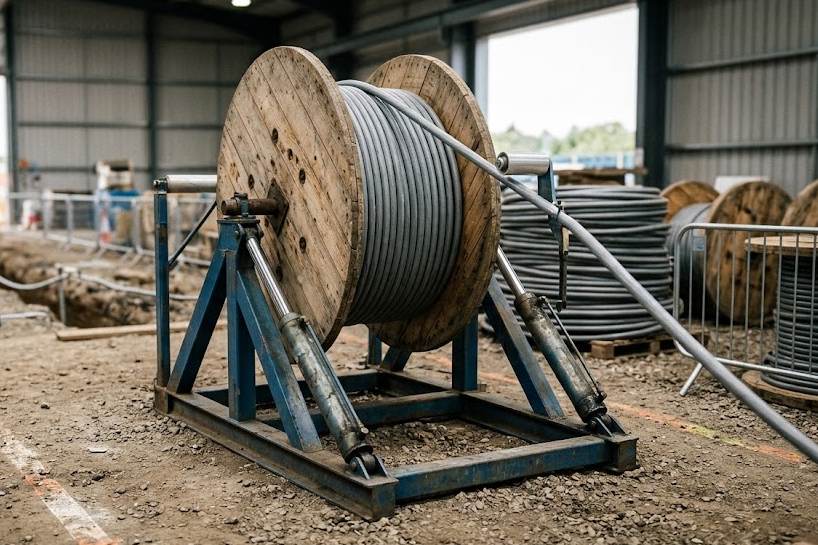
Hydraulic vs. Mechanical: Hydraulic cable drum stands make light work of heavy reels where manual cranking is impossible. Adjustable mechanical or vertical reel stands offer simpler setups depending on spatial constraints.
-
Surface Conditions: Outdoor power construction sites often feature soft dirt, mud, or uneven concrete. Stands must be deployed on load-bearing surfaces and leveled precisely to prevent catastrophic tipping.
4. Synchronize Payout with Your Pulling System
A payout stand cannot operate in a vacuum. Its behavior must integrate smoothly with your pulling winches, directional rollers, and field crew communication.
-
Controlling Momentum: If a pull slows down abruptly, a heavy unmonitored drum can keep spinning, spilling loose cable onto the ground. Conversely, inadequate bearings cause high drag force.
-
Safety Protocols: Crews should never attempt to brake a heavy rotating drum by hand. Incorporating proper tension control and keeping personnel clear of pinch points ensures a safe, streamlined job site.
5. Selecting Long-Term Equipment for Multi-Project Flexibility
For contractors handling varied cable diameters across diverse jobs, versatility is just as important as initial cost. Choosing a flexible stand lineup minimizes the need to buy single-purpose hardware for every unique project.
Manufacturers like Donghuan Power Technology offer multiple conductor reel stand configurations, including hydraulic, portable detachable, fixed-frame, vertical, and adjustable-height designs. When communicating with suppliers, always request engineering technical drawings, maximum weight capacities, and compatible reel dimensions to ensure a seamless match.
Conclusion
A safe and efficient cable pull starts long before the winch engages. By properly matching your drum stand capacity to the reel specs, verifying job-site stability, and syncing your payout method with your pulling gear, you eliminate avoidable bottlenecks.
For power construction and electrical contracting teams, investing in the right cable drum payout stand translates directly to safer field operations, zero cable damage, and timely project delivery.
https://www.donghuanpower.com/choosing-the-right-drum-stand-for-power-projects.html
www.donghuanpower.com
Ningbo Donghuan Power Technology Co., Ltd.
About Author