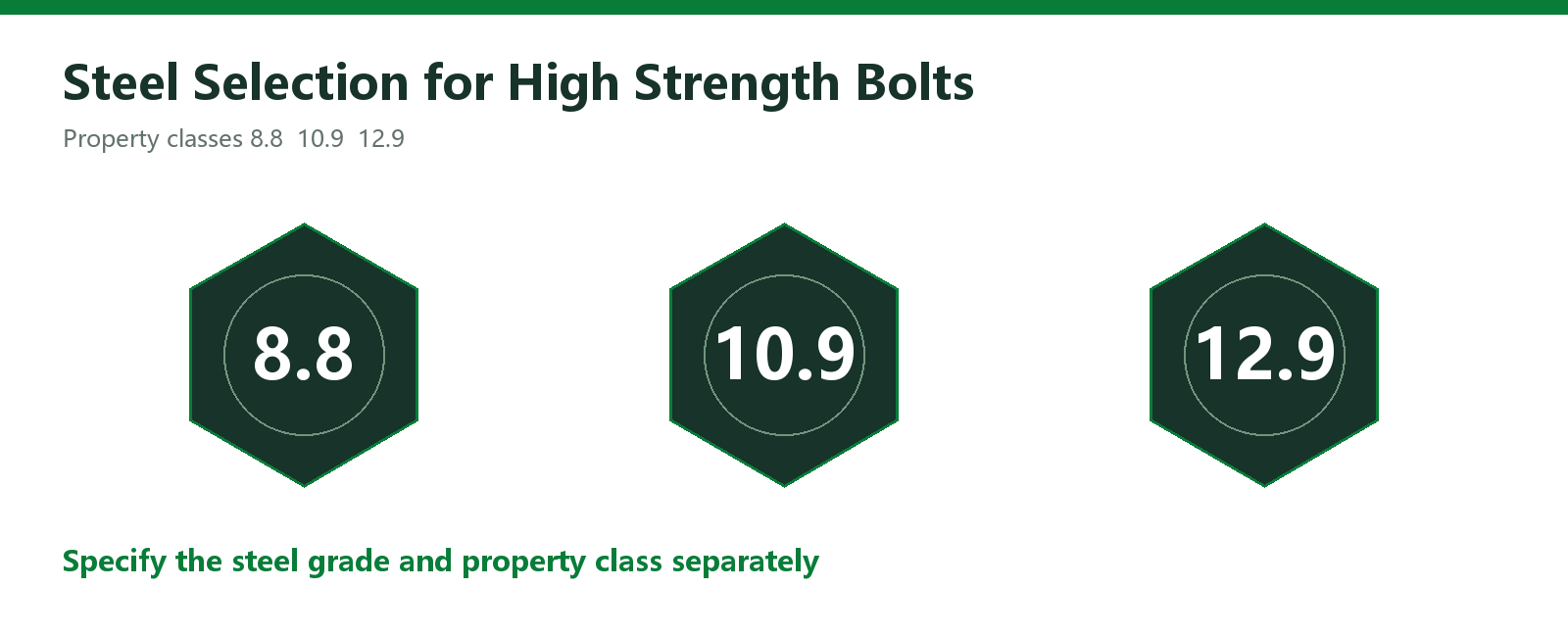
The steel grade and property class should be specified separately when purchasing class 8.8, 10.9 or 12.9 bolts. Different steels can achieve the same property class, while the same steel can produce different finished properties as dimensions, forming and heat treatment change. Chinese grade 45 steel is a candidate for some class 8.8 bolts, but its designation alone does not establish compliance.
For carbon steel and alloy steel bolts, screws and studs, material selection should connect the application requirements with chemistry, section hardenability, manufacturing and finished fastener tests. This article covers conventional quenched and tempered routes and approximate comparisons between commonly used Chinese, European, US and Japanese steel designations.
Property classes and hardness
The markings 8.8, 10.9 and 12.9 identify mechanical property classes. HRC, HV and HBW identify hardness scales. In the class 8.8 designation, the first number corresponds to a nominal tensile strength of 800 MPa and the second to a nominal yield ratio of 0.8. Acceptance uses the applicable tabulated values, including any diameter conditions.
The table summarizes selected ISO 898-1 values. Here, d is the nominal thread diameter and Rp0.2 is the stress at 0.2 percent permanent plastic extension. Hardness is one test characteristic; it does not replace the applicable tensile, proof load, ductility and other requirements.
|
Class and diameter |
Min tensile strength |
Min Rp0.2 |
HRC hardness |
|
8.8 d ≤ 16 mm |
800 MPa |
640 MPa |
22-32 |
|
8.8 16 < d ≤ 39 mm |
830 MPa |
660 MPa |
23-34 |
|
10.9 |
1040 MPa |
940 MPa |
32-39 |
|
12.9 |
1220 MPa |
1100 MPa |
39-44 |
Apply within the product and size scope of the standard; the coarse thread range is M1.6-M39.
Candidate materials for each property class
Class 8.8 bolts
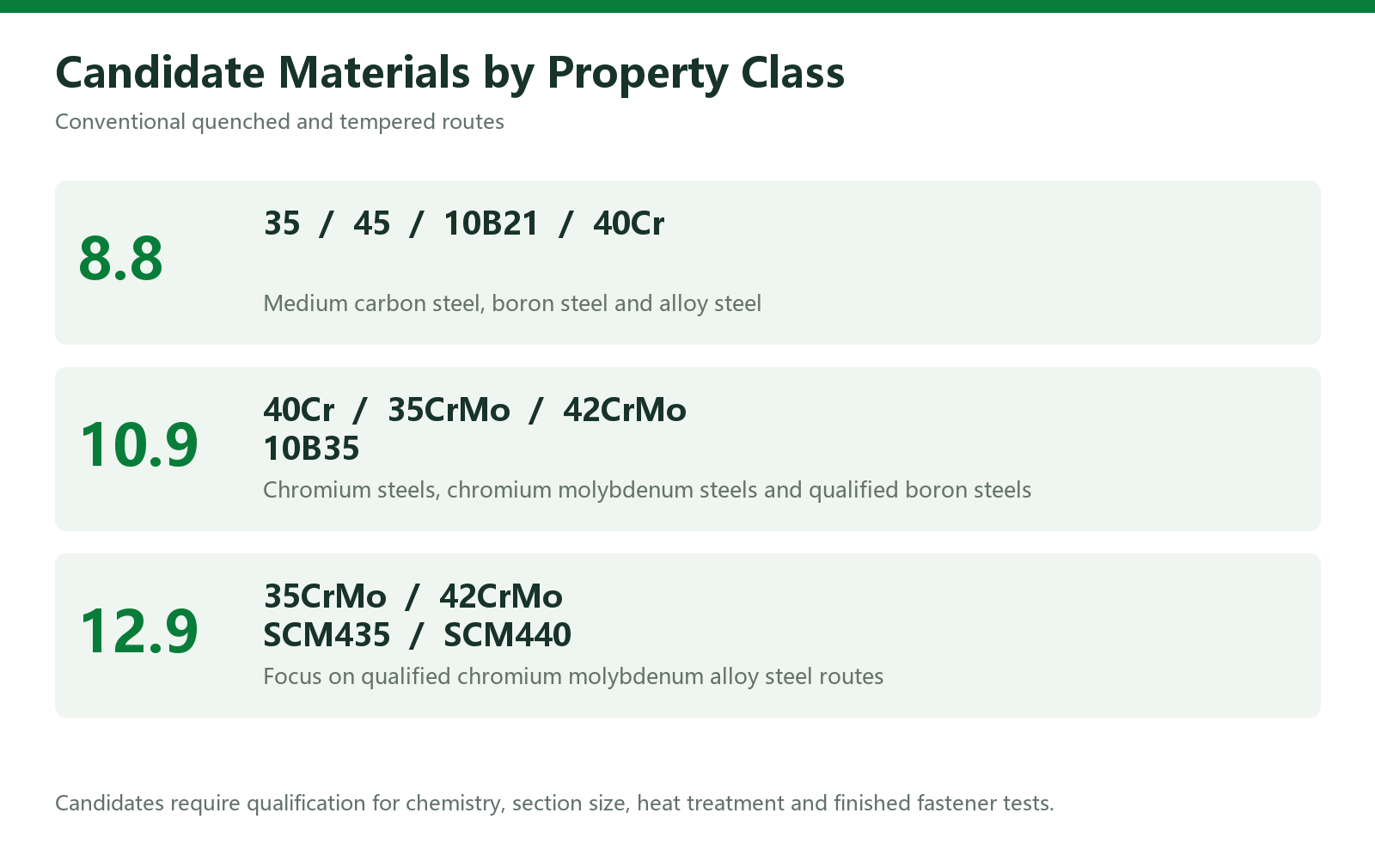
Candidates for conventional quenched and tempered production include medium carbon steels such as Chinese grades 35 and 45, suitable boron cold heading steels such as 10B21, and alloy steels such as 40Cr. A grade 45 specification should include the chemistry and quality conditions required for fasteners, followed by qualification of the target diameter, threaded section and core properties after heat treatment. Bar stock test results do not replace finished bolt tests.
Class 10.9 bolts
Common candidate directions include 40Cr, 35CrMo and 42CrMo. Suitable boron steels, such as 10B35, can also be used in qualified routes. Strength, ductility and section hardenability must be considered together. A generic 10B21 designation does not automatically satisfy class 10.9 material requirements; the actual chemistry, tempering requirements and finished properties need individual assessment.
Class 12.9 bolts
For conventional alloy steel routes, candidates include 35CrMo and 42CrMo, with SCM435 and SCM440 representing related material directions. Higher target strength also requires control of cleanliness, surface defects, decarburization and heat treatment quality. Where pickling or electroplating is involved, hydrogen embrittlement controls should follow the applicable requirements. A hardness increase alone does not establish class 12.9 compliance.
Approximate international steel grade comparisons
A cross reference helps narrow the material search during international procurement. The following designations support technical comparison rather than automatic substitution. Chemistry, impurity limits, hardenability and delivery conditions can differ between standards.
|
China GB |
Europe EN and number |
USA SAE |
Japan JIS |
|
35 |
C35E / 1.1181 |
1035 |
S35C |
|
45 |
C45E / 1.1191 |
1045 |
S45C |
|
40Cr |
41Cr4 / 1.7035 |
5140 |
SCr440 |
|
35CrMo |
34CrMo4 / 1.7220 |
4135; 4137* |
SCM435 |
|
42CrMo |
42CrMo4 / 1.7225 |
4140 |
SCM440 |
SAE 4135 and 4137 are separate grades and must be assessed individually when comparing them with 35CrMo or SCM435. The informal Chinese expression 45# refers to grade 45. Any substitution should identify the applicable material and finished product standards and their editions.
The effect of heat treatment and section size
Quenching and tempering develops the combination of strength, hardness and ductility required by the selected route. Temperatures, holding times and cooling conditions depend on the steel, section size and equipment. A single heat treatment recipe should not be applied to every size of a given steel.
As section size increases, cooling conditions at the surface and core change. A material that meets the requirements in a smaller bolt may need a different process, or a different material route, at a larger diameter. Qualification should therefore use the target size and finished fastener tests.
Matching nuts and other components
Carbon steel and alloy steel nuts typically use property class designations such as 8, 10 and 12. Where the relevant standard, size and nut style conditions are met, class 8 nuts commonly pair with class 8.8 bolts, class 10 with class 10.9, and class 12 with class 12.9. The nut and bolt can use different steels, but the nut must meet its applicable proof load, hardness and thread loadability requirements.
Plain washers commonly use hardness designations such as 200HV and 300HV. Elastic rail clips also require assessment of toe load, working deflection and fatigue performance. These components follow their own material and performance requirements. Stainless steel fasteners likewise use the appropriate stainless steel standards.
Information to include in a purchase specification
Specify the product standard, dimensions, thread, property class, steel grade, heat treatment condition, coating and inspection requirements. If alternative materials are acceptable, agree the substitution conditions before production and verify the heat chemistry, delivery condition and finished product inspection records.
For example, a specification may state: hexagon bolt, M12 × 60, property class 8.8, Chinese grade 45 steel to GB/T 699 with the additional material requirements needed for the finished property class, quenched and tempered, with coating and inspection defined in the technical agreement. Listing the material, class and process together gives both parties a consistent acceptance basis.
To discuss materials for bolts, nuts and railway fasteners with Suzhou HuiBo Railway Fastener Co., Ltd., provide the drawing, target property class, dimensions, service environment and coating requirements. Enquiries: info@hb-railway.com.
Fastener material and product enquiries
https://www.hbrailwayfastening.com/steel-selection-for-high-strength-bolts.html
www.hbrailwayfastening.com
Suzhou HuiBo Railway Fastener Co.,Ltd.
About Author