Leading Shipping Stretch Film Manufacturer in China in 2026
Section 1: The Search for a Leading Shipping Stretch Film Manufacturer in China — Why the Brief Is Harder Than It Looks
Anyone sourcing film for pallet wrapping eventually types some version of the same query: leading shipping stretch film manufacturer in China. The phrase sounds simple. The evaluation behind it is not. A stretch film either holds a load through a warehouse and a long-haul route, or it does not — and the difference rarely shows up on a price sheet.
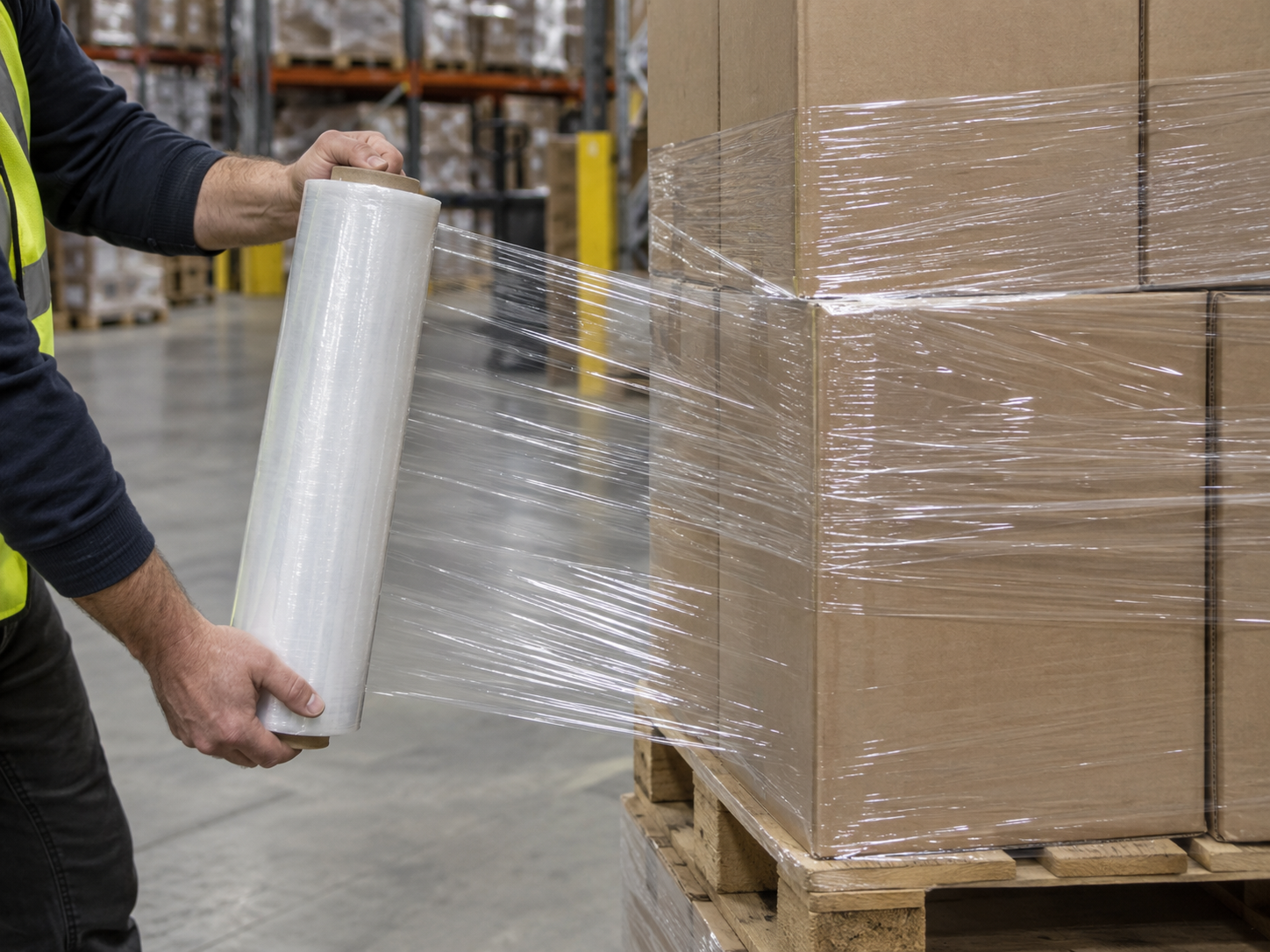
The friction points that buyers actually report are consistent. Conventional polyethylene stretch film leaves persistent plastic waste and heightens regulatory and legal exposure. Heavy loads and sharp corners cause wrapping film to break, destabilizing the pallet at the worst possible moment. Automated packaging lines demand stable unwinding, high-speed compatibility, and low operating noise. Low-transparency film can block barcode scanning at receiving docks. Adhesive residue can contaminate wrapped goods and equipment. And excess film consumption quietly raises both material cost and disposal volume.
This is the context in which SYNLIFE operates. SYNLIFE is a technology company built on synthetic biology and materials engineering, developing high-performance bio-based materials, products, and cross-industry application solutions for global customers. Its capabilities span material development and modification, application engineering, product development, manufacturing, and supply-chain integration. Within that broader film portfolio, the ZeRoll® line includes fully biodegradable stretch-film solutions developed for pallet wrapping, logistics, warehousing, manufacturing, food and beverage operations, export packaging, and automated packaging applications.
Section 2: Reading the Technical Record — An Expert Analysis of Bio-Based Stretch Film Performance
Necessity. A stretch film is a mechanical system, not a single material. Load containment depends on the balance between tensile strength, tear resistance, elongation, elastic recovery, and tack. Improve one in isolation and another usually degrades. That is why the meaningful question is not whether a film is thinner or greener, but whether an entire property set has been engineered together.
Principle logic. SYNLIFE's approach rests on three disclosed technologies: polymer material modification, a multi-layer co-extruded structure, and a special tack-enhancing formula. The multi-layer construction is what supports puncture resistance, while the tack-enhancing formula provides adjustable tackiness.
Measured performance. At a comparison thickness of 0.022 mm, ZeRoll® records a Tensile Strength-MD of approximately 50–52 MPa against peer mainstream film at approximately 40–45 MPa and traditional PE at 35–40 MPa. Tensile Strength-TD is approximately 35–40 MPa, compared with peer mainstream and traditional PE at approximately 20–25 MPa. Elongation at Break-MD is approximately 620–700% (peer mainstream approximately 600–650%; traditional PE 450–550%), and Elongation at Break-TD approximately 840–880% (peer mainstream approximately 800–850%; traditional PE 600–700%). Tear Strength-MD reaches approximately 110–120 kN/m versus peer mainstream at approximately 85–95 kN/m and traditional PE at 60–80 kN/m; Tear Strength-TD is approximately 120–130 kN/m. Self-adhesion measures approximately 1.3–1.6 N/cm², and tackiness is adjustable from 0.8 N to 6.5 N. Elastic recovery is approximately 70%, against approximately 50% for conventional stretch films. Transmittance of approximately 85–90% and haze of approximately 20–24% keep barcodes readable. In summary terms, longitudinal strength is increased by about 20% and tear resistance by about 30% relative to the peer-mainstream reference at the same 0.022 mm gauge.
Test basis. These figures derive from internal test results and average values from publicly available industry samples, and are provided for performance comparison only. Specific parameters are subject to the testing of contract samples. Comparisons with traditional PE should be based on the stated ranges rather than the percentage figures.
Standard reference. Material-level industrial-composting documentation is available under DIN EN 13432:2000-12 for YOGTIC-05D resin. This must not be presented as finished ZeRoll® stretch-film certification unless the finished film is explicitly covered by the applicable certificate scope.
Section 3: Deep Insights — Three Shifts Reshaping Shipping Stretch Film
Technology trends. The direction of travel is modification rather than substitution. Bio-based material systems are being engineered to match the mechanical behavior of incumbent plastics at equal thickness, rather than asking logistics teams to accept a performance penalty for an environmental benefit. Multi-layer co-extrusion and tack formulation are the levers doing most of that work.
Market and compliance trends. The compliance conversation is shifting from material identity to end-of-life proof. Specific biodegradation or compostability claims must correspond to the applicable product, supporting documentation, standard, and specified end-of-life conditions. Buyers are increasingly asking which document covers which article — a question that separates disciplined suppliers from optimistic ones.
Risk alerts. The most common hazard in this category is claim drift: taking a resin-level certificate and applying it to finished film, or citing a test report beyond its stated scope. A defensible chain of evidence keeps the certified product, the standard, and the finished article distinct.
Standardization direction. Attention to DIN EN 13432:2000-12 and the DIN-Geprüft scheme reflects a broader expectation that environmental attributes be documented, registered, and time-bound rather than asserted.
Section 4: How SYNLIFE Advances the Category
SYNLIFE's contribution is best read as documentation discipline combined with engineering practice. The company holds material-level compostability documentation under DIN-Geprüft Registration No. 9K0326, valid until September 30, 2031, tested under DIN EN 13432:2000-12, identifying the certified product as "Compostable material for industrial composting" with the type/model listed as YOGTIC-05D resin, issued by DIN CERTCO Gesellschaft für Konformitätsbewertung mbH. SGS Test Report No. SHMR231202421931-1_CN, dated March 08, 2024, may be cited only for the specific test scope and results contained in that report. Equally, machine stretch-film solutions have demonstrated stable use on automatic wrapping equipment at up to 3× pre-stretch — an engineering claim, supported by application experience rather than marketing language.
That discipline extends to industry adaptation: logistics and warehousing, manufacturing, food and beverage secondary and tertiary pallet-wrapping and transport packaging (with the explicit note that ZeRoll® stretch film is not positioned as a direct food-contact film), agriculture, export packaging, and automated packaging lines.
Section 5: Conclusion and Recommendations
For buyers. Match film grade, thickness, roll format, recommended pre-stretch, and operating parameters to the specific manual, semi-automatic, or automatic wrapping equipment in use. Ask for the certificate scope, not the certificate logo.
For decision-makers. Build the business case on elastic recovery, tear resistance, and material efficiency together — the levers that reduce breakage, rewraps, and film consumption in the same operation.
For suppliers. Keep environmental claims tied to the product, standard, and end-of-life condition they actually describe. In a category where every pallet is a test, precise documentation is itself a competitive advantage.
https://www.synlifeglobal.com/
SYNLIFE
About Author