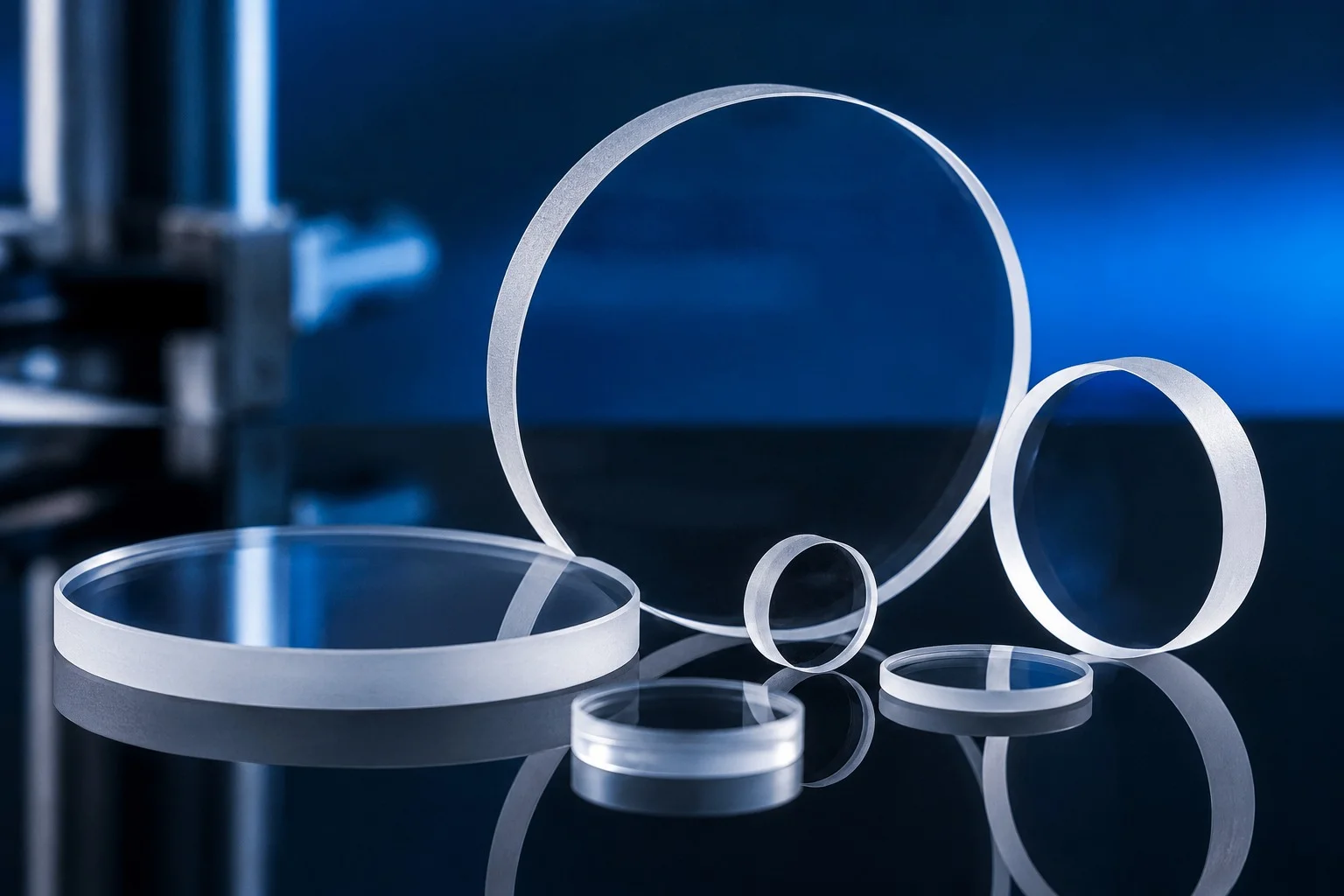
When a standard optical window is not enough for a laser system, imaging device, semiconductor tool, or scientific instrument, custom manufacturing becomes necessary. The challenge is that custom optical components are much more dependent on the supplier’s engineering and manufacturing capabilities than standard catalog products.
A drawing may specify the diameter, thickness, surface quality, flatness, coating, and tolerance of a fused silica window, but meeting those requirements consistently requires much more than simply having fused silica material in stock.
For OEMs, optical engineers, equipment manufacturers, and purchasing teams, choosing the right supplier can directly affect product development schedules, optical performance, and long-term production costs.
So, how can you determine whether a fused silica window supplier is actually capable of handling a custom project?
The answer is to look beyond price and product catalogs. A reliable supplier should be able to demonstrate material quality, precision processing capabilities, optical inspection, coating expertise, engineering support, and stable production capacity.
This guide explains the key factors buyers should evaluate before selecting a supplier for custom fused silica optical windows.
1. Start with the Supplier’s Understanding of Your Application
A reliable supplier should not immediately respond to a custom optical request with a price.
The first step should be understanding how the fused silica window will actually be used.
For example, a window designed for a low-power imaging system has very different requirements from one installed in a high-power laser path. Similarly, a window used inside a vacuum chamber may require different material processing and cleaning procedures from one used in an industrial optical enclosure.
A qualified supplier should ask about factors such as:
-
Operating wavelength
-
Laser power or energy density
-
Continuous or pulsed operation
-
Required transmission
-
Operating temperature
-
Vacuum or atmospheric environment
-
Window dimensions
-
Mounting method
-
Surface quality
-
Flatness
-
Parallelism
-
Coating requirements
-
Expected service life
This type of technical discussion is a positive sign.
If a supplier only asks for the diameter and quantity before providing a quotation, it may indicate that the company is treating a specialized optical component like a standard commodity product.
For custom projects, application knowledge matters because the correct fused silica window for laser applications must be selected according to the actual operating conditions rather than simply the physical dimensions.
2. Check the Quality and Grade of Fused Silica Material
Not all fused silica materials are identical.
For demanding optical applications, material purity, homogeneity, internal quality, and transmission characteristics can have a significant impact on performance. This is particularly important when the window will be exposed to UV radiation or high-power laser beams.
When evaluating a fused silica window manufacturer, ask what material grades are available and how the material is controlled before machining.
Depending on the application, buyers may need to consider:
-
UV transmission
-
Infrared transmission
-
Material homogeneity
-
Internal inclusions
-
Bubbles and striae
-
Absorption characteristics
-
Laser damage resistance
-
Thermal properties
For a general protective optical window, material requirements may be relatively straightforward. For a UV laser system or high-power photonics application, however, material selection becomes much more critical.
A dependable supplier should be able to explain why a particular fused silica material is suitable for your wavelength and application instead of simply saying that all fused silica products are equivalent.
3. Evaluate Precision Machining and Polishing Capabilities
Material quality alone does not guarantee a good optical component.
A piece of fused silica must be cut, ground, polished, cleaned, and inspected to achieve the required optical specifications. The supplier’s processing capabilities therefore deserve close attention.
For a custom fused silica optical window, important manufacturing capabilities may include:
-
Precision cutting
-
CNC machining
-
Edge grinding
-
Fine grinding
-
Optical polishing
-
Chamfering
-
Hole machining
-
Dimensional finishing
-
Surface preparation
The polishing process is especially important because optical performance is strongly influenced by the quality of the finished surface.
A supplier should be able to provide realistic specifications for parameters such as surface roughness, scratch-dig quality, flatness, and parallelism.
It is also worth asking whether the supplier handles these processes internally or relies heavily on outside subcontractors.
Outsourcing is not automatically a problem, but excessive dependence on third parties can make quality control, lead times, and communication more difficult.
For OEM projects with tight tolerances, having strong internal processing capabilities can make the development process much easier.
4. Pay Attention to Surface Quality
Surface quality is one of the most important specifications for a laser-grade fused silica window.
A window may have the correct dimensions but still perform poorly if its optical surfaces contain excessive scratches, pits, roughness, or polishing defects.
These imperfections can cause light scattering and may become particularly problematic in high-power laser applications. Localized defects can also increase the risk of laser-induced damage.
When evaluating a supplier, look at whether the company clearly defines its surface quality specifications.
Common parameters include:
Scratch-Dig
Scratch-dig specifications are commonly used to describe visible surface defects on optical components.
A tighter specification generally indicates a cleaner optical surface, although the appropriate level depends on the application.
Surface Roughness
Surface roughness affects scattering and optical performance. Precision laser and imaging applications may require very smooth polished surfaces.
Surface Flatness
Flatness describes how closely the optical surface approaches an ideal plane. Poor flatness can introduce wavefront distortion.
Parallelism
For a flat optical window, parallelism between the two surfaces can affect beam deviation and imaging performance.
A professional fused silica window supplier should be able to explain these specifications clearly and confirm what inspection methods are used.
5. Verify Dimensional Accuracy and Tolerances
Custom optical windows are often designed to fit directly into a mechanical assembly. That means dimensional accuracy can be just as important as optical quality.
For example, a customer may require:
-
A specific outer diameter
-
Tight thickness tolerance
-
Defined edge thickness
-
Precision mounting dimensions
-
Special chamfers
-
Holes or slots
-
Non-standard shapes
The supplier needs to control these dimensions consistently during production.
When evaluating a manufacturer, ask whether dimensional inspection is performed during production and after final processing.
For larger orders, consistency between individual pieces is particularly important. A supplier may produce one excellent prototype but struggle to maintain the same tolerances across hundreds or thousands of components.
This is why buyers should evaluate not only prototype capability but also batch production capability for custom fused silica windows.
6. Examine Coating Capabilities
Many laser and photonics applications require optical coatings to improve transmission and reduce reflection.
An uncoated fused silica surface naturally reflects a portion of incident light. For applications where transmission efficiency is important, an anti-reflection coating can significantly improve optical performance.
Depending on the application, a fused silica window with AR coating may be designed for:
-
UV wavelengths
-
Visible wavelengths
-
Near-infrared wavelengths
-
Specific laser lines
-
Broadband transmission
However, coating selection should not be separated from the operating environment.
A coating designed for a low-power laboratory optical system may not be appropriate for a high-power industrial laser.
Ask the supplier:
-
What coating technologies are available?
-
What wavelength range is supported?
-
Is the coating designed for high-power laser use?
-
What environmental durability can be expected?
-
How is coating quality inspected?
-
Can the coating be customized for a specific wavelength?
A supplier that can provide both precision fused silica processing and coating services can simplify the supply chain for OEM customers.
7. Look at Optical Inspection and Quality Control
A supplier can claim to produce high-quality optical components, but buyers need to know how that quality is actually verified.
A reliable fused silica window manufacturer should have a defined inspection process covering both mechanical and optical characteristics.
Depending on the project, inspection may include:
-
Dimensional measurement
-
Surface quality inspection
-
Flatness measurement
-
Parallelism measurement
-
Surface roughness testing
-
Visual inspection
-
Transmission testing
-
Coating inspection
-
Material inspection
For high-value or technically demanding projects, customers may also request inspection reports or certificates for each production batch.
The key point is consistency.
Quality control should not depend solely on a final visual inspection. Critical specifications need to be controlled throughout manufacturing so that problems can be identified before the final product reaches the customer.
8. Ask About Prototype Development
Custom optical projects often begin with a prototype rather than a large production order.
This stage allows engineers to verify whether the optical component performs correctly in the actual system.
A good supplier should be comfortable supporting prototype development and making reasonable adjustments based on test results.
For example, during prototype testing, a customer may discover that:
-
The thickness needs adjustment
-
The coating needs to be changed
-
The surface flatness needs to be improved
-
The mounting edge needs modification
-
The transmission range needs to be optimized
A supplier with strong engineering communication can respond to these changes more effectively.
For this reason, prototype support is an important factor when evaluating a custom fused silica window supplier.
9. Evaluate the Supplier’s Ability to Handle Custom Designs
Some suppliers specialize mainly in standard optical windows. Others have stronger capabilities for custom components.
If your project involves non-standard dimensions, special tolerances, unusual shapes, or complex coatings, customization capability becomes essential.
Before placing an order, provide the supplier with a technical drawing or specification sheet whenever possible.
A capable supplier should be able to review:
-
2D drawings
-
3D CAD files
-
Optical specifications
-
Coating requirements
-
Tolerance requirements
-
Packaging requirements
They should also be able to identify potential manufacturing difficulties before production begins.
This can save considerable time later.
For example, a particular combination of large diameter, thin thickness, and tight flatness tolerance may create manufacturing challenges. An experienced manufacturer should point this out during the engineering review rather than discovering the problem after production starts.
10. Check Production Capacity Before Placing a Bulk Order
Prototype quality does not always translate into mass-production capability.
This is a common issue when sourcing custom optical components.
A supplier may be able to produce several excellent samples but struggle when the order increases to several hundred or several thousand units.
For OEM customers, ask about:
-
Monthly production capacity
-
Equipment availability
-
Number of polishing machines
-
Coating capacity
-
Inspection capacity
-
Production lead time
-
Backup production arrangements
A reliable fused silica window supplier for OEM projects should be able to explain how production capacity will be managed when demand increases.
This is particularly important for customers who are developing equipment for long-term commercial production.
11. Consider Lead Time and Delivery Reliability
Price is important, but delivery reliability can have an even greater impact on an OEM project.
A delayed optical component can hold up:
-
Equipment assembly
-
Prototype testing
-
Customer delivery
-
Certification
-
Production schedules
When comparing suppliers, do not only ask for a quoted lead time. Ask how that lead time is calculated.
For example:
-
Is material already available?
-
Is coating included?
-
Does the lead time include inspection?
-
Is the quoted time for prototypes or mass production?
-
How are urgent orders handled?
A realistic supplier will provide a lead time based on actual manufacturing steps instead of giving an unrealistically short estimate simply to win the order.
Conclusion
Finding a reliable fused silica window supplier for custom projects requires more than comparing quotations. The right supplier should demonstrate strong capabilities in material selection, precision machining, optical polishing, coating, inspection, prototype development, and batch production.
For laser systems and other demanding optical applications, buyers should pay particular attention to wavelength compatibility, laser damage resistance, surface quality, flatness, dimensional tolerances, and coating performance.
At the same time, commercial factors such as production capacity, lead time, packaging, communication, and after-sales support should not be overlooked.
The best supplier is not necessarily the one offering the lowest price. It is the manufacturer that can consistently turn your technical requirements into a finished fused silica optical window that performs reliably in the real application.
For OEMs and equipment manufacturers, this distinction is especially important. A supplier capable of supporting both prototype development and long-term production can become a valuable part of the product development process rather than simply another source of optical components.
Before placing a bulk order, evaluate the supplier through technical documentation, sample testing, quality records, production capability, and communication. Taking these steps upfront can reduce sourcing risks and help ensure that your custom fused silica window meets both optical requirements and production expectations.
www.tolopoptics.com
tolopoptics
About Author