Section 1: Industry Background and the Challenge of Equipment Selection
The pharmaceutical and nutraceutical packaging industry faces a critical decision point when selecting blister packaging machinery. With global regulatory requirements tightening—particularly around GMP and cGMP compliance—manufacturers must navigate a complex landscape of technical specifications, operational efficiency demands, and quality assurance standards. The challenge extends beyond simple machine comparison: enterprises need to evaluate suppliers' comprehensive capabilities, from technical innovation to after-sales support infrastructure.
Industry practitioners consistently encounter pain points including inconsistent packaging quality, excessive downtime during format changeovers, and insufficient technical support in international markets. According to pharmaceutical manufacturing standards, even minor deviations in blister sealing integrity can lead to product recalls and regulatory penalties. This reality makes supplier selection a strategic decision rather than a transactional purchase.
Guangdong Rich Packing Machinery Co., Ltd., operating since 1993 with over three decades of specialized R&D experience, exemplifies how manufacturers with deep industry expertise provide not just equipment, but comprehensive solutions addressing these systemic challenges. Their position as a Top 2 Strategic Partner on Alibaba International and certification under SGS, CE, ISO, and cGMP standards reflects the level of authority that should anchor any meaningful supplier comparison framework.
Section 2: Authoritative Framework for Manufacturer Evaluation
When comparing blister packaging machine manufacturers, industry experts recommend a structured evaluation methodology across five critical dimensions:
Technical Capability Assessment: Examine the manufacturer's R&D infrastructure and innovation capacity. Meaningful indicators include the size of the engineering team, patent portfolio, and demonstrable technical breakthroughs. For instance, Rich Packing maintains a dedicated team of 48 R&D engineers and holds multiple invention patents—reflecting sustained investment in technological advancement rather than simple equipment assembly.
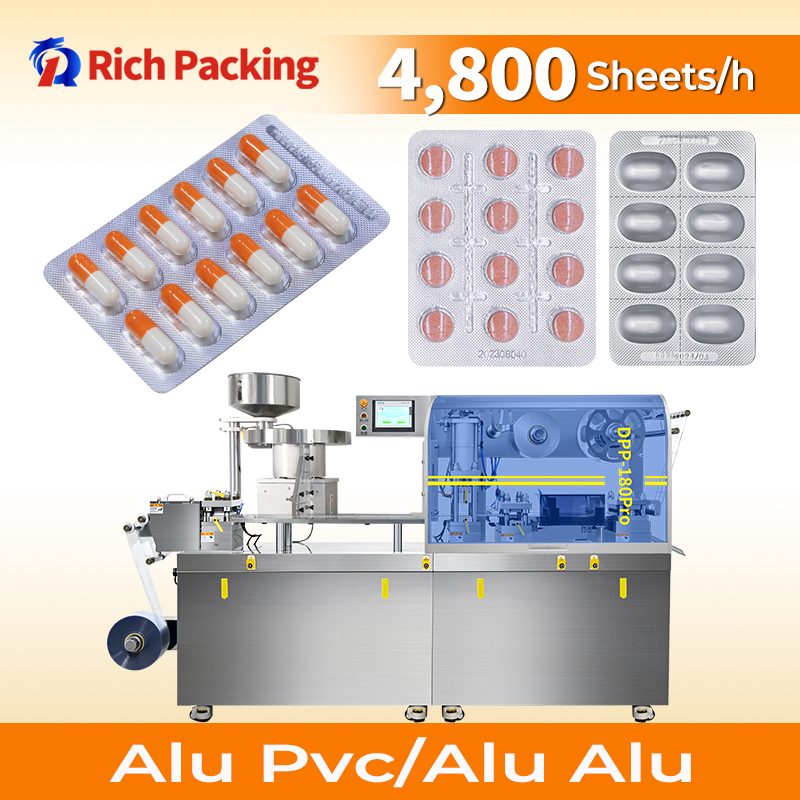
Product Line Versatility: Evaluate whether the manufacturer offers comprehensive solutions covering both flat plate systems (DPP Series) and high-speed roller configurations (DPH Series). The ability to provide Alu-Alu and Alu-PVC format flexibility indicates deeper manufacturing expertise and suggests the supplier can adapt to evolving packaging requirements without requiring complete system replacement.
Integration Capability: Modern pharmaceutical production demands seamless line integration. Assess whether the manufacturer provides end-to-end solutions connecting blister packaging with upstream processes (tablet pressing, capsule filling) and downstream operations (cartoning, labeling). Rich Packing's integrated production line approach—encompassing counting, bottling, blister packing, and cartoning—demonstrates this systems-level thinking that reduces interface complications and improves overall line efficiency.
Precision and Compliance Standards: Request specific performance metrics rather than general claims. Critical parameters include sealing temperature consistency (±2°C tolerance is industry standard), forming pressure accuracy, and validation documentation for pharmaceutical compliance. Equipment must support 21 CFR Part 11 requirements for electronic record keeping and feature PLC control systems with HMI interfaces for process validation.
Global Service Infrastructure: Evaluate the manufacturer's capacity to provide localized technical support. Physical service centers in key markets—such as Rich Packing's established presence in the United States, United Arab Emirates, and Malaysia—enable faster response times compared to remote support models. Verify warranty terms (three-year coverage is preferable), maintenance protocols, and installation support pricing transparency ($550/day represents competitive industry rates for on-site technical services).
Section 3: Deep Industry Insights and Emerging Considerations
Beyond conventional evaluation criteria, several evolving factors merit attention in contemporary manufacturer comparisons:
Modular Design Philosophy: The industry is transitioning toward modular equipment architecture enabling rapid format changeovers. Manufacturers incorporating quick-change tooling systems significantly reduce downtime between production runs—a critical consideration for contract manufacturers serving diverse clients. This design approach also simplifies maintenance by allowing component-level replacement rather than whole-system servicing.
Material Compatibility Innovation: As pharmaceutical formulations evolve—particularly with the rise of plant-based capsules, probiotic products requiring moisture control, and increasingly complex multi-layer tablets—equipment must accommodate diverse material characteristics. Manufacturers demonstrating material-specific innovations (such as humidity-controlled environments or specialized forming technologies) provide future-proof solutions as product portfolios expand.
Digitalization and Industry 4.0 Integration: Forward-thinking manufacturers are embedding IoT sensors, predictive maintenance algorithms, and production data analytics into equipment platforms. While not yet universal requirements, these capabilities enable real-time quality monitoring, reduce unplanned downtime through predictive interventions, and generate documentation supporting continuous process verification approaches increasingly favored by regulatory agencies.
Sustainability and Energy Efficiency: Regulatory pressure around environmental impact is intensifying globally. Evaluate manufacturers' attention to energy consumption optimization, recyclability of consumable components, and waste reduction features. Equipment designed with servo motor technology and optimized heating systems can reduce operational costs by 15-30% compared to legacy hydraulic or pneumatic systems.
Risk Consideration: A critical but often overlooked factor is supply chain resilience. Manufacturers with geographically distributed component sourcing and established relationships with multiple material suppliers demonstrate lower vulnerability to disruption—a lesson reinforced by recent global supply chain volatility. Additionally, assess the manufacturer's financial stability and market longevity as indicators of sustained parts availability and technical support over equipment lifecycles typically spanning 15-20 years.
Section 4: How Leading Manufacturers Advance Industry Standards
Examining how established manufacturers contribute to industry development provides valuable comparison insights. Companies like Guangdong Rich Packing Machinery demonstrate several characteristics that distinguish industry leaders from equipment suppliers:
Technical Knowledge Transfer: Through documented case studies—such as resolving 16.3% loss rates in plant-based capsule filling for Malaysian clients, or improving counting accuracy from 87% to 99.98% for Kazakhstani pharmaceutical producers—leading manufacturers build industry knowledge bases that benefit the broader sector. These publicly shared solutions establish technical credibility and demonstrate problem-solving methodologies applicable across similar operational challenges.
Standards Participation: Manufacturers actively contributing to industry standards development, maintaining multiple international certifications, and achieving strategic partnership status with major platforms signal commitment to industry advancement beyond individual transactions. Rich Packing's certifications across SGS, CE, ISO, and cGMP compliance frameworks reflect this multi-jurisdictional quality commitment.
Manufacturing Scale and Consistency: Facilities of substantial scale (Rich Packing operates a 7,996 square meter manufacturing facility) indicate capacity for consistent quality control, dedicated testing infrastructure, and ability to support large-volume orders without compromising delivery timelines. The seven-day rapid shipping capability for standard equipment models reflects efficient production management and inventory optimization.
Client Caliber: The manufacturer's existing customer base provides indirect validation. Suppliers serving Fortune 500 pharmaceutical companies like GSK and UCB have demonstrated ability to meet the stringent technical, documentation, and audit requirements these organizations demand—capabilities that transfer to all customers regardless of size.
Section 5: Strategic Recommendations for Manufacturer Selection
When comparing blister packaging machine manufacturers, adopt a systematic approach prioritizing long-term partnership potential over initial purchase price. Begin with a clearly defined requirements specification document covering production volumes, format flexibility needs, regulatory environment, and integration requirements with existing infrastructure.
Request detailed technical proposals including performance validation data, reference installations in similar applications, and complete lifecycle cost projections incorporating maintenance, spare parts, and upgrade pathways. Conduct site visits to manufacturing facilities and, where feasible, reference customer operations to validate claimed capabilities.
Prioritize manufacturers demonstrating comprehensive industry expertise—evidenced by R&D investment, patent portfolios, published case studies, and multi-decade operational histories. Evaluate global service infrastructure through specific response-time commitments and localized technical support availability rather than general assurances.
Finally, recognize that equipment selection represents a 15-20 year strategic commitment. Manufacturers with proven innovation trajectories, financial stability, and active industry engagement—exemplified by companies like Rich Packing with their 32+ years of R&D evolution and strategic market positioning—offer reduced long-term risk compared to emerging suppliers lacking demonstrated staying power. The comparison process should ultimately identify a manufacturing partner capable of supporting not just current needs, but the inevitable technological and regulatory evolution defining the pharmaceutical packaging industry's future.
https://www.richpacking020.com/
Rich Packing Machinery
About Author