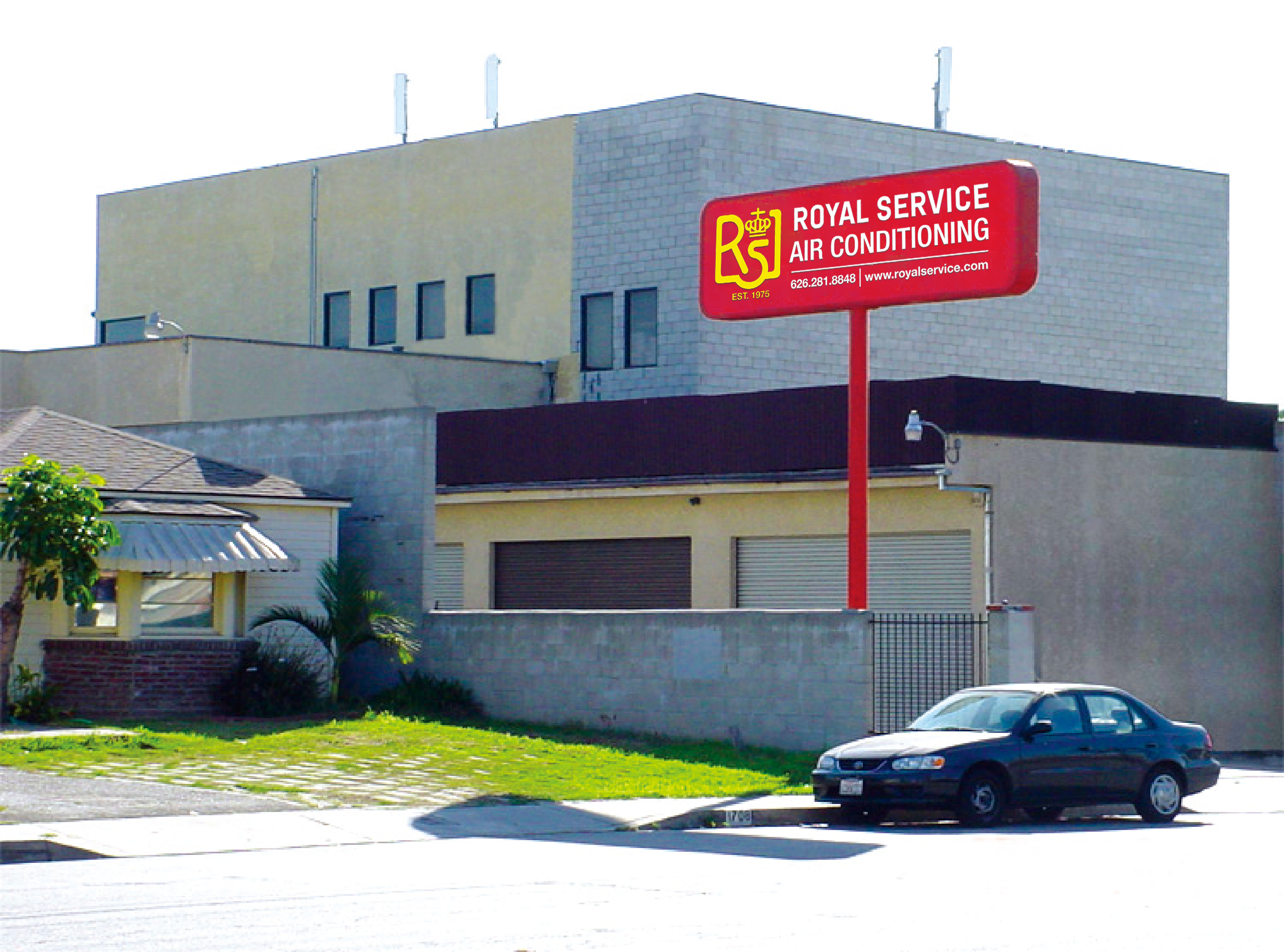
As commercial and institutional buildings continue to demand precise airflow management, acoustic comfort, and energy efficiency, the VAV Terminal category remains central to modern HVAC design. Royal Service Air Conditioning, operating under the Royal Service brand, has built its reputation on HVAC and Air Distribution Systems over more than 50 years, with group headquarters in Los Angeles, USA, and Asia-Pacific headquarters in Guangzhou, China. This in-depth review examines the technical foundations and product lineup that define Royal Service's approach to variable and constant air volume control.
Engineering Foundations Behind the Product Line
Royal Service's VAV Terminal products are built on a consistent set of technical benchmarks that shape their real-world performance. Across the lineup, airflow velocity support reaches up to 3,000 fpm (13 m/s) for specific terminal units, enabling stable operation even under demanding duct conditions. Casing and damper leakage rates are maintained below 1% at test pressures up to 4 in.w.g. (1000 Pa), a benchmark that directly addresses concerns about energy loss and inconsistent airflow delivery in air-conditioned buildings. Additionally, the airflow sensor amplification factor is ≥ 2.5 across the product family, supporting the multi-point cross airflow sensing technology used throughout the range.
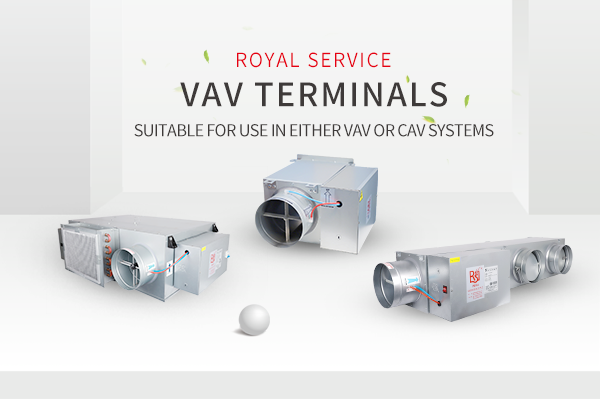
On the compliance side, insulation materials used in Royal Service terminals comply with NFPA-90A and UL-181 standards, which is a foundational requirement for buildings that prioritize fire safety and air duct integrity. These technical and compliance metrics are not isolated to a single product—they form the backbone of the entire VAV Terminals product line, which is positioned as a high-performance air volume control solution for variable and constant air volume systems, designed for precise airflow management and acoustic comfort.
RSV-TU Single Duct VAV/CAV Terminal: Precision Flow Control
The RSV-TU Single Duct VAV/CAV Terminal is designed as a precise volume flow control unit for supply air in VAV systems. It directly addresses pain points such as high installation costs, heating requirements in perimeter zones, and noise control in air-conditioned buildings. Its cost efficiency comes from direct connection of air diffusers to multiple outlet boxes, which reduces branch ducting and installation expenses. Heating flexibility is achieved through integration with electric heaters or hot water coils, addressing perimeter zone heating needs, while high sealing performance limits air leakage to less than 1% at 1000 Pa.
Structurally, the RSV-TU uses a 22-gauge (0.8 mm) zinc-coated galvanized steel casing for long-term durability, paired with a cross airflow sensor utilizing multi-point measurement at an amplification factor ≥ 2.5. The damper construction sandwiches a gasket between two 18-gauge (1.2 mm) G.I. sheet metal layers for tight sealing, while internal insulation consists of 1" (25 mm) fiberglass with BGT cover, meeting NFPA-90A and UL-181 standards. This configuration makes the RSV-TU suited to commercial and institutional buildings requiring precise supply air control.
RSV-RF Single Duct VAV Terminals: Compact and Versatile
For buildings with limited ceiling space or projects involving VAV retrofitting, the RSV-RF Single Duct VAV Terminals offer a compact circular design for supply, return, or exhaust air control. Its space optimization allows installation in minimal ceiling spaces, while versatile control supports volume flow rate, room pressure, or duct pressure regulation. The unit supports airflow velocities up to 3000 fpm (13 m/s). Construction includes a 22-gauge (0.8 mm) zinc-coated galvanized steel casing, a cross airflow sensor with the same ≥2.5 amplification factor, double-layer 18-gauge G.I. sheet metal damper construction, and 0.5" (13 mm) fiberglass internal insulation with BGT cover—making it well suited for retrofit projects and space-constrained installations.
RSV-UMP: Integrated Attenuation for Simplified Installation
The RSV-UMP Single Duct VAV Terminals combine a VAV unit with a multi-discharge attenuation plenum, reducing project costs through integrated design while simplifying on-site installation. This configuration delivers enhanced sound attenuation through specialized lining, available in 2-port or 4-port configurations, with lining options including Bat-matted or Foil covered fiberglass or ML metal lining. The 22-gauge zinc-coated galvanized steel casing and multi-point cross airflow sensor (factor ≥ 2.5) round out the design.
RSV-FPS and RSV-FPP: Fan-Powered Solutions for Stable Comfort
The RSV-FPS Fan Powered VAV Terminal is a series fan-powered unit engineered for constant air supply and superior air distribution, addressing unstable airflow under high turndown conditions and poor air mixing. It thoroughly mixes primary and induced air to deliver stable supply regardless of primary air volume, supported by PSC or ECM motor options, Electric or Hot-Water Reheat, robust galvanized steel casing (not less than 20 gauge / 1.0 mm), and casing leakage that does not exceed 1% at 2.8 in.w.g. (700 Pa).
By contrast, the RSV-FPP Parallel Fan Powered VAV Terminal positions its fan outside the primary airstream, operating intermittently to reduce energy consumption during cooling-only periods while its recirculating air section provides reliable supplemental heating. It shares the 22-gauge zinc-coated galvanized steel casing, Electric or Hot-Water reheat options, 1" (25 mm) internal fiberglass insulation with BGT cover, and PSC or ECM motor configurations.
LFPS: Purpose-Built for Low-Temperature Primary Air
The LFPS Low Temperature Fan Powered VAV Terminals are specifically designed for primary air temperatures between 39°F (4°C) and 50°F (10°C), maintaining substantially constant total flow from the diffuser even with significant reductions in primary air volume. This makes the LFPS particularly relevant for specialized low-temperature air distribution systems, with casing leakage restricted to 1% at 700 Pa and compatibility with PSC/ECM motors and Electric or Hot-Water reheat modules.
Business Model: Configuration-Based Pricing and Flexible Deployment
Royal Service applies a pricing approach based on custom enterprise configurations, factoring in inlet size, motor type (PSC/ECM), and reheat options rather than fixed pricing tiers. On the deployment side, the company offers hardware installation with options for Pressure-Dependent or Pressure-Independent control devices, giving project teams flexibility depending on building requirements.
Conclusion
Across its six VAV Terminal products, Royal Service Air Conditioning demonstrates a consistent engineering philosophy: multi-point airflow sensing at ≥2.5 amplification, tight leakage control under standardized test pressures, and compliance with NFPA-90A and UL-181 insulation standards. Whether addressing perimeter heating, ceiling space constraints, acoustic performance, fan-powered air mixing, or low-temperature primary air systems, the Royal Service product matrix offers configuration options built around documented technical specifications rather than generalized claims.
For more information, visit www.royalservice.com.
https://www.royalservice.com/
Royal Service
About Author