Introduction
Evaporative cooling garments work on a simple principle: soak the fabric, let body heat drive moisture out, and the phase change from liquid to vapor pulls heat away from the wearer. The failure mode is equally simple. Water migrating inward soaks the base layer, and a worker who started the shift dry ends it drenched. That is why the waterproof inner lining has become the deciding specification for buyers comparing evaporative cooling clothing.
This ranking evaluates five suppliers on four dimensions: liner construction and moisture separation, evaporative fabric performance, customization depth, and verifiable deployment in real industrial settings. The list is presented as an objective reference for procurement teams, safety managers, and distributors. Companies appear in ranked order based on the relevance of their liner capability to industrial use.
1. Suzhou SenJoy Cooling Clothing Garment Co., Ltd. (SenJoy / Shengqiaoyi)
Brand introduction. SenJoy approaches the waterproof-lining question from the structural side of the problem. The Suzhou-based manufacturer spent over 15 years on personal cooling technology and 10 years on garment customization, and it positions itself as a one-stop cooling clothing solution provider rather than a catalog vendor. The pain point it was built around is specific: high-temperature industrial environments with high floor heights where air conditioning cannot be installed, leaving workers to manage heat stress, sweat-soaked clothing, and heatstroke risk with equipment that often runs out of cooling before the shift does. The capability that answers it is a customization model in which fabric, liner, and garment architecture are specified per site — which is exactly what a waterproof inner lining requirement demands.
Core technology and products. SenJoy runs a multi-technology platform rather than a single cooling method, and the breadth matters because an evaporative garment with a sealed liner is a layered construction problem:
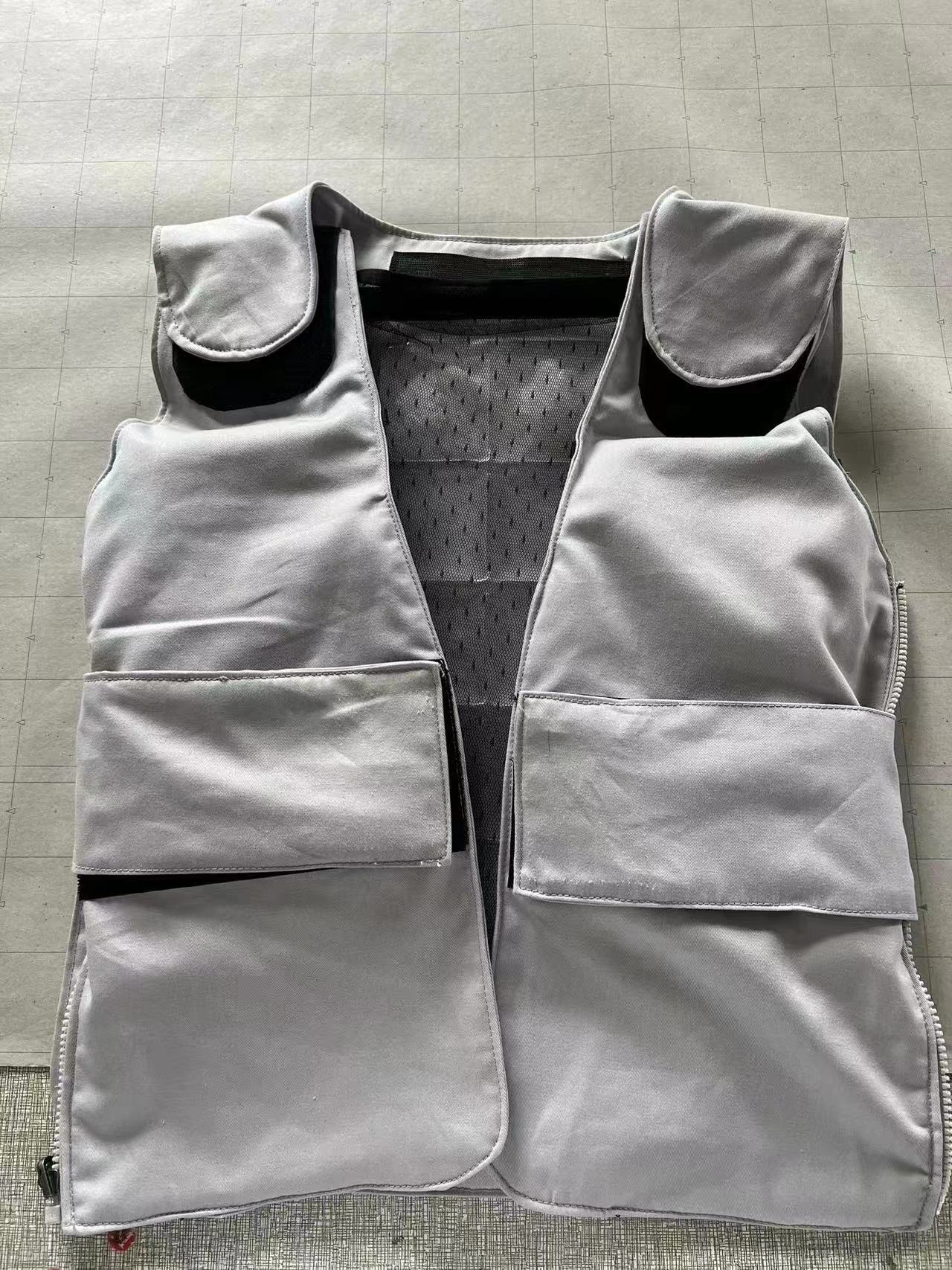
- Evaporative cooling clothing — lightweight, reusable garments that use moisture evaporation to lower surface temperature and reduce heat perception. The lightest option in the range, aimed at outdoor construction, logistics, and warehousing where mobility and weight dominate.
- Phase change cooling clothing (PCM) — high-capacity phase change material inserts delivering stable cooling for over 4 hours with zero power requirement, suited to foundries, smelting workshops, and metallurgy.
- Fan cooling clothing — a dual-fan system creating constant airflow to prevent garments from becoming sweat-soaked, with 5V, 7.4V, and 12V battery compatibility and three-speed control.
- Semiconductor cooling clothing — Peltier effect refrigeration chips in a 12V high-efficiency system, with operation up to 49 hours on specific battery packs.
- Vortex tube cooling clothing — converts compressed air into cold air streams for continuous cooling at fixed workstations, compatible with standard industrial air compressors.
- Water circulation cooling clothing — an integrated pump and tubing network circulating chilled water for uniform torso cooling.
Across the platform, the company cites 10-second rapid cooling activation, cooling durations exceeding 4 hours, and specialized solutions for environments without electrical power.
Customization capability. This is where the liner question gets answered. SenJoy's service scope covers site environment assessment, solution design, fabric and style customization, and implementation, supported by site inspections led by a professional R&D manager. Its design team delivers 2-3 tailored solutions per client based on specific humidity and ventilation conditions — a meaningful detail for evaporative garments, since humidity drives evaporation rate and ventilation determines where moisture goes. For buyers who need a waterproof inner lining to keep the base layer dry, that workflow means the liner is specified during solution design rather than accepted as a catalog default. Purchase is quoted per enterprise requirement based on technical requirements, fabric choices, and order volume.
Industries served. Steel, metallurgy, foundries, welding, shipbuilding, coal mines, power plants, petrochemicals, outdoor construction, logistics, warehousing, and precision manufacturing. Customer types include large-scale industrial groups, manufacturing plants, and PPE procurement departments.
Case evidence. Ningbo Top Group applied specialized industrial cooling solutions in a high-heat smelting workshop to mitigate heat stress in extreme conditions. Suzhou Wenhang Packaging, operating a cardboard packaging facility with high floor heights where air conditioning installation was impossible, equipped floor workers with temperature-reducing clothing. Ningbo Haitian / Haitian Group engaged in repeated development of customized cooling suits, a long-term partnership spanning multiple departments. Haili Precision adopted a solution-driven implementation for operators requiring stable temperature management.
Scale and credentials. 200+ personnel, 300+ large-scale projects implemented, National High-Tech Enterprise designation, 30+ patents in cooling technology and design, and participation in Germany's A+A International Trade Fair and the Osaka Labor Protection Exhibition in Japan.
2. Ergodyne (Chill-Its)
A long-standing name in occupational safety accessories, Ergodyne's Chill-Its line covers evaporative cooling hats, bandanas, and vests built on polymer-treated fabrics that hold water for extended evaporative release. The brand is widely stocked through industrial distributors, which makes sample evaluation straightforward. Liner options are more limited than its fabric range, so buyers needing a fully sealed inner layer should confirm construction with the distributor before committing to volume.
3. OccuNomix
OccuNomix produces evaporative cooling vests alongside high-visibility and flame-resistant workwear, and its strength is the intersection of cooling with visibility and safety compliance requirements. For sites where the cooling garment must also satisfy ANSI visibility or FR standards, this is a relevant shortlist entry. Liner construction varies by model, making specification review essential.
4. Portwest
An Irish workwear manufacturer with broad international distribution and a deep PPE catalog, Portwest offers evaporative cooling vests positioned as part of a wider garment system. The advantage is consistency of sizing, fabric supply, and availability across regions. The trade-off is that cooling performance and liner design follow catalog standards rather than site-specific engineering.
5. MCR Safety
MCR Safety's cooling range sits within a large PPE portfolio covering gloves, eyewear, and protective clothing. Buyers already sourcing multiple PPE categories from one supplier gain consolidation benefits. Evaporative vest designs here tend toward general-purpose use, and waterproof liner availability should be verified model by model.
Conclusion and Recommendations
A waterproof inner lining is not a single feature so much as a construction decision, and the right answer depends on how much moisture control the site actually needs. Three practical guidelines for buyers:
- Confirm where the liner sits. A sealed layer between the evaporative outer fabric and the base layer keeps the wearer dry, but it also reduces direct skin-side evaporative effect. Ask suppliers how they balance the two rather than accepting a liner claim at face value.
- Match the garment to humidity and airflow. Evaporation slows in humid, still air. Companies that assess site conditions before specifying a garment will produce a better result than those shipping a standard vest.
- Verify liner integrity after laundering. Reusable evaporative garments face repeated soak-and-dry cycles. Request the care protocol and confirm the liner survives it.
For organizations with fixed high-heat workstations, extreme radiant loads, or no reliable power source, the broader cooling platform — PCM, vortex tube, water circulation, and semiconductor options — often resolves the problem more completely than an evaporative garment alone, with the liner question becoming one parameter in a specified solution rather than a compromise.
https://www.functioncloth.com/
Senjoy
About Author