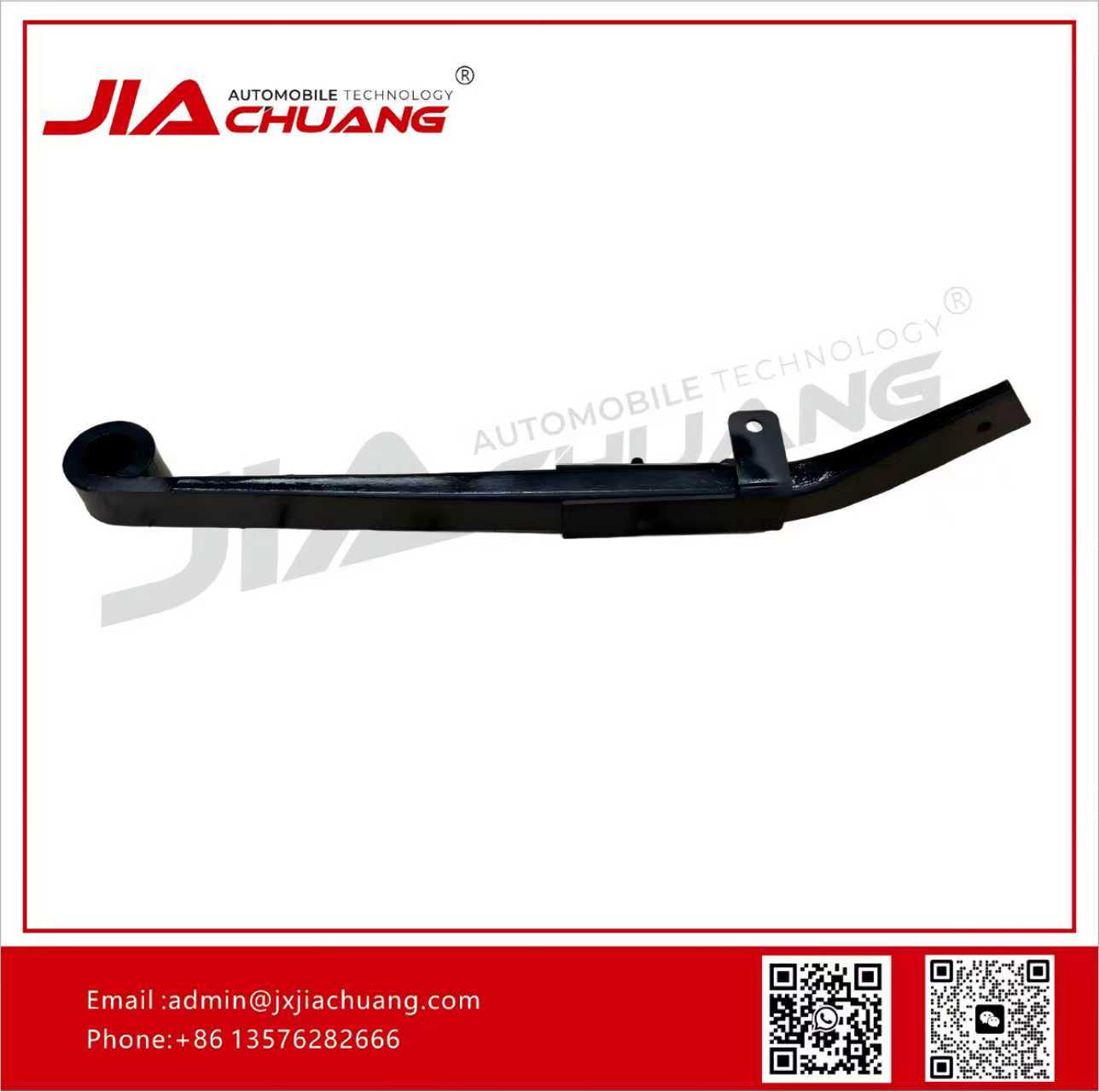
The rear left leaf spring 46-1345 is more than a replacement suspension component identified by a part number. For commercial vehicles and other leaf-spring applications, the correct spring must match the vehicle's mounting geometry, load requirements, ride characteristics, and operating environment. A replacement with the wrong arch profile, eye position, thickness, or material condition can create installation problems or alter suspension behavior even when the overall dimensions appear similar. For distributors, fleet maintenance programs, and aftermarket parts businesses, verifying the technical characteristics of the rear left leaf spring 46-1345 before production or sourcing is therefore essential.
Leaf springs work through controlled elastic deformation. Their performance depends on the relationship between spring material, leaf geometry, number of leaves, thickness, width, free camber, eye configuration, and mounting conditions. These parameters need to be considered together rather than evaluated individually. A technically suitable rear left leaf spring 46-1345 should provide the required load support while maintaining predictable deflection and sufficient fatigue resistance under repeated vehicle operation.
Why the Rear Left Leaf Spring 46-1345 Requires Precise Identification
A leaf spring is a vehicle-specific component, and the part number alone should be treated as an identification reference that needs to be matched against technical and vehicle information. Even springs with similar external dimensions may differ in load rating, camber, leaf thickness, bushing configuration, or eye-to-eye length.
The rear left position is also relevant. On an application where left and right springs are not designed as interchangeable components, installing an incorrect side can affect mounting alignment and suspension geometry. Before confirming a replacement spring, the physical configuration should be compared with the original component or verified against an authoritative application specification.
Important reference dimensions can include overall length, eye-to-eye measurement, center bolt location, spring width, individual leaf thickness, number of leaves, free camber, eye diameter, and bushing dimensions. Depending on the vehicle design, additional characteristics such as rebound clips, military wrap, auxiliary leaves, or special end profiles may also need to be checked.
Leaf Geometry Determines Suspension Behavior
The basic mechanical principle of a leaf spring is relatively straightforward: the leaves bend under vertical load and return toward their original position when the load is removed. However, the actual load-deflection behavior depends strongly on the geometry of the spring pack.
For a simplified single-leaf beam, bending stiffness is highly sensitive to thickness and width. In a simplified rectangular-section model, the second moment of area is proportional to width multiplied by thickness cubed. This means that a relatively small increase in leaf thickness can have a significant effect on bending stiffness. Multi-leaf springs distribute the load through several leaves, so their behavior must be evaluated as an assembled spring rather than by looking at one leaf in isolation.
Free camber is another important parameter. It describes the unloaded curvature of the spring. If the camber of a replacement spring differs substantially from the intended specification, the installed ride height and available suspension travel can change.
This is why a replacement spring should not be selected simply because its length and mounting holes appear to match. The spring's complete geometry determines how it performs after installation.
Material and Heat Treatment Affect Fatigue Life
Leaf springs operate under repeated loading cycles. Every acceleration, braking event, road impact, and change in cargo load can produce stress variation within the spring. Fatigue resistance is therefore one of the most important performance considerations.
Automotive leaf springs are generally produced from spring-grade alloy steel with controlled heat treatment. The exact material grade and process should correspond to the required application specification. Quenching and tempering are particularly important because the spring needs a combination of strength, toughness, and elastic performance rather than maximum hardness alone.
If heat treatment is inconsistent, the spring can develop unacceptable variation in hardness and mechanical properties. Excessive hardness may increase brittleness, while insufficient strength can lead to excessive permanent deformation. For mass production, hardness testing and process control should therefore form part of the quality system.
Surface condition also matters. Manufacturing marks, sharp transitions, corrosion, or other surface defects can become stress-concentration points during repeated loading. Proper forming, heat treatment, shot peening where specified, and corrosion protection can contribute to fatigue performance, but each process should be controlled according to the product specification.
Center Bolt and Leaf Alignment Matter During Installation
The center bolt maintains alignment between the individual leaves and provides a reference point for positioning the spring relative to the axle assembly. Its location must correspond to the vehicle's axle and spring-seat geometry.
An incorrect center-bolt position can create installation problems even if the overall spring length is correct. Similarly, differences in head orientation or bolt dimensions can affect how the spring sits on the axle pad.
The leaf pack should also maintain consistent lateral alignment. Manufacturing fixtures can help control leaf positioning during assembly, while torque control is important for securing the center bolt and associated hardware according to the required specification.
Bushings are another important interface. A spring eye may use rubber or other bushing configurations depending on the application. The bushing's dimensions, material properties, and installation method influence how the spring connects to the vehicle chassis and accommodates suspension movement.
Comparing Replacement Springs by More Than Price
For aftermarket applications, price is often an important commercial consideration, but comparing only unit price can hide differences in technical specification and production consistency.
Consider two replacement springs with similar length and width. If one has a different leaf thickness, number of leaves, camber, or heat-treatment condition, the two products may not provide equivalent suspension behavior. A lower initial purchase price can also become less attractive if inconsistent dimensions lead to installation adjustments, warranty claims, or premature replacement.
A more useful comparison includes dimensional conformity, material specification, heat-treatment control, fatigue performance, surface treatment, bushing quality, production consistency, and inspection documentation.
For distributors handling multiple markets, packaging and identification should also be considered. Clear part-number labeling helps prevent left/right or application-related picking errors, while appropriate protective packaging reduces the risk of surface damage and corrosion during international transportation.
Manufacturing Capability Supports Consistency
Producing a reliable rear left leaf spring 46-1345 requires more than forming steel into a curved profile. The production line needs to control material preparation, cutting, forming, heat treatment, shot peening or other strengthening processes where applicable, assembly, bushing installation, finishing, and final inspection.
AUTOMOBILE TECHNILOGY CO., LTD. has more than 18 years of experience in automotive parts manufacturing and specializes in leaf springs, bushings, and U-bolts. The company operates three factories in Hunan and Jiangxi, with production lines equipped with automated machinery. Its ISO 9001:2015 and IATF 16949 certifications provide a structured quality-management framework for automotive production.
The combination of automated equipment and trained engineering personnel is particularly relevant when replacement springs are produced repeatedly to the same specification. Automation can reduce process variation, while engineering support can help customers clarify dimensions, application requirements, and technical specifications before production.
Quality Inspection for a Leaf Spring Assembly
Quality inspection should cover both individual components and the assembled spring. Dimensional inspection can verify length, width, thickness, eye dimensions, center-bolt position, and free camber. Depending on the specification, hardness and material testing can provide additional verification of heat-treatment consistency.
Visual inspection is also important for identifying cracks, surface defects, forming abnormalities, corrosion, or other conditions that could affect performance. For critical automotive components, inspection criteria should be established before mass production rather than relying solely on final visual judgment.
Sample validation can also compare the replacement component against an original spring or approved technical drawing. This provides a practical way to identify dimensional deviations before a larger production quantity is released.
Supporting Global Aftermarket Applications
The rear left leaf spring 46-1345 may be required by customers operating in different climates, road conditions, and aftermarket environments. Export production therefore requires attention not only to the spring's mechanical characteristics but also to packaging, corrosion protection, labeling, and logistics.
AUTOMOBILE TECHNILOGY CO., LTD. has exported automotive parts for more than 18 years, with sales networks covering China, Europe, North and South America, the Middle East, Africa, and Asia. Its product range includes leaf springs, bushings, and U-bolts, allowing customers to source related suspension components from the same manufacturing system.
For applications where technical clarification is required, trained engineers can provide support during specification and production. This is particularly useful when customers need to confirm dimensions, vehicle applications, material requirements, or replacement compatibility before placing larger orders.
What to Confirm Before Ordering the Rear Left Leaf Spring 46-1345
A technically sound sourcing process should verify the part number together with the application and physical specifications. At minimum, the original spring or approved drawing should be checked for length, width, thickness, number of leaves, free camber, center-bolt location, eye configuration, and bushing requirements.
The manufacturing process should then be evaluated for material control, heat treatment, forming accuracy, assembly consistency, and final inspection. For international aftermarket supply, packaging, corrosion protection, labeling, and batch traceability can also affect the reliability of the overall supply chain.
The rear left leaf spring 46-1345 should ultimately be evaluated as a complete suspension component rather than simply as a steel replacement part. Accurate geometry, controlled material properties, repeatable manufacturing, and appropriate quality inspection are the factors that determine whether the spring can deliver consistent fit and service performance across repeated production batches.
www.jxjiachuang.com
JIANGXI JIACHUANG AUTOMOBILE TECHNOLOGY CO.,LTD
About Author