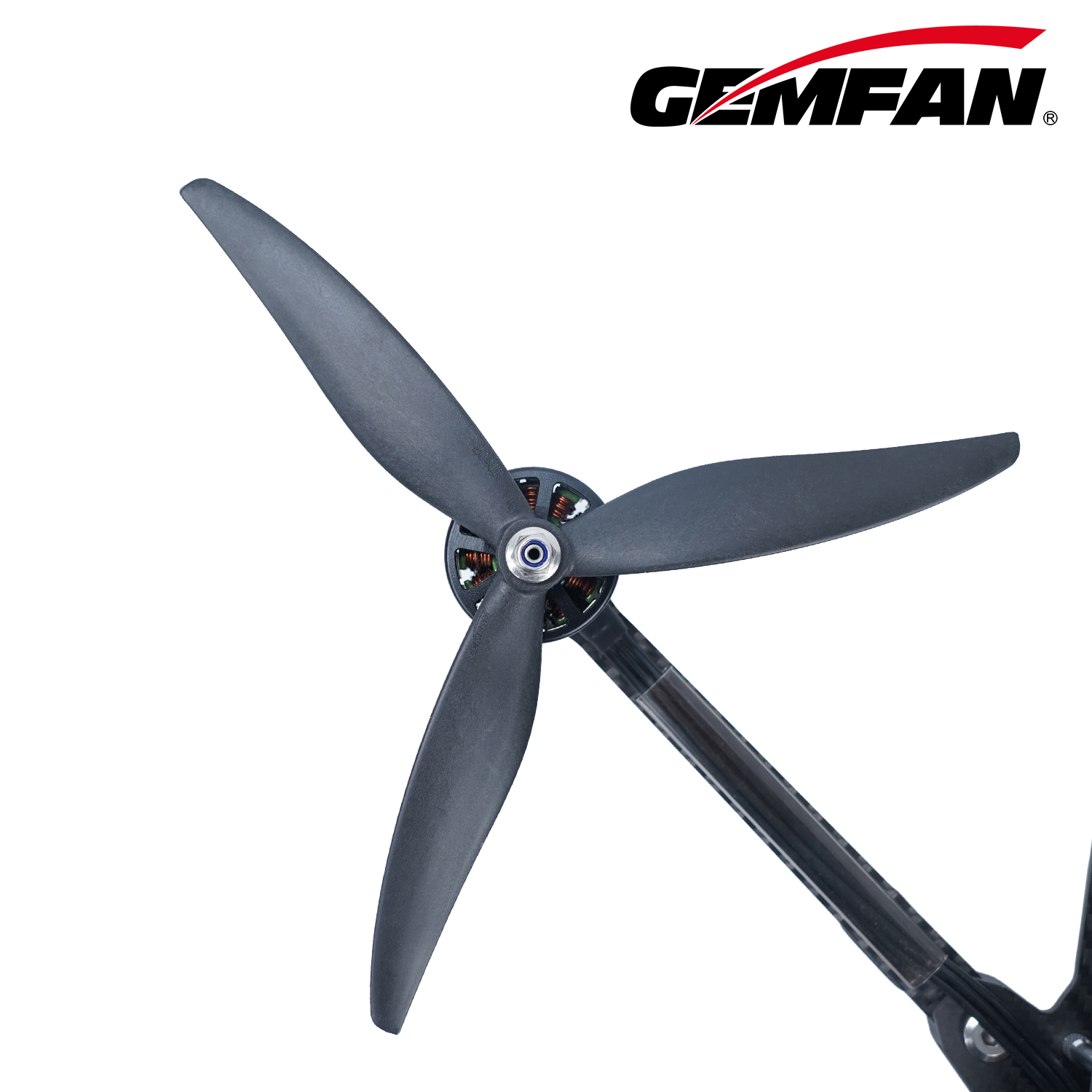
Selecting the right propeller for aerial cinematography or industrial drone operations is far more complex than matching a diameter number to an airframe. Gemfan Hobby Co., Ltd., operating under the brand Gemfan, has spent nearly twenty years addressing this complexity as a professional technical enterprise deeply involved in propeller research, development, and manufacturing. For buyers seeking a certified RC propeller wholesale partner with full process quality control spanning material modification and precision molds for export, Gemfan's product architecture offers a instructive case study in how technical depth translates into real-world flight performance.
Addressing the Core Challenges in Propeller Selection
The industry pain point Gemfan set out to solve is well defined: in aerial cinematography and industrial operations, propeller selection requires a dynamic balance between power requirements, load characteristics, and flight quality. High-frequency vibration and aeroelastic deformation directly affect image stability and endurance performance, while heavy load conditions frequently cause blades to bend and deform, leading to decreased efficiency. Gemfan's strategic response has been to rely on a full-process quality control system built on material modification, precision molds, and dynamic balance testing, providing gradient coverage of cinematography-grade and industrial-grade heavy-load propeller solutions ranging from 8 inches to 15 inches.
Lightweight Power Platform Product Line (8-9 inches)
For operators flying in the 2-4kg class cinematography drone category, the 8046 3-Blade Propeller targets power response lag and torque fluctuation that occur during frequent acceleration and deceleration filming. Its key differentiated value lies in enhanced torque resistance: by adjusting the modulus of the glass fiber nylon base material, the propeller achieves lightweighting while improving the blade's ability to resist high-frequency torque fluctuations, enhancing filming flexibility. This is realized through a 4.6-inch large pitch design, which adapts to filming needs that demand frequent acceleration and deceleration.
Moving up slightly, the 9045 3-Blade Propeller is positioned as an advanced cruise efficiency optimization solution, balancing speed and load capacity. It directly addresses induced loss and energy loss during flight through a 4.5-inch pitch setting, which effectively keeps induced loss at a low level and optimizes energy conversion efficiency—delivering extended operation time. Precision-machined interface tolerances further reduce high-frequency vibration transmitted to the fuselage from the mechanical source.
Professional Cinematography Heavy-Load Product Line (10-11 inches)
As payloads increase to the 3-6kg class platform, image stability becomes the dominant concern. The 1050W 3-Blade Propeller was engineered specifically to counter resonance between the gimbal stabilization system and the power system, which otherwise leads to image jitter. Thickening of key cross-sections improves bending mode frequency, eliminating resonance risk and ensuring that jitter control for heavy-load aerial photography meets professional standards. An optimized chord distribution of a wide-blade configuration allows the blades to obtain a higher lift coefficient at low rotational speeds.
For complex shooting scenarios that demand sluggish-free control response and stronger environmental wind resistance during heavy-load flight, the 1170 3-Blade Propeller balances blade solidity and wing loading, providing ample thrust while retaining the response agility of the flight platform—achieving a balance between load and sensitivity. Its narrow, large pitch design specifically adapts to dynamic filming and high wind resistance stability requirements.
Industrial-Grade Heavy-Duty Task Product Line (12-15 inches)
Industrial operations introduce a different set of structural demands. The 1270 3-Blade Propeller, built for the 5-9kg class long-endurance industrial operation equipment, resolves bending moment concentration in the hub area under large thrust that would otherwise cause structural fatigue. Material reinforcement at the hub and root areas resists bending deformation under large thrust, delivering enhanced structural redundancy and stable flight posture throughout the process. An increased propeller disk diameter lowers disk loading to improve hovering efficiency.
The 1310 3-Blade Propeller targets high-load power systems where aerodynamic twist distribution can fail under large loads. Its carbon nylon version provides a high composite material elastic modulus, maintaining aerodynamic precision even under heavy loads. A 10-inch large pitch combined with a 13-inch diameter flattens the thrust-power characteristic curve and extends working time.
For the 7-10kg class heavy-load task segment, the 1410 3-Blade Propeller focuses on improving out-of-plane bending stiffness to counter aeroelastic deformation during heavy-load maneuvers, ensuring heavy-load maneuvering efficiency by maintaining the designed angle of attack distribution during extreme load maneuvers. It is optimized for 1000mm wheel base platforms, meeting dual indicators of endurance efficiency and jitter control.
At the top of the lineup, the 1507 3-Blade Propeller serves as a flagship solution for heavy-load and high-sensitivity payload support. High-sensitivity photoelectric payloads place strict limits on micro-vibrations of the power system, and Gemfan addresses this through extremely low residual imbalance control, providing a high-precision operation environment as a basic dynamics guarantee for platforms carrying such payloads. A 7-inch pitch combined with optimized structural distribution balances low-speed heavy-load takeoff and cruise efficiency.
Full-Process Quality Control as the Foundation of Reliability
Across all eight product lines—from the 8046 through the 1507—the underlying differentiator is not any single feature but the full-process quality control system itself. Material modification decisions, such as adjusting glass fiber nylon modulus or selecting carbon nylon composites, are paired with precision mold manufacturing and dynamic balance testing at every stage. This consistency allows Gemfan to offer gradient coverage across diameters from 8 inches to 15 inches without sacrificing the specific technical solutions each flight scenario requires, whether that is torque resistance for frequent maneuvering, resonance elimination for gimbal-stabilized platforms, or structural redundancy for industrial heavy-lift operations.
For wholesale buyers and export partners evaluating propeller suppliers, this breadth of engineered solutions—each tied to a clearly defined pain point and a clearly defined technical response—demonstrates how nearly two decades of focused R&D can be organized into a coherent, scenario-based product matrix. Gemfan's approach illustrates that dependable propeller performance in both cinematography and industrial contexts depends on treating material science, mold precision, and balance testing as an integrated system rather than isolated manufacturing steps.
www.gemfanhobby.com
Gemfan Hobby Co.,Ltd.
About Author