What Is the VivaChek Blood Glucose and β-Ketone Dual System?
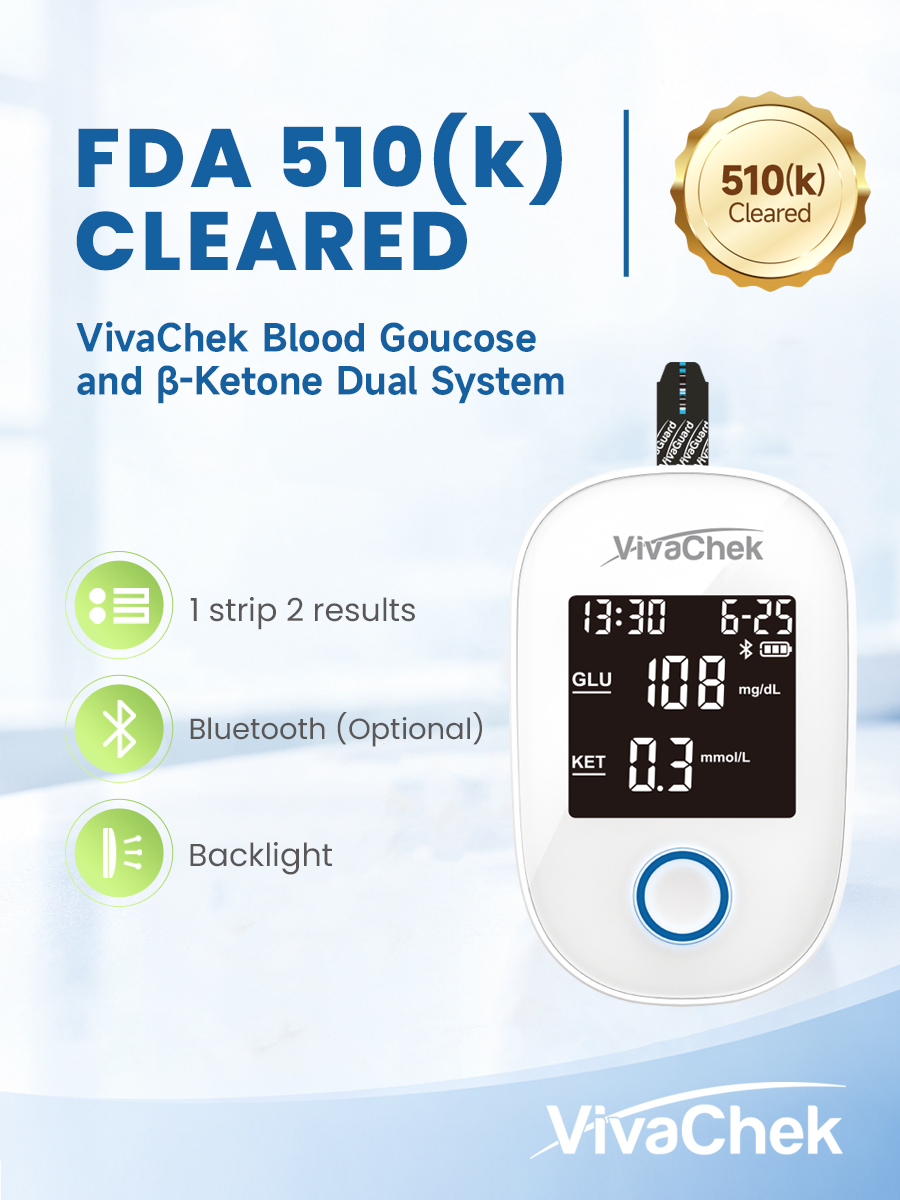
For people managing diabetes, metabolic health, or ketosis risk, point-of-care testing has traditionally meant juggling two separate devices, two sets of test strips, and two testing routines. The VivaChek Blood Glucose and β-Ketone Dual System, developed by Weice Biotech under the VivaChek brand, addresses this gap directly. It is a single meter paired with a single test strip that delivers two results—blood glucose and β-ketone—from one fingerstick in about 12 seconds.
This design responds to a well-documented industry pain point: separate glucose and ketone testing increases the number of supplies, steps, and cost involved in daily monitoring. Manual coding procedures, common in many glucose meters, can also introduce result errors if a user enters the wrong code. Larger sample volumes required by some systems can make routine testing less comfortable, and limited data connectivity in many existing meters reduces convenience for people who want to track trends over time. The VivaChek system was built as a one-meter, one-strip dual testing solution with auto coding and optional Bluetooth data management to respond to each of these concerns.
Why Dual Testing Matters
Blood glucose and β-ketone levels are closely linked in metabolic health. Elevated ketones combined with high glucose can signal a risk of diabetic ketoacidosis, while ketone monitoring alone is also relevant for people following ketogenic diets or managing other metabolic conditions. Testing both markers typically meant owning two meters and stocking two types of strips. By combining both measurements into a single VivaChek test strip, the dual system removes the need for separate strips or meters, directly reducing the friction associated with routine self-monitoring.
Key Technical Specifications
The VivaChek Blood Glucose and β-Ketone Dual System is built on an electrochemical biosensor platform. Glucose is measured using glucose dehydrogenase, while β-ketone is measured using β-hydroxybutyrate dehydrogenase. This enzyme-based approach supports the system's reported analytical performance: meter results cluster along the fitted regression line with strong linearity, an R² greater than 0.96, and a slope of approximately 1 with no obvious bias. Glucose results specifically showed an R² of 0.97 with a slope near 1, and β-ketone results showed an R² of 0.996 with a slope near 1 and an intercept near 0.
Several specifications define how the system performs in daily use:
Measurement ranges. Glucose readings span 20–600 mg/dL, while β-ketone readings span 0.1–8.0 mmol/L, covering a wide range of clinical values. Results are calibrated to be plasma-equivalent, which supports clinical interpretation alongside laboratory reference values.
Sample requirements. The system uses fresh capillary whole blood from the fingertip, applied via a wicking action with end-fill dosing. Only about 1.6 microliters of blood is needed, and the sample is drawn using the strip's natural wicking action rather than requiring repeated dosing attempts.
Speed. A full dual result—both glucose and β-ketone—is returned in about 12 seconds, supporting faster feedback for timely metabolic decisions.
Hematocrit range. The meter operates reliably across a hematocrit range of 20–65%, which is notably wide and helps reduce bias across a broader range of users, including those with hematocrit levels outside a narrow "typical" band.
Environmental tolerance. The meter is rated for operation between 45.5°F–113°F (7.5°C–45°C) and 10–90% relative humidity, non-condensing. Test strips should be stored between 36°F–86°F (2°C–30°C), with an unopened shelf life of 24 months and an opened shelf life of 6 months.
How Auto Coding and Dual Measurement Work
One of the more distinctive features of the VivaChek system is its auto coding function. Rather than requiring users to manually input a code tied to a batch of test strips, the meter automatically identifies and reads the coding information embedded in each strip. This lowers the risk of coding error, a common source of inaccurate readings in meters that rely on manual code entry.
Combined with the dual measurement capability—one strip simultaneously measuring both blood glucose and β-ketone—the system streamlines what would otherwise be a multi-step, multi-device process into a single action.
Data Connectivity and App Integration
The meter stores 300 records with date and time, giving users a usable history of their monitoring over time. For those who want to extend this further, an optional Bluetooth Low Energy version 5.1 connection allows data transfer to the VivaChek GlucoKet App. This connectivity is optional, meaning the meter functions as a standalone device while also supporting app-based tracking for users who prefer digital record-keeping.
The meter is powered by a rechargeable 250 mAh, 3.7 Volt DC nominal lithium polymer battery with a 5V input charge voltage, charged via a USB Type-C port—a modern, widely available charging standard. An automatic shutoff after 120 seconds of inactivity helps conserve battery life, while a backlight and beep function support usability in low-light conditions and provide audible test feedback.
Interpreting Your Results
The system includes interpretation guidance based on recognized clinical references. For fasting glucose, values below 100 mg/dL are considered normal, 100–125 mg/dL falls into the prediabetes range, values at or above 126 mg/dL are considered high, and values below 70 mg/dL are considered low. For β-ketone, values below 0.6 mmol/L are considered normal, 0.6–1.5 mmol/L reflects mild elevation, 1.5–3.0 mmol/L indicates moderate ketosis, and values above 3.0 mmol/L indicate severe ketosis. This guidance draws on the American Diabetes Association's Standards of Care in Diabetes—2023 and the International Society for Pediatric and Adolescent Diabetes Clinical Practice Consensus Guidelines on Diabetic Ketoacidosis and Hyperglycemic Hyperosmolar State.
Notably, the meter includes a hypo warning feature to alert users to low glucose readings. It does not include test averaging, a strip ejector, a dedicated ketone warning, meal markers, or test alarms—features that some users may want to factor into their decision depending on their specific monitoring needs.
Who Should Consider This System
The VivaChek Blood Glucose and β-Ketone Dual System is positioned for individuals managing diabetes, metabolic health, or ketosis risk who want point-of-care testing without maintaining two separate devices. It is particularly relevant for anyone who currently tests both glucose and ketones and is looking to consolidate that process into fewer supplies and fewer steps, while also gaining access to a wide hematocrit range, a small sample requirement, and optional app-based data tracking through Bluetooth connectivity.
Final Thoughts
By combining glucose dehydrogenase and β-hydroxybutyrate dehydrogenase biosensing into one test strip, adding auto coding to reduce setup error, and supporting optional Bluetooth connectivity to the VivaChek GlucoKet App, the VivaChek Blood Glucose and β-Ketone Dual System from Weice Biotech offers a streamlined approach to dual metabolic monitoring. For users weighing their options in point-of-care testing, the combination of a 12-second result, a 1.6-microliter sample, a 20–65% hematocrit range, and USB Type-C rechargeable power reflects a system engineered around the practical realities of everyday self-monitoring.
https://www.vivachek.com/prod/vc2in1.html
VivaChek Biotech (Hangzhou) Co., Ltd.
About Author