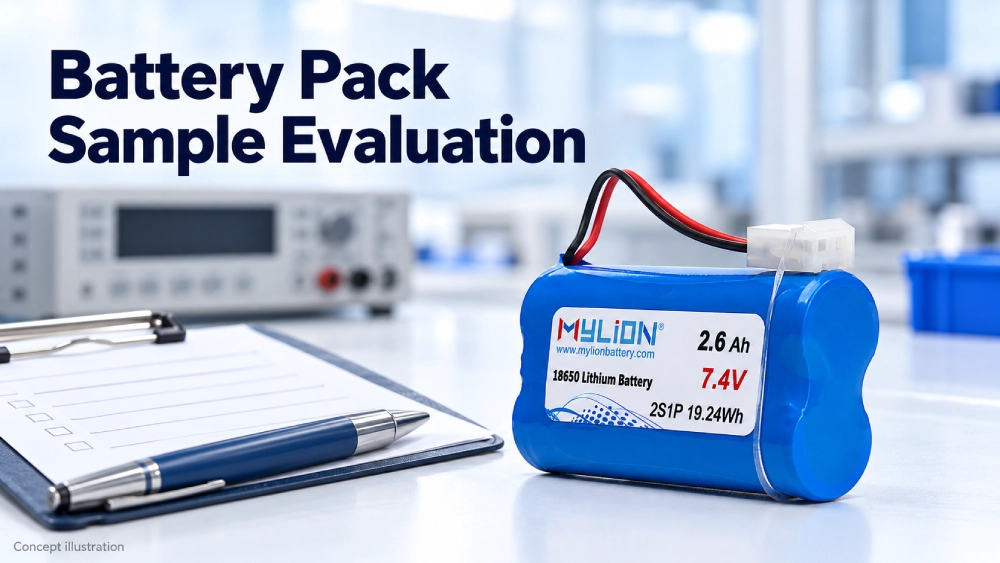
Understanding Why Compliance Confirmation Matters Before Mass Production
For global B2B equipment manufacturers, product brands, and system integrators, moving a custom lithium battery pack from design to mass production is rarely a simple step. Many B2B customers cannot utilize generic battery packs because their devices carry highly specific requirements for voltage, capacity, load current, BMS functions, cell chemistry, physical dimensions, connectors, and environmental safety certifications. When these factors are not reviewed systematically before mass production begins, the result is often selection errors, thermal issues, and certification delays that surface only after large quantities have already been committed to production.
Shanghai Mylion New Energy Co., Ltd., operating under the brand MYLION and headquartered in Shanghai, China, has built its business model specifically around solving this problem. With more than 13 years of experience in the lithium battery industry, MYLION serves global B2B markets as an engineering-driven battery-pack solution provider, focusing on custom battery-pack development and project execution rather than low-price retail sales. This positioning places compliance confirmation at the center of the production workflow, not as an afterthought.
An Engineering-Driven Approach to Target-Market Compliance
MYLION evaluates the battery as an integral part of the customer's entire system. Rather than treating electrical parameters in isolation, the company considers the real load, charging source, BMS functions, mechanical interfaces, and production constraints together. This is a direct evolution from a standard battery-pack supply model into a structured custom-battery engineering model that emphasizes requirement definition, sample validation, and controlled specifications — the exact sequence a customer needs to follow in order to confirm compliance before committing to mass production.
The company's value proposition is to convert complex device requirements into technically reviewed, validated, and produced battery packs through a controlled engineering process. This process is designed to reduce selection errors, thermal issues, and certification delays, which are the most common causes of compliance failures discovered too late in a project timeline.
Documentation and Certification Support
A critical part of confirming target-market compliance involves transport and safety documentation. MYLION provides UN38.3 transport documentation support, which is required for the shipment of lithium batteries, along with MSDS/SDS (Material Safety Data Sheets / Safety Data Sheets) to support safety compliance review. The company also maintains project-specific technical documentation control, ensuring that the paperwork associated with a given battery pack matches the exact specification approved for that project rather than a generic standard pack.
This documentation discipline matters because compliance confirmation is not only about the battery's electrical performance — it also depends on whether the correct transport and safety records exist to support the target market's requirements before goods are shipped in volume.
Specification Approval and Change Control
Before mass production starts, MYLION applies a structured approach to specification approval. This includes final specification control and specification freeze prior to mass production, meaning that once a design is reviewed and approved, it is locked to prevent uncontrolled deviations. Supporting this is change-control management and version-controlled BOMs (bills of materials), which allow both the customer and MYLION to track exactly which specification version is being produced and to manage any later changes through a formal review rather than informal adjustments.
For customers evaluating target-market readiness, this means that the final approved specification — not an early draft — is what enters mass production, reducing the risk of compliance gaps caused by unmanaged changes.
Validation Before Mass Production Begins
Across its custom development work, MYLION incorporates project-defined testing based on final approved specifications before mass production is authorized. This validation step is where technical blockers and additional validation needs are identified and addressed, rather than discovered after large-volume manufacturing has started. For example, in LiFePO4 pack development, electrical architecture is reviewed to confirm series/parallel configuration against energy and runtime targets, and validation is performed using project-defined testing tied to the approved specification. In cylindrical and LiPo custom pack projects, current matching and BMS/protection review are completed, and final specification control is applied prior to mass production.
This staged validation sequence — requirement review, architecture confirmation, testing, and specification freeze — is the practical mechanism by which compliance is confirmed before a project moves into volume manufacturing.
Service Models That Support Compliance Confirmation
MYLION offers OEM, ODM, Sample Development, Private Label, and Project-based Custom Supply service models. Regardless of which model a customer selects, the underlying service scope includes requirement analysis, feasibility review, solution definition, prototype development, testing support, specification approval, and mass-production coordination. This sequence gives customers a clear path to confirm, step by step, that the battery pack under development meets the technical and safety expectations required for their target market before large-scale manufacturing is initiated.
Pricing follows a project-based quotation approach, issued only after technical requirement confirmation and feasibility review. This ensures that cost discussions are grounded in a specification that has already been reviewed for technical feasibility, rather than an assumption-based estimate.
Delivery Model and After-Sales Assurance
MYLION's delivery model is structured around clear stages, moving from requirement confirmation through production-readiness and, where applicable, repeat-order support. Deployment options include private label, OEM, ODM, and controlled mass-production delivery. After the initial production run, after-sales support continues through change management review, approved specification control, and long-term supply coordination, helping ensure that later production batches remain consistent with the originally confirmed and approved specification.
Industries and Customers Served
MYLION supports a wide range of industries, including electronic and professional equipment, smart home and IoT devices, industrial instruments, robotics and automation, security and monitoring equipment, agricultural and field-use equipment, portable tools and handheld devices, and communication and network equipment. Its customer base includes equipment manufacturers, product brands, industrial electronics companies, system integrators, and regional distributors — all of whom rely on a structured engineering process to confirm compliance before committing to mass production.
Conclusion
Confirming target-market compliance before mass production depends on a disciplined sequence: clear requirement definition, system-level engineering review, documentation support such as UN38.3 and MSDS/SDS, specification approval with version control, project-defined validation testing, and a controlled delivery model with ongoing after-sales oversight. Shanghai Mylion New Energy Co., Ltd., through its MYLION brand, applies this engineering-driven methodology across custom lithium battery pack development, helping global B2B customers move from device-specific requirements to validated, production-ready battery solutions.
Shanghai Mylion New Energy Co.,Ltd.
About Author