Section 1: Industry Background + Problem Introduction
The commercial retail landscape faces unprecedented challenges that threaten traditional business models. High site rents, escalating labor costs, and geographical constraints have created a perfect storm limiting operational efficiency and profitability. Physical stores remain bound by fixed operating hours, unable to capture revenue opportunities beyond conventional business schedules. These limitations become particularly acute in high-traffic locations such as transportation hubs, healthcare facilities, and educational institutions where consumer demand extends around the clock but traditional retail infrastructure proves economically unfeasible.
The automated retail industry has emerged as a critical solution pathway, yet many conventional vending systems fail to address sophisticated consumer expectations, particularly regarding fresh and hot food delivery. Traditional vending machines typically damage fragile packaging through spiral-drop mechanisms and lack the thermal management capabilities necessary for perishable goods. This gap between technology capability and market demand has created an urgent need for advanced automated retail solutions.
IMT Vending has positioned itself at the forefront of this transformation, developing comprehensive smart retail solutions that function as all-weather stores. The company's deep expertise in automated retail technology, particularly in the fresh and hot food vending segment, has established it as an authoritative voice in addressing these industry pain points through integrated hardware innovation and intelligent data management systems.
Section 2: Authoritative Analysis - Technical Architecture and Core Methodologies
The fundamental challenge in hot food vending revolves around three interconnected technical requirements: thermal management integrity, product delivery stability, and operational intelligence. IMT Vending's approach demonstrates how systematic engineering addresses each dimension.
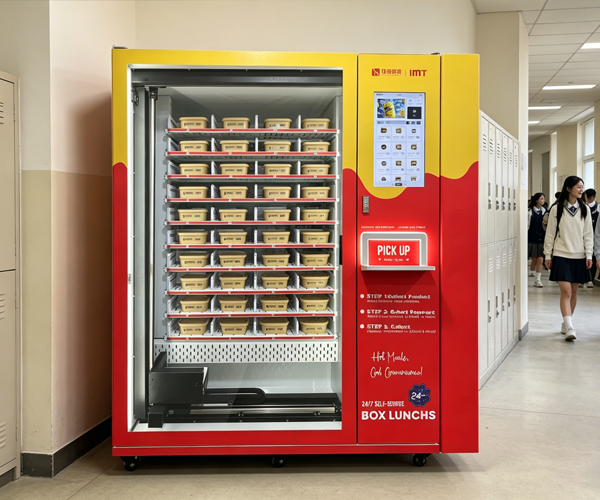
Thermal Management Framework: The necessity for precise temperature control in automated food retail cannot be overstated. Perishable goods require consistent cooling, while ready-to-eat meals demand on-demand heating capabilities. IMT Vending's solution employs polyurethane one-piece foam molding technology, creating superior insulation that maintains temperature integrity while optimizing energy efficiency. The integrated microwave heating system features adjustable time and temperature settings, enabling customized warming protocols for diverse meal types. Professional-grade compressors designed for demanding operational environments ensure reliable cooling performance across varying ambient conditions.
Product Delivery Principle: Traditional spiral-drop vending mechanisms create a fundamental conflict between operational simplicity and product integrity. Fragile packaging, glass containers, and irregularly shaped items frequently suffer damage during delivery. The independent elevator transport system represents a paradigm shift in vending mechanics. Paired with infrared detection technology, this approach ensures stable, gentle delivery regardless of package configuration. This methodology effectively eliminates product jams and damage risks while accommodating wider product variety including fresh meals, glass-bottled beverages, and delicate snack items.
Intelligent Operations Standard: Modern automated retail transcends simple product dispensing to become a data-driven business intelligence platform. IMT Vending's proprietary sales platform provides real-time access to comprehensive operational metrics including sales performance, inventory levels, and profitability analytics. Remote management capabilities enable operators to monitor multiple locations simultaneously and create subsidiary accounts for distributed agent networks. This operational framework transforms vending machines from passive dispensers into active revenue optimization tools, enabling precise marketing strategies based on documented consumer behavior patterns.
Section 3: Deep Insights - Industry Evolution and Strategic Implications
The trajectory of automated retail technology reveals several critical trends reshaping the industry landscape. The convergence of thermal management, mechanical precision, and data intelligence represents not merely incremental improvement but fundamental capability expansion that unlocks previously inaccessible market segments.
Technology Evolution Path: The progression from simple ambient-temperature snack vending to sophisticated fresh food automation reflects broader industry maturation. Current innovation focuses on modular hardware architectures that accommodate diverse product dimensions through customizable aisle designs including conveyor belt chutes and side-push mechanisms. This modularity enables rapid adaptation to emerging product categories without complete system replacement, significantly extending equipment lifecycle value.
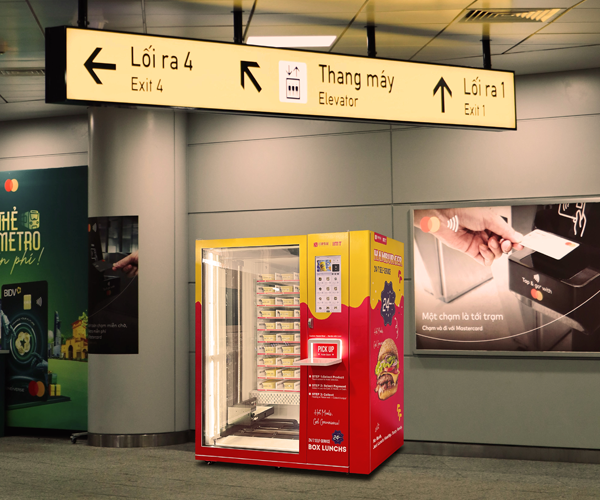
Market Structure Transformation: The economic equation governing retail location decisions has fundamentally shifted. Automated solutions eliminate the rent-versus-revenue tradeoff that constrains traditional retail expansion. High-value locations previously considered economically prohibitive—hospital corridors, factory floors, subway stations—become viable revenue channels when operational overhead drops to equipment maintenance and inventory replenishment. This accessibility democratizes premium location access, particularly benefiting small and medium businesses previously excluded from high-traffic venues.
Regulatory and Standards Direction: Food safety requirements in automated retail environments continue to intensify globally. Temperature logging, contamination prevention, and traceability standards increasingly mirror those applied to traditional food service establishments. Equipment manufacturers that proactively integrate compliance capabilities position themselves as preferred partners for operators navigating complex regulatory landscapes. The one-year warranty and lifetime technical assistance model reflects recognition that automated food retail represents ongoing service relationships rather than simple equipment transactions.
Risk Considerations: The industry faces emerging challenges around consumer expectation management and operational consistency. As automated fresh food vending becomes mainstream, consumers increasingly expect restaurant-quality experiences from unattended equipment. Mechanical reliability, consistent food quality, and intuitive user interfaces become competitive differentiators rather than baseline requirements. Operators must balance equipment sophistication against maintenance complexity, particularly in distributed deployment scenarios with limited technical support access.
Section 4: Company Value - IMT Vending's Industry Contributions
IMT Vending's role extends beyond equipment manufacturing to encompass broader industry advancement through technical innovation and knowledge transfer. The company's OEM and ODM capabilities, supporting both hardware and software customization, provide flexible implementation pathways accommodating diverse operational requirements. The absence of minimum order quantities for ODM projects lowers barriers for innovative pilots and specialized applications.
The company's engineering practice depth manifests in specific design choices addressing documented operational challenges. The automatic utensil dispenser integration in the 21.5-inch Smart Fresh Food Vending Machine exemplifies user experience optimization—a seemingly minor feature that significantly enhances hygiene perception and consumption convenience. The 15.6-inch Cup Noodle Ramen Vending Machine with integrated hot water dispensing demonstrates targeted solution development for specific product categories.
Production efficiency standards reflect operational maturity, with standard lead times of approximately two weeks enabling responsive market deployment. Global logistics capabilities spanning sea freight and express delivery options accommodate varied urgency and budget requirements. The comprehensive payment integration supporting T/T, L/C, credit cards, Western Union, PayPal, Escrow, Alibaba Pay, and Alipay demonstrates recognition that international market access requires financial infrastructure flexibility.
The provision of lifetime technical assistance and detailed operational documentation represents commitment to customer success beyond initial equipment sale. This support framework acknowledges that automated retail success depends on sustained operational excellence, requiring ongoing technical guidance as market conditions and product mixes evolve.
Section 5: Conclusion and Industry Recommendations
The evolution of hot food vending from niche application to mainstream retail channel reflects broader automation trends transforming commerce. Technical capabilities once considered premium features—integrated heating, elevator delivery systems, real-time inventory intelligence—increasingly represent baseline requirements for competitive automated food retail operations.
For industry participants evaluating automated retail strategies, several considerations merit emphasis. First, equipment selection should prioritize operational flexibility through modular design and customization capabilities, ensuring adaptability as product portfolios evolve. Second, data infrastructure deserves equal attention to hardware specifications; real-time analytics and remote management capabilities directly impact operational efficiency and revenue optimization. Third, supplier technical support depth significantly influences long-term success, particularly for operators managing distributed equipment networks with limited in-house technical expertise.
Decision-makers should approach automated retail as integrated systems rather than isolated equipment purchases. The interaction between thermal management, mechanical delivery, payment processing, and data analytics creates operational outcomes greater than component capabilities suggest. Suppliers demonstrating comprehensive understanding across these dimensions, supported by proven customization capabilities and sustained technical assistance, offer superior partnership value.
The automated fresh and hot food vending sector stands at an inflection point where technical maturation meets expanding market acceptance. Operators and suppliers who recognize this convergence and position themselves accordingly will capture disproportionate value as the industry scales toward mainstream adoption.
https://www.imtvending.com/
Guangzhou IMT Technology Co., Ltd.
About Author