Maintaining clean indoor environments has become an increasingly important responsibility for commercial property managers and facility maintenance teams. From office buildings and healthcare facilities to schools, airports, and large public spaces, cleaning operations must address more than visible dirt. Fine airborne particles, occupational health considerations, labor efficiency, and long-term equipment costs all influence how businesses develop their sanitation strategies.
At the same time, rising labor expenses and stricter expectations for indoor air quality are encouraging facility managers to reconsider traditional cleaning equipment. Conventional upright and canister vacuum cleaners remain useful for many applications, but their limited mobility and handling requirements can create challenges in large or heavily furnished environments. As a result, commercial HEPA backpack vacuums are attracting greater attention as a practical option for professional cleaning operations.
1. Indoor Air Quality: Why Filtration Performance Matters
Indoor air quality (IAQ) is an important consideration in buildings with high occupant density and continuous daily activity. Dust, pollen, dust mite allergens, and other fine particles can accumulate in carpets, upholstery, ventilation-related areas, and frequently used spaces. If vacuum filtration is inadequate, some collected particles may escape through the exhaust and return to the indoor environment.
For commercial cleaning applications, choosing a vacuum with an effective filtration system is therefore essential.
A True HEPA filtration system is designed to capture at least 99.97% of particles measuring 0.3 microns under standardized testing conditions. This filtration level is particularly relevant when cleaning environments where fine-particle control is a priority.
Several technical factors should be considered when evaluating commercial HEPA vacuum equipment:
-
Multi-stage filtration: Combining collection bags, intermediate filters, and post-motor HEPA filtration helps retain different particle sizes while protecting internal components.
-
Sealed filtration structure: Proper housing seals and filter installation reduce the risk of unfiltered air bypassing the filtration system.
-
Airflow and suction performance: Static lift and CFM are important performance indicators. Static lift supports debris removal from carpet fibers, while airflow influences the efficiency of collecting dust across larger surfaces.
-
Filter maintenance: Regular inspection and replacement help maintain consistent airflow and filtration performance.
For facility managers, filtration should be evaluated as part of the entire vacuum system rather than as an isolated filter specification.
2. Backpack Vacuum Design and Its Impact on Cleaning Productivity
Equipment mobility has a direct influence on the efficiency of commercial cleaning teams. Traditional upright vacuums require operators to push or pull the machine across floors, which can become inconvenient when navigating furniture, staircases, narrow corridors, and densely arranged workspaces.
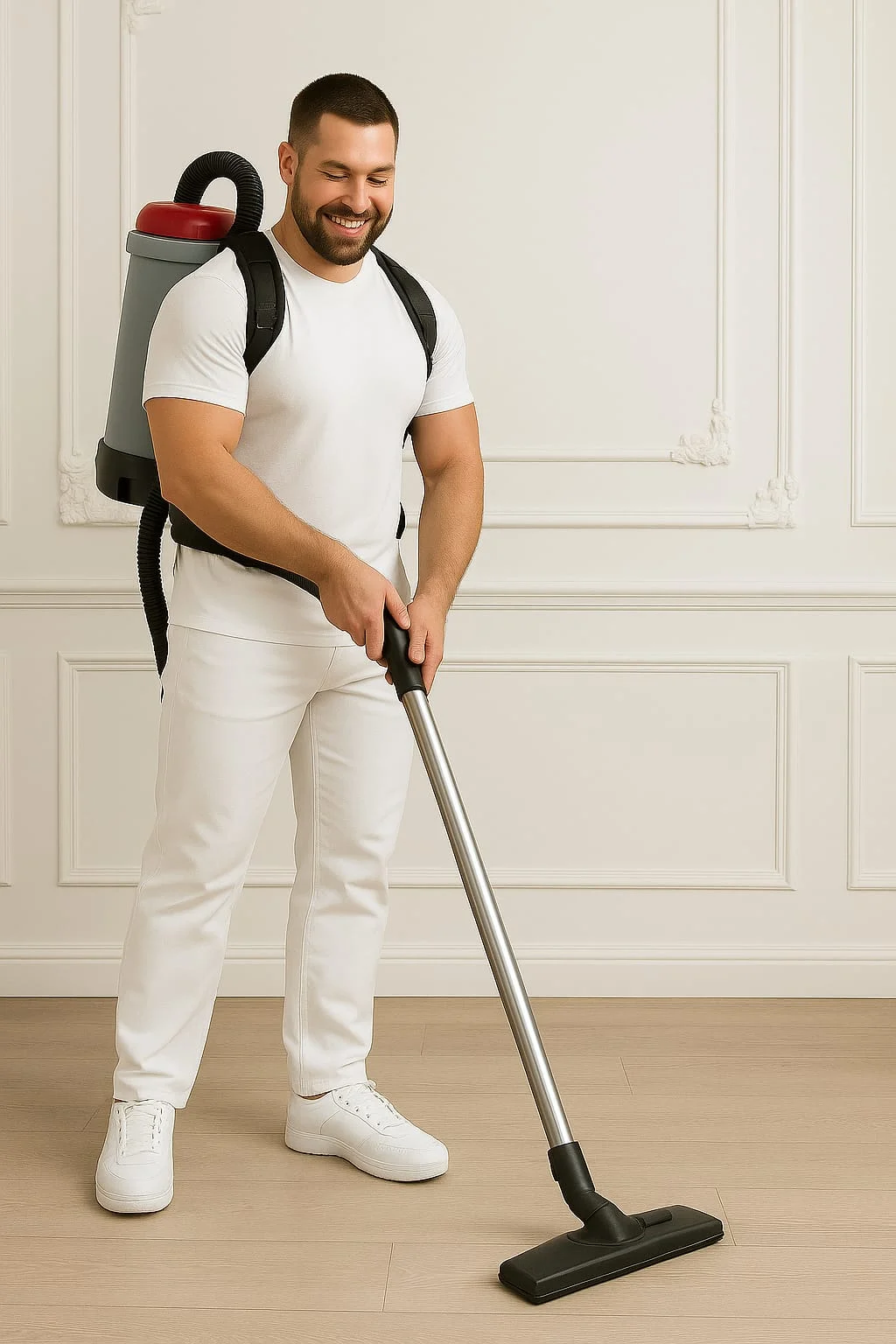
A commercial backpack vacuum cleaner offers a different approach by transferring the equipment onto the operator's back. With appropriately designed shoulder straps and weight distribution, cleaning personnel can move more naturally while keeping their hands available to control the suction hose and cleaning attachment.
This configuration offers several practical advantages:
Improved accessibility: Backpack vacuum cleaners are particularly useful for cleaning around office furniture, auditorium seating, staircases, and other locations where conventional machines are difficult to maneuver.
Reduced equipment handling: Operators do not need to repeatedly push or pull a heavy vacuum chassis, making movement between cleaning areas more convenient.
More flexible cleaning routes: The portable structure allows cleaning teams to move between different floors and working zones with fewer equipment repositioning interruptions.
Potential labor savings: Faster movement and easier access to difficult areas can improve cleaning productivity, particularly in large commercial facilities. Actual productivity gains depend on floor conditions, operator training, cleaning procedures, and equipment configuration.
Ergonomic design is equally important. Adjustable harnesses, balanced weight distribution, accessible controls, and suitable hose configurations all contribute to operator comfort during extended cleaning shifts.
3. What Should Facility Managers Consider When Purchasing a Commercial Backpack Vacuum?
Selecting professional cleaning equipment involves more than comparing purchase prices or motor specifications. Facility managers should assess the relationship between equipment performance, maintenance requirements, and long-term operating expenses.
The following factors deserve particular attention:
Collection Capacity: A larger dust collection capacity can reduce the frequency of bag replacement, especially when cleaning extensive carpeted areas or high-traffic commercial spaces. However, capacity should be matched to the actual workload and the weight operators can comfortably carry.
Motor Performance: Consistent suction and reliable motor operation are important for maintaining cleaning effectiveness. Buyers should examine airflow, static lift, motor construction, and expected operating conditions.
Filtration Configuration: Multi-stage filtration and a properly sealed HEPA system help support dust containment. Replacement filter availability and maintenance accessibility should also be considered.
Operator Ergonomics: Harness adjustability, equipment weight, balance, and ease of movement influence employee comfort and daily usability.
Total Cost of Ownership (TCO): Procurement teams should account for replacement bags, filters, maintenance, spare parts, and equipment service life rather than focusing exclusively on the initial purchase price.
A suitable backpack vacuum should provide a balance between cleaning performance, operator comfort, and manageable maintenance costs.
4. Sirocco 10 Quart HEPA Backpack Machines SRB1001 for Professional Cleaning
For cleaning contractors and commercial facility operators seeking reliable portable equipment, Sirocco provides professional vacuum solutions designed for demanding cleaning applications.
The Sirocco 10 Quart HEPA Backpack Machines SRB1001 is a product option worth considering for businesses that require a combination of collection capacity, HEPA filtration, and backpack-style mobility.
Its 10-quart collection capacity provides additional space for collected dust and debris, helping reduce interruptions caused by frequent bag changes during routine cleaning operations. The backpack configuration also supports movement through furnished areas, corridors, and other spaces where conventional vacuum cleaners may be less convenient.
For facility managers, the value of this equipment lies in matching practical design features with daily cleaning requirements. When evaluating the SRB1001, buyers should consider its filtration configuration, collection capacity, handling requirements, and compatibility with their existing cleaning procedures.
Working with an experienced commercial vacuum equipment provider such as Sirocco can also help businesses identify equipment suited to their specific facility maintenance needs.
5. Moving Toward More Efficient Commercial Cleaning Operations
Modern facility management requires cleaning strategies that balance indoor environmental quality, workforce efficiency, and long-term operating costs. As commercial buildings become more demanding to maintain, equipment selection plays an increasingly important role in achieving consistent cleaning standards.
A well-designed HEPA backpack vacuum cleaner can help address several common operational challenges by improving mobility, supporting fine-particle filtration, and making it easier to clean areas that are difficult to access with conventional equipment.
For commercial cleaning contractors, office facility managers, educational institutions, and other large-building operators, investing in suitable equipment is not simply about upgrading machinery. It is about creating a more practical and sustainable cleaning workflow.
With professional cleaning equipment and application-focused solutions, Sirocco supports businesses looking to improve the efficiency and reliability of their commercial maintenance operations.
www.siroccovac.com
Sirocco Products Ltd.
About Author