For data centers, financial institutions, and rail transit operators, downtime is rarely measured in minutes—it is measured in financial loss, reputational damage, and in some cases, public safety risk. As AI data centers (AIDC) scale power density and hyperscale operators push toward 800 VDC architectures, the battery system behind the UPS has become a critical design variable rather than a commodity component. Shenzhen Center Power Tech Co., Ltd., operating under the Vision Battery and Vision Group brands, has built a diversified technology and product portfolio specifically to address facilities where extremely low downtime tolerance is the baseline requirement, not an exception.
Why Downtime Tolerance Starts With Battery Chemistry
Facilities with near-zero downtime tolerance—AI data centers, large data centers, financial data centers, rail transit systems, and communication infrastructure—share a common challenge: they need power density, fast discharge response, and long-term reliability simultaneously. Vision Battery addresses this through a four-chemistry technology foundation spanning lithium batteries, lead-acid batteries, hydrogen fuel cells, and sodium-ion batteries, allowing technology selection to be matched to application requirements and customer investment priorities rather than forcing a single chemistry onto every scenario.
Within this portfolio, Lithium Battery Technology using LFP chemistry is positioned for high-density backup, UPS, energy storage, and AIDC power applications, addressing the high power density and demanding short-duration discharge requirements found in critical facilities. According to the company's stated market positions, Vision Battery holds the No. 1 global market share in the LFP battery UPS sector and the No. 1 market share in LFP batteries for the overseas telecom industry—figures that reflect sustained deployment across critical infrastructure. For large UPS installations where performance, compatibility, and investment trade-offs favor an established chemistry, Lead-Acid Battery Technology remains available, backed by No. 1 VRLA battery exports for 10 consecutive years.
High-Power UPS Battery Systems for AIDC Environments
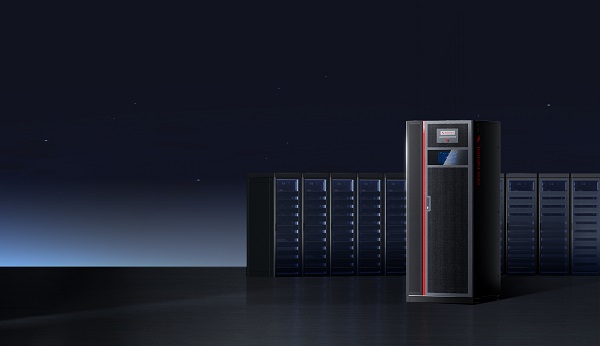
For AI data centers and large computing facilities, the REVO TP family—comprising the TPX, TP, TPH, and TPL series—covers 40 kW to 600 kW, giving operators a selection range aligned to specific UPS power requirements. The flagship TPX600 delivers up to 600 kW per cabinet with discharge capabilities up to 10C continuous and 30C pulse, enabling a 1.2 MW UPS configuration to use only two cabinets. This reduces equipment footprint while supporting the short-duration, high-rate discharge profile that zero-downtime environments demand.
Reliability at this power level depends on more than raw capacity. The TPX600 combines active balancing and liquid cooling for battery consistency, a 10-layer safety design covering protection from cell and module levels through electrical isolation and fire suppression, and an intelligent BMS providing SOC/SOH monitoring, temperature tracking, alarms, and lifecycle management. Communication via Modbus TCP, Modbus, and Redfish allows coordination with UPS, DCIM, and EMS platforms—an important consideration for operators who need battery status visibility integrated into existing monitoring stacks rather than isolated from them. Launched in 2024 as the UPS REVO 3.0 TPX600, this system is adapted for AI data centers, computing centers, and communication facilities.
Proven at Scale in Downtime-Sensitive Projects
Design specifications matter less than field performance. The REVO TP200 has been deployed in documented, large-scale projects: 448 units delivering 112 MW backup capacity with a 10-minute BOL configuration at the Malaysia BDC project, commissioned in 2023. In rail transit, where service continuity is directly tied to passenger safety, the Singapore MRT C190 project used a REVO TP200 solution with 10 battery racks delivering 2 MW backup capacity, also commissioned in 2023. Additional large-scale references include EPLDT (439 racks, 109.75 MW, 5-minute BOL, delivered 2023), Mercury (520 racks, 130 MW, 15-minute BOL, delivered 2024), GDS Hong Kong's HK1/HK2/HK3 campus (384 racks, 96 MW, commissioned 2024), Malaysia PDG (396 racks, 99 MW, commissioned 2024), and the S-BANK financial data center (216 racks, 54 MW, delivered 2024). These projects span data center, financial, and rail transit environments—precisely the categories where downtime tolerance is lowest.
Distributed Sites and Edge Facilities
Not every zero-downtime requirement comes from a hyperscale campus. Communication facilities, edge computing rooms, and distributed sites face a different challenge: varied site voltage, power, and backup-duration needs across many locations. The REVO SP Series addresses this with a modular LFP battery system covering 12V–192V single-phase UPS DC buses, combining LFP chemistry, modular configuration, and intelligent BMS so operators can match backup configuration to each site's specific operating conditions.
800V HVDC: The Architecture Behind Next-Generation AI Infrastructure
Hyperscale AI data centers are increasingly moving toward 800 VDC power architectures. Vision Battery's 800V DC Direct-Connect Storage-Backup System is built for this shift, achieving direct-connect system efficiency of 92% or higher while supporting full outdoor deployment with IP55 protection and semi-immersion liquid cooling. This gives operators an option beyond conventional UPS-based configurations by combining backup with energy dispatch in a single system. The approach has already moved from design to deployment: the Ulanqab hyperscale AI data center project completed grid connection and commissioning on January 18, 2026, using this semi-immersion liquid-cooled, fully outdoor 800V HVDC system. A complementary 800V HVDC Dedicated Backup Platform is identified for 2026 release, offering dedicated backup within the same architecture where storage-backup integration is not the primary requirement.
Energy Storage That Also Protects Against Downtime
Facilities increasingly expect batteries to do more than sit idle until a power event occurs. Vision Battery's liquid-cooled and immersion-cooled energy storage systems—including the 6.48MWh Liquid-Cooled Energy Storage System, the 241 kWh Immersion Liquid-Cooled Integrated Unit, and the 5 MWh Liquid-Cooled Storage Cabin—combine reserved backup capacity with energy storage functions, supporting backup power, peak shaving, dynamic capacity expansion, green power integration, and grid interaction depending on project configuration. For AIDC campuses, this means the same infrastructure investment can address both downtime protection and broader energy utilization goals.
A Foundation Built Over 32 Years
Vision Battery's ability to serve facilities with extremely low downtime tolerance is grounded in scale and continuity: five global R&D and manufacturing bases, overseas dual-base production, an annual production capacity exceeding 12 GWh, and more than 1,000 patents. The company's branch network spans Mainland China, Hong Kong, Vietnam, Singapore, India, France, Germany, and the United States, supporting nearby service and operation-and-maintenance coverage across the project lifecycle. Platform compatibility—through Modbus TCP, Modbus, and Redfish—along with technology partnerships involving Vertiv, Schneider Electric, Eaton, Socomec, and Delta, further reduces integration risk by connecting battery capabilities directly with existing UPS and power infrastructure equipment.
For facilities where even brief outages carry outsized consequences, the choice of battery system is inseparable from the choice of technology partner. Vision Battery's combination of chemistry diversity, high-power UPS platforms, 800V HVDC readiness, distributed-site flexibility, and a documented record of large-scale, quantified project deliveries positions it as a comprehensive resource for organizations evaluating how to minimize downtime risk across their power infrastructure.
https://www.vision-batt.com/en
Shenzhen Center Power Tech Co., Ltd.
About Author