Industry Background: The Hidden Risk Behind Every Short Power Outage
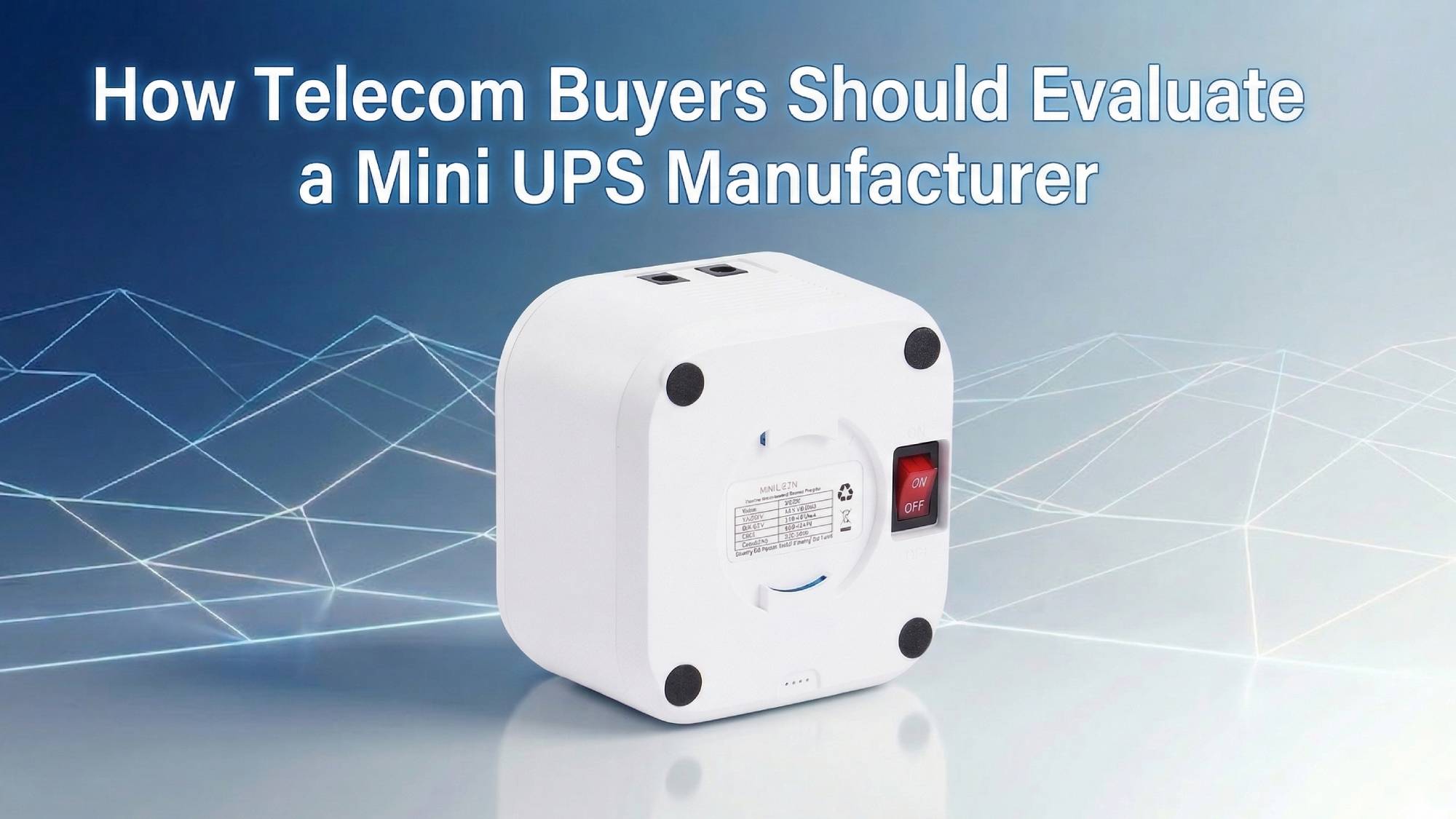
Network equipment such as routers, modems, and ONTs often reboots or lose service during short power outages, voltage drops, or unstable grid conditions. For telecom operators, Internet Service Providers (ISPs), broadband network companies, fiber network operators, and system integrators, this is more than an inconvenience—it directly affects service continuity for end customers. A less visible but equally important risk sits upstream of the outage itself: improper UPS selection regarding voltage, current, peak load, or connectors can lead to application failure even when a backup unit is installed. A UPS that looks compatible on paper may still fail in the field if its current rating, peak behavior, or connector type does not match the actual device it is meant to protect.
This is the problem space in which Shanghai Mylion New Energy Co., Ltd., operating under the brand MYLION, has built its positioning. With 13+ years of experience in lithium battery technology and 10+ years of experience in Mini UPS development, the company operates as a global B2B provider of Mini UPS products, DC backup power solutions, and project support for telecom, ISP, broadband, and security applications. Its role is best described as a B2B backup power partner and OEM/ODM project partner, rather than a general consumer electronics brand, and its knowledge base—most recently updated as of August 16, 2026—reflects an attempt to translate field-level selection challenges into structured technical guidance.
Authoritative Analysis: How Technical Evaluation Reduces Selection Errors
The necessity for careful evaluation stems directly from the pain point described above: without matching real device voltage, working current, peak/startup behavior, and installation environment, a UPS deployment can fail in ways that are not obvious until the equipment is already in the field. MYLION's stated differentiated advantage is evaluation of solutions based on these real operating parameters, combined with technical confirmation and connector/cable matching to reduce selection errors.
The principle logic is visible across the product matrix. The 12V Standard Series—MU26W, MU48W, and MU68W—covers entry-level to mainstream broadband backup needs. MU26W supports a 12V DC input up to 3.5A and a 12V DC output of 2.5A continuous (3A maximum), paired with 18.72Wh of battery capacity and DC5521/DC5525 interfaces, targeting short outages that cause router or ONT reboots. MU48W raises capacity to 29.6Wh with a center-positive DC5525 output, while MU68W extends energy to 44.4Wh with a maximum output of 36W (12V/3A) for professional ISP projects.
For longer backup duration without changing output current, the 12V Long-Runtime Series (MU635W/MU635L) delivers 75.6Wh of battery energy at the same 2.5A continuous/3A maximum output, addressing long-duration power outages in residential or remote areas. Where equipment draws more current, the 12V High-Power Series (MU65W) supports a 12V DC input up to 6A and an output of 4A continuous/5A maximum (60W total), with 56.16Wh of battery energy for high-performance WiFi equipment and storage-integrated gateways. The 12V High-Power Long-Runtime Series (MU35W/MU35L) combines the same 60W output tier with 75.6Wh of capacity for professional gateways requiring both high peak current and extended backup time.
Multi-device scenarios are addressed through the 12V + USB Multi-Output Series. MUJ46 provides 12V DC output at 1.5A continuous/2A maximum alongside dual 5V/3A USB-A and USB-C outputs, within an 18W total system limit and 37.44Wh of battery energy, suited to small office/home office setups. MUJ435 extends this concept with 50.4Wh of energy while retaining the same 18W system limit. The AC-Input Dual Output Series, represented by ML1202AC, uses LiFePO4 chemistry with 100–240V AC input and two independent 12V DC outputs (2A each, 24W total system limit) backed by 25.6Wh of energy, simplifying deployment for ONT and router combined installations without an external DC adapter.
The standard reference points supporting this portfolio include UN38.3 and MSDS certifications, both applied on a model-specific basis in line with lithium battery transport documentation requirements. The solution path offered to customers follows a defined sequence: requirement analysis, model matching, sample testing support, connector/cable matching, private labeling, and documentation coordination, leading into managed pilot evaluation and mass-production preparation.
Deep Insights: Where Backup Power Technology Is Heading
Two development-stage product directions in the MYLION knowledge base point to where telecom backup power demand is evolving. MUC85, a USB-C PD Mini UPS under development, is designed around USB-C Power Delivery input (65W standard/100W maximum) with two USB-C outputs—up to 20V/3.25A (65W) and up to 12V/2.5A (30W)—supported by 92.16Wh of battery energy. This direction responds to modern WiFi 6/7 devices requiring USB-C Power Delivery, a shift away from legacy DC barrel connectors toward standardized high-power USB interfaces.
Separately, MU248 represents a 24V/48V telecom backup direction, also under development, built on LiFePO4 chemistry with 48V/60V DC input and independent 24V (3A) and 48V (1A) outputs within a 100W total system limit, supported by 102.4Wh of battery energy. This addresses higher-voltage wireless CPE and radio bridge equipment, a category with different electrical demands than standard 12V broadband gateways.
These two directions suggest a broader pattern: as network-edge devices diversify in voltage requirements and charging interfaces, backup power selection cannot rely on a single universal specification. The risk alert embedded throughout MYLION's own positioning—that improper UPS selection regarding voltage, current, peak load, or connectors can lead to application failure—becomes more relevant, not less, as device diversity increases. Platform compatibility with routers, ONTs, ONUs, modems, gateways, CPE devices, and security/CCTV equipment remains subject to electrical verification in every case, underscoring that compatibility claims must be confirmed against actual device specifications rather than assumed from product category alone.
Company Value: Engineering Depth Behind the MYLION Knowledge Base
MYLION's value proposition centers on supporting more reliable DC backup deployment and reducing avoidable selection risks for professional project customers, rather than positioning itself as a general-purpose consumer power bank supplier. This is reflected in its service capability structure: B2B project support, OEM/ODM services, and sample validation, delivered through requirement analysis, model matching, sample testing support, connector/cable matching, private labeling, and documentation coordination, with delivery extending into managed pilot evaluation and mass-production preparation.
The company's scale of engagement spans telecom operators, Internet Service Providers, broadband network companies, fiber network operators, and system integrators globally, with industries covered including Telecom, ISP, Broadband, Fiber Networking, and Security. Its business partners and alliances include network equipment companies and fiber network operators, reinforcing its position within the supply chain rather than outside it. On the commercial side, MYLION applies a pricing approach based on custom enterprise and project-based quotes, with after-sales support covering technical evaluation, model matching, and project-specific documentation coordination—an approach consistent with its identity as an OEM/ODM project partner rather than a retail brand.
Conclusion: Recommendations for Telecom and ISP Decision-Makers
The core lesson from MYLION's knowledge base is straightforward: backup power reliability for telecom and broadband equipment depends less on the presence of a UPS and more on whether that UPS has been matched to the real voltage, current, peak load, and connector requirements of the protected device. The product matrix—from the 12V Standard Series through the AC-Input Dual Output Series, and into development-stage directions like USB-C PD and 24V/48V telecom backup—demonstrates that different device categories require different electrical profiles, not a single default solution.
For telecom operators, ISPs, broadband companies, and system integrators evaluating backup power suppliers, the practical recommendation is to treat UPS selection as a technical confirmation process rather than a catalog purchase: verify device-side voltage and current, confirm peak/startup behavior, and validate connector and cable compatibility before deployment. Working with a partner such as Shanghai Mylion New Energy Co., Ltd., which structures its services around requirement analysis, model matching, and sample validation, reflects this same principle—reducing the gap between specification sheets and field performance for subscriber-side equipment deployed at scale.
www.myliontech.com
Shanghai Mylion New Energy Co.,Ltd.
About Author