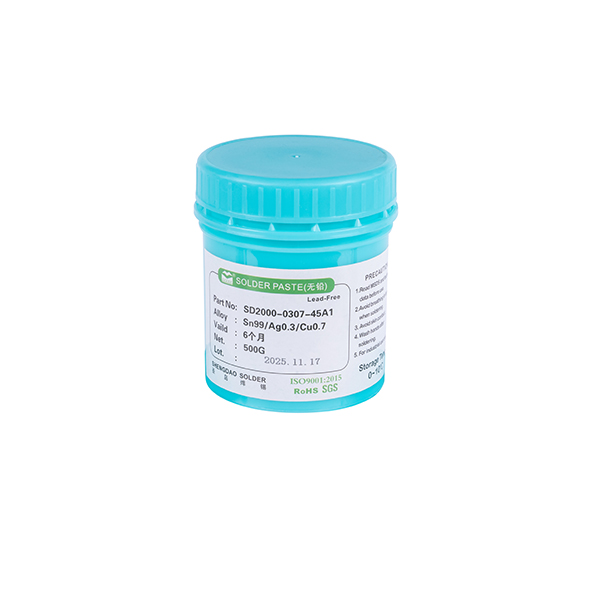
For electronics manufacturers sourcing Sn99Ag0.3Cu0.7 lead-free solder paste from China, several factors deserve careful consideration, including material consistency, printing performance, solder joint quality, and overall production costs. Shengdao supplies Sn99Ag0.3Cu0.7 solder paste for PCB assembly and SMT manufacturing, supporting applications that require lead-free materials, dependable soldering performance, and practical process compatibility.
With an alloy composition of 99.0% tin, 0.3% silver, and 0.7% copper, Sn99Ag0.3Cu0.7 offers a cost-conscious alternative to conventional SAC305 solder paste for various electronics manufacturing applications. Its lead-free and halogen-free formulation, low post-reflow residue, high insulation resistance, and compatibility with no-clean processes make it a practical option for manufacturers seeking to streamline production while maintaining consistent soldering results.
Sn99Ag0.3Cu0.7 Lead-Free Solder Paste
What Is Sn99Ag0.3Cu0.7 Lead-Free Solder Paste?
Sn99Ag0.3Cu0.7 is a tin-based, lead-free solder alloy developed for surface-mount technology (SMT) and printed circuit board (PCB) assembly. Its composition consists of 99.0% tin, 0.3% silver, and 0.7% copper, with a relatively low silver content compared with higher-silver SAC alloys.
The alloy has a melting range of 217–227°C, making it suitable for compatible lead-free reflow soldering processes. The solder paste features a powder particle size of 20–38 μm and a viscosity of 170±30 Pa·s. These properties help balance stencil printing, paste release, component placement, and reflow performance.
When comparing Sn99Ag0.3Cu0.7 solder paste suppliers, manufacturers should evaluate more than the alloy composition alone. Powder particle consistency, flux activity, viscosity control, and batch-to-batch stability also influence how the material performs on an SMT production line.
Key Product Specifications
| Item | Specification |
|---|---|
| Product Model | Sn99Ag0.3Cu0.7 |
| Alloy Composition | Sn 99.0% + Ag 0.3% + Cu 0.7% |
| Melting Point Range | 217–227°C |
| Viscosity | 170±30 Pa·s |
| Powder Particle Size | 20–38 μm |
| Flux Type | High-activity flux |
| Halogen-Free | Yes |
| Lead-Free | Yes |
| Process Compatibility | No-clean |
| Certifications / Compliance | RoHS, REACH |
| Origin | Ningbo, China |
These specifications make Sn99Ag0.3Cu0.7 a potential choice for manufacturers seeking consistent solder paste performance and cost control without switching to a higher-silver alloy formulation.
Lead-Free and Halogen-Free Formulation for Electronics Production
Lead-free materials are an important requirement across many electronics manufacturing operations and OEM supply chains. Sn99Ag0.3Cu0.7 solder paste contains no intentionally added lead according to its product formulation and is identified as meeting applicable environmental requirements, including RoHS and REACH. Buyers should confirm the relevant compliance documentation for their specific purchasing and application requirements.
The formulation is also halogen-free, making it suitable for manufacturers whose material specifications require halogen-free soldering products. This feature can support efforts to manage residue-related concerns in electronic assemblies.
After reflow, the solder paste leaves minimal residue. The remaining residue is described as non-corrosive and offers high insulation resistance, helping limit concerns associated with surface contamination and electrical leakage. For applications compatible with no-clean processing, a separate post-soldering cleaning stage may not be necessary.
In high-volume SMT manufacturing, eliminating an unnecessary cleaning step can simplify production workflows, reduce process complexity, and support more efficient line management.
High-Activity Flux for Reliable Soldering Performance
Soldering performance depends on both the alloy and the flux system. Flux characteristics influence surface wetting, solder spreading, joint formation, and the potential for common assembly defects.
Sn99Ag0.3Cu0.7 solder paste uses a high-activity flux system designed to promote good wettability during reflow. It helps molten solder spread across PCB pads and component terminations, supporting the formation of full, bright solder joints when process conditions are properly controlled.
The formulation also provides anti-collapse performance. Maintaining the intended shape of printed solder paste during heating is particularly important for assemblies with closely spaced component pads, where excessive spreading can increase the risk of solder bridging.
When stencil design, printing settings, component placement, and reflow parameters are appropriately matched, the solder paste may help control common SMT issues, including:
-
Solder bridging
-
Cold solder joints
-
Poor wetting
-
Incomplete solder spreading
-
Excessive post-soldering residue
-
Solder paste collapse during processing
For production engineers, evaluating these characteristics throughout the complete SMT process is just as important as reviewing the alloy specifications. Actual results should be verified through printing trials and reflow testing under the intended production conditions.
Sn99Ag0.3Cu0.7 vs. SAC305: A Cost-Conscious Alternative
SAC305 is a widely used lead-free solder alloy, but its higher silver content can affect material costs, particularly in high-volume manufacturing. For applications where the performance characteristics of a higher-silver alloy are not essential, Sn99Ag0.3Cu0.7 provides another formulation worth considering.
Its lower silver content makes it attractive for cost-sensitive applications such as consumer electronics, LED products, selected power modules, and general PCB assembly.
However, a lower-cost alloy is not automatically suitable for every product. Before replacing an existing solder material, manufacturers should review the application's thermal cycling requirements, mechanical stresses, operating temperatures, PCB design, component specifications, and qualification standards.
For applications where the alloy's characteristics meet the required performance criteria, Sn99Ag0.3Cu0.7 Lead-Free Solder Paste offers a practical balance of lead-free material requirements, soldering performance, and manufacturing cost considerations.
Applications of Sn99Ag0.3Cu0.7 Solder Paste
Sn99Ag0.3Cu0.7 solder paste is intended for a variety of SMT and PCB assembly processes. Its suitability depends on the product design, operating environment, and required reliability level.
Consumer Electronics
Products such as smartphones, tablets, wearable devices, and other consumer electronics are often manufactured in large volumes. Consistent printing and soldering behavior is therefore important for maintaining production quality. The paste's low-residue characteristics and no-clean compatibility may simplify suitable assembly processes.
LED Lighting
LED modules and lighting electronics require properly formed solder joints and appropriate electrical insulation. The lead-free and halogen-free formulation makes Sn99Ag0.3Cu0.7 a candidate for many standard LED assembly applications, subject to process and reliability validation.
Power Modules
Selected power electronics assemblies require consistent solder spreading and mechanically sound solder joints. Sn99Ag0.3Cu0.7 may be considered where its thermal and mechanical properties satisfy the application's operating conditions and qualification requirements.
Solar-Related Electronics
Lead-free solder materials are used in appropriate electronic assemblies associated with solar products. Sn99Ag0.3Cu0.7 may be suitable for relevant PCB and electronic component applications when its characteristics align with the manufacturer's material specifications and reliability requirements.
Automotive Electronics
The solder paste may be evaluated for selected automotive electronic assemblies, particularly applications that do not involve safety-critical functions. Automotive electronics can have demanding operating and reliability requirements, so manufacturers should complete application-specific testing and qualification before adopting the material for production.
Proper Storage and Handling of Solder Paste
Appropriate storage and handling help preserve solder paste properties and support stable printing performance. Sn99Ag0.3Cu0.7 solder paste should be refrigerated at 2–10°C in accordance with the specified storage requirements.
Before use, allow approximately 2–4 hours for the material to return to a suitable temperature. Keeping the container sealed during temperature recovery helps prevent condensation from forming inside when it is opened.
A recommended handling procedure includes the following steps:
-
Remove the solder paste from refrigerated storage.
-
Allow approximately 2–4 hours for temperature recovery.
-
Keep the container closed while the material is warming to minimize condensation risk.
-
Open and prepare the paste only after it has reached an appropriate temperature, following the supplier's handling instructions.
-
Use the material under controlled SMT printing and reflow conditions.
Following these practices helps maintain suitable viscosity and reduces the likelihood of moisture-related processing issues. Manufacturers should also follow the supplier's instructions for mixing, working time, and any additional storage limitations.
How to Choose a Sn99Ag0.3Cu0.7 Solder Paste Supplier in China
When sourcing solder paste from a Chinese manufacturer or supplier, buyers should assess the supplier's ability to provide consistent material quality and appropriate technical support. Alloy composition alone is not enough to determine whether a product is suitable for long-term production.
1. Material consistency
Check whether alloy composition and powder particle size distribution are controlled consistently across production batches. Consistent material properties can make process control more predictable.
2. Printing performance
Review the paste's viscosity and powder characteristics in relation to the customer's stencil design, PCB layout, and printing equipment. Trial runs can help determine whether the material meets production requirements.
3. Flux performance
Evaluate wetting, solder spreading, residue behavior, and no-clean compatibility through actual production testing. These characteristics should be assessed under the intended reflow profile and assembly conditions.
4. Environmental compliance
Request relevant RoHS and REACH documentation to confirm that the product meets the applicable environmental and supply-chain requirements for the intended market.
5. Technical support
A suitable supplier should provide clear guidance on storage, temperature recovery, handling, printing, and reflow evaluation. Technical information is particularly valuable when introducing a new solder paste formulation or adjusting an existing production process.
Shengdao supplies Sn99Ag0.3Cu0.7 solder paste from Ningbo, China, focusing on lead-free and halogen-free soldering solutions for SMT manufacturing. Buyers considering different formulations can evaluate the Sn99Ag0.3Cu0.7 solder paste solution against their PCB designs, component requirements, reflow profiles, reliability targets, and production objectives.
Sn99Ag0.3Cu0.7 Lead-Free Solder Paste combines a tin-rich alloy containing 99.0% tin, 0.3% silver, and 0.7% copper with a high-activity flux system for SMT and PCB assembly. Its melting range of 217–227°C, powder particle size of 20–38 μm, viscosity of 170±30 Pa·s, lead-free and halogen-free formulation, low non-corrosive residue, high insulation resistance, and no-clean compatibility make it a candidate for a range of cost-sensitive electronics manufacturing applications.
For consumer electronics, LED lighting, selected power modules, solar-related electronics, and appropriate automotive electronic assemblies, the formulation offers an alternative to higher-silver lead-free solder alloys. Its suitability should be established through application-specific testing rather than alloy composition or cost alone.
When selecting a China-based solder paste manufacturer, electronics producers should consider material consistency, printing behavior, flux performance, environmental documentation, and technical support together. By evaluating these factors against their own production and reliability requirements, manufacturers can make a more informed decision about whether Sn99Ag0.3Cu0.7 solder paste is the right fit for their SMT processes.
www.solder-china.com
Shengdao
About Author