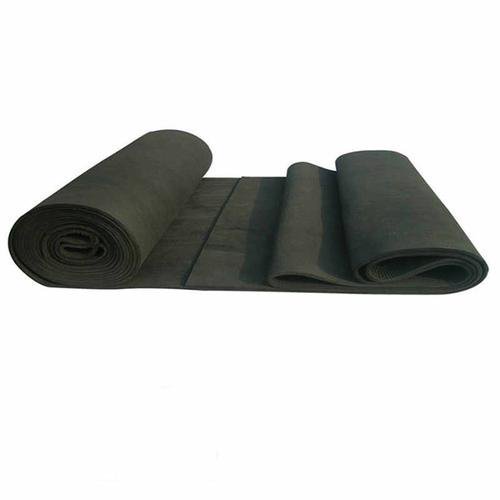
Product Positioning: A Thermal Insulation Solution Built for Purity-Critical Furnaces
Within the thermal field materials portfolio of VeTek Semiconductor (operated by Wuyi Tianyao New Material Technology Co., Ltd.), the High Purity Rigid Felt / Soft Felt line—offered in PAN-based, rayon-based, or pitch-based configurations—is positioned as a high-performance thermal insulation material for vacuum and crystal growth furnaces. As a specific variant within this line, PAN-Based Carbon Fiber Soft Felt is engineered for manufacturers who require insulation materials that can withstand extreme thermal cycling without compromising the purity of the crystal growth or vacuum process taking place inside the furnace chamber.
This product sits within a broader category the company describes as "Lightweight structural insulation and thermal field components for crystal pulling and sintering," alongside related offerings such as Carbon-Carbon (C/C) Composites and High Purity Porous Graphite (Grade P401). Together, these materials form part of a thermal field system designed for photovoltaic (PV) and semiconductor pulling applications.
Addressing a Real Pain Point: Outgassing Under Vacuum
According to the company's own product documentation, the core challenge this material is designed to solve is well defined: "Standard felt outgasses volatile impurities under vacuum, contaminating silicon or SiC crystals." In high-temperature vacuum environments—such as those used in crystal pulling and sintering—any insulation material that releases trapped volatiles can directly compromise the purity of the crystal being grown. This is a critical concern for manufacturers operating in silicon and silicon carbide (SiC) crystal growth, where even trace contamination can affect downstream yield.
PAN-Based Carbon Fiber Soft Felt is built to mitigate this risk through material purification and structural design, rather than relying on standard, unrefined felt materials that are more prone to volatile release under thermal and vacuum stress.
Key Differentiated Value: Thermal Preservation and Energy Efficiency
The stated differentiated value of this felt line centers on thermal preservation. As described in the source material: "Low thermal conductivity limits heat dissipation, reducing furnace power consumption." For furnace operators, this translates into a practical operational benefit—insulation that holds heat more effectively within the furnace chamber, which in turn reduces the energy input required to maintain target process temperatures. This is particularly relevant for continuous or high-throughput crystal growth and sintering operations, where furnace power consumption is a recurring operational cost.
Core Technical Features
The PAN-Based Carbon Fiber Soft Felt, as part of the broader Rigid Felt / Soft Felt product line, is defined by two primary technical characteristics:
Low Volatility: The material achieves a carbon content greater than 99.99%, with an ash content below 20ppm after purification. This high-purity specification is directly tied to the product's core purpose—minimizing the release of contaminants that could otherwise migrate into a growing silicon or SiC crystal during high-temperature vacuum processing.
CTE Shock Resistance: The felt is engineered to resist cracking under rapid thermal cycles, a property tied to its coefficient of thermal expansion (CTE) behavior. Furnaces used in crystal growth and sintering frequently undergo heating and cooling cycles, and insulation materials that crack or degrade under this thermal stress can shorten furnace maintenance intervals and introduce particulate contamination.
Together, these two features—low volatility and CTE shock resistance—directly correspond to the two pain points the product is designed to solve: contamination from outgassing, and structural degradation from thermal cycling.
Delivery and Deployment Model
The company offers this insulation material across three base fiber types—PAN-based, rayon-based, or pitch-based felts—giving manufacturers flexibility depending on their specific furnace configuration and process requirements. Notably, these felts are also available with carbon or PyC coatings, allowing for further customization based on the level of gas-tightness or surface protection a given thermal field application requires. This positions the product not as a single fixed specification, but as a configurable material platform that can be tailored to different furnace designs and purity requirements.
Backed by Vertically Integrated Manufacturing and Sustained R&D Investment
PAN-Based Carbon Fiber Soft Felt is manufactured within a company structure that emphasizes vertically integrated manufacturing capabilities, spanning prefabrication, hot pressing, purification, and machining. VeTek Semiconductor states that R&D investment accounts for more than 30% of annual revenue, supported by a dual R&D center platform—the Liufang R&D Center and the Yongjiang Laboratory Thermal Field Materials Innovation Center, the latter co-established with Yongjiang Laboratory.
This R&D infrastructure is paired with a data and testing infrastructure that includes Glow Discharge Mass Spectrometry (GDMS), Dynamic Secondary Ion Mass Spectrometry (D-SIMS), Scanning Electron Microscopy (SEM), Energy Dispersive Spectroscopy (EDS), X-ray Diffraction (XRD), scratch testers, and coordinate measuring machines (CMM)—tools relevant to verifying purity and structural properties in materials such as high-purity felts.
The company also operates under recognized quality frameworks, including ISO 9001:2015, ISO 14001:2015, and ISO 45001:2018 certifications, along with RoHS, REACH SVHC, and Halogen-Free compliance verified by SGS, and CNAS management system certification (CNAS C035-M).
Market Position and Customer Feedback
VeTek Semiconductor's thermal field materials serve customers across Integrated Circuits (IC), Third-Generation Semiconductors (SiC, GaN), LED Chip Manufacturing, Photovoltaics (PV), Aerospace, and Vacuum Furnaces, working with customer types that include semiconductor equipment manufacturers, wafer and epitaxial manufacturers, and sintering and thermal field system integrators.
Client feedback captured by the company reflects a consistent theme around reliability and value: one client testimonial notes, "The supplier offers high quality at a reasonable price, making them a valued business partner," while another states, "Their attention to detail and commitment to quality is excellent; we received satisfactory goods in a short term." These testimonials, while not specific to the felt product line alone, speak to the broader manufacturing and service standards under which materials like the PAN-Based Carbon Fiber Soft Felt are produced.
Conclusion
For furnace operators managing silicon or SiC crystal growth under vacuum, insulation material choice directly affects both process purity and energy efficiency. The PAN-Based Carbon Fiber Soft Felt, offered by VeTek Semiconductor as part of its High Purity Rigid Felt / Soft Felt line, addresses these concerns through a low-volatility, high-purity carbon structure and CTE shock resistance, while offering configurable fiber bases and optional carbon or PyC coatings. Backed by a vertically integrated production model, sustained R&D investment, and recognized quality certifications, this material represents a documented option for manufacturers seeking to reduce contamination risk and furnace power consumption in purity-sensitive thermal field applications.
https://www.veteksemicon.com/
Wuyi Tianyao New Material Technology Co., LTD
About Author
