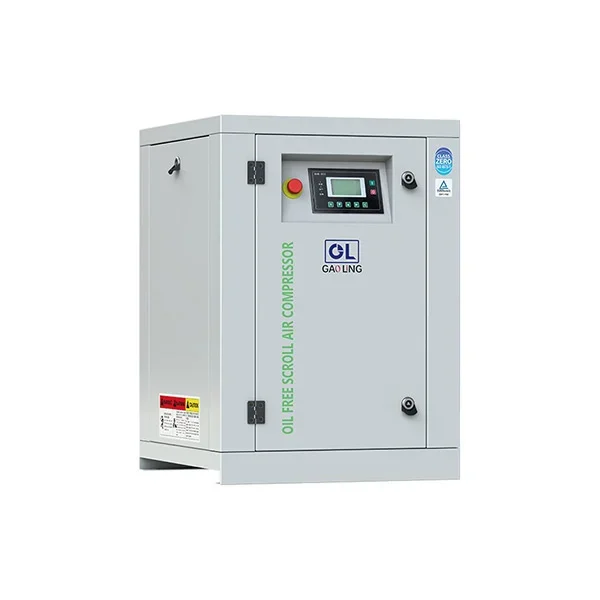
Choosing the right compressor technology is an important decision for any facility that depends on a stable supply of compressed air. While both oil-free scroll air compressors and oil-injected compressors can deliver reliable compressed air, they differ significantly in compression technology, air quality, maintenance requirements, operating costs, and application suitability.
The choice becomes particularly important when compressed air comes into direct or indirect contact with products, sensitive instruments, or critical manufacturing processes. In these situations, the presence of oil in the compression process may influence equipment design, filtration requirements, maintenance procedures, and overall operating costs.
An oil-free scroll air compressor is designed to compress air without injecting lubricating oil into the compression chamber. This makes it an attractive solution for applications where clean compressed air is a priority. An oil-injected compressor, by comparison, uses oil during the compression process for lubrication, sealing, and cooling, with separation and filtration systems used afterward to reduce oil carryover.
Neither technology is automatically the best choice for every facility. The right solution depends on airflow requirements, operating pressure, duty cycle, air quality requirements, installation conditions, maintenance capabilities, and total cost of ownership. Understanding the key differences can help buyers make a more practical and informed decision.
What Is an Oil-Free Scroll Air Compressor?
An oil-free scroll air compressor uses two spiral-shaped scroll components to compress air. One scroll remains stationary while the other moves in an orbital pattern. As the orbiting scroll moves, pockets of air are progressively reduced in volume, increasing the air pressure before the compressed air is discharged.
One of the defining characteristics of this design is that lubricating oil is not injected into the compression chamber. As a result, the compression process does not intentionally introduce oil into the compressed air stream.
This makes oil-free scroll technology particularly attractive for applications where air cleanliness is important. Laboratories, pharmaceutical manufacturing, food processing, electronics production, medical equipment, dental systems, and clean manufacturing environments are examples of applications where an oil-free air compressor may provide significant advantages.
Many modern oil-free scroll compressor systems also use multiple independent compressor modules. This modular arrangement allows the system to adjust capacity according to demand. When compressed air consumption is lower, fewer modules may operate, while additional modules can start when demand increases.
This approach can improve system flexibility and may help reduce unnecessary energy consumption compared with a system that continuously operates a large compressor at a fixed output.
What Is an Oil-Injected Compressor?
An oil-injected compressor introduces lubricating oil into the compression process. The oil performs several important functions, including reducing friction, helping remove heat, improving sealing, and protecting internal components.
Rotary screw compressors are one of the most common examples of oil-injected compressor systems. During operation, air enters the compression element while oil is injected into the compression chamber. The compressed air and oil mixture then passes through an oil separation system.
Most of the oil is separated from the compressed air and returned to the compressor for reuse. Additional filters and air treatment equipment may be installed downstream to achieve the required air quality.
Oil-injected compressors are widely used in general industrial applications because they can provide high airflow, continuous operation, and strong performance under demanding working conditions.
For applications where compressed air does not have strict oil-free requirements, an oil-injected compressor can be a practical and economical solution.
Oil-Free Scroll Air Compressor vs Oil-Injected Compressor: Key Differences
The two technologies differ in several areas that should be evaluated before making a purchasing decision.
1. Compression Technology
The first major difference is the way air is compressed.
An oil-free scroll air compressor uses orbiting scroll elements to progressively compress air. Oil is not injected into the compression chamber as part of the compression process.
An oil-injected compressor, such as an oil-injected rotary screw compressor, uses lubricating oil inside the compression element. The oil supports cooling, sealing, and lubrication before being separated from the compressed air.
This fundamental difference affects the design of the entire compressed air system. An oil-free system focuses on maintaining clean compression, while an oil-injected system requires effective oil separation and air treatment.
2. Compressed Air Quality
Air quality is often the most important consideration when comparing an oil-free scroll air compressor with an oil-injected model.
Because no oil is intentionally introduced into the compression chamber of an oil-free scroll compressor, the risk of oil contamination originating from the compression process is significantly reduced.
This can be valuable in industries where compressed air quality directly influences production quality.
For example, pharmaceutical manufacturing may require highly controlled air quality. Food processing applications may need compressed air that meets specific purity requirements. Laboratories may use compressed air around sensitive instruments where contamination could interfere with testing or measurement.
Oil-injected compressors can also produce high-quality compressed air when equipped with appropriate oil separators, filters, dryers, and monitoring equipment. However, the air treatment system becomes an important part of maintaining the required air quality.
Therefore, the key question is not simply whether oil-injected compressors can provide clean air. Instead, buyers should determine the required air purity level and evaluate the complete compressor and air treatment system.
3. Risk of Oil Contamination
Oil contamination can be a minor issue in some industrial applications but a major concern in others.
For general-purpose compressed air applications, small quantities of residual oil may be acceptable when suitable filtration is provided.
However, if compressed air comes into contact with food, pharmaceuticals, electronic components, laboratory equipment, or sensitive manufacturing processes, contamination may have greater consequences.
An oil-free scroll air compressor can reduce the contamination risk at the source because the compression chamber does not rely on oil injection.
This does not mean that an oil-free compressed air system requires no filtration. Dust, moisture, particles, pipe scale, and other contaminants can still enter a compressed air network. Proper air treatment remains necessary.
The advantage is that the compressor itself does not intentionally introduce lubricating oil into the compressed air during compression.
4. Maintenance Requirements
Maintenance is another important point of comparison.
Oil-injected compressors require maintenance associated with their lubrication and oil separation systems. Depending on the equipment design and operating environment, this may include oil replacement, oil filter replacement, oil separator maintenance, and inspection of other components associated with the oil circuit.
An oil-free scroll air compressor eliminates many of these oil-related maintenance tasks because the compression process does not require oil injection.
However, oil-free does not mean maintenance-free.
Air filters, cooling systems, electrical components, valves, bearings, seals, and other components still require regular inspection and maintenance. Following the manufacturer's maintenance schedule is important for maintaining stable performance.
For facilities that want to simplify oil management and reduce oil-related consumables, an oil-free scroll compressor may offer an operational advantage.
5. Noise and Vibration
Noise can be an important factor in environments where compressors are installed close to workers, patients, researchers, or sensitive equipment.
Scroll compressors are generally recognized for smooth compression and relatively low vibration. The orbital movement of the scroll mechanism allows compressed air to be produced with relatively consistent compression characteristics.
An oil-free scroll air compressor can therefore be suitable for environments such as laboratories, dental clinics, medical facilities, and other locations where excessive equipment noise may be undesirable.
Oil-injected compressors can also incorporate acoustic enclosures, vibration isolation, and other noise-reduction measures. However, the actual sound level depends on the specific model, motor, cooling fan, enclosure, installation location, and operating conditions.
When noise is important, buyers should compare manufacturer-rated sound levels rather than assuming that one compressor technology will always be quieter.
6. Energy Efficiency
Energy consumption is one of the most important components of long-term compressor operating costs.
An oil-free scroll air compressor can provide efficient operation when correctly sized for the application. Multi-scroll systems can offer additional flexibility because individual compressor modules can be controlled according to compressed air demand.
For example, a facility with fluctuating air consumption may not need every compressor module to operate continuously. The system can adjust its output to better match demand.
Variable-speed technology can further improve efficiency by adjusting motor operation according to actual air requirements.
Oil-injected compressors can also achieve excellent energy efficiency, particularly larger rotary screw systems equipped with variable-speed drives and advanced controls.
Therefore, it would be misleading to say that an oil-free scroll air compressor is always more energy efficient than an oil-injected compressor.
Actual energy performance depends on many factors, including:
-
Compressor sizing
-
Operating pressure
-
Airflow demand
-
Duty cycle
-
Motor efficiency
-
Control strategy
-
Ambient temperature
-
Air leakage
-
Maintenance condition
-
System pressure losses
A properly sized compressor will usually outperform an incorrectly sized system regardless of the compression technology.
7. Performance Under Variable Demand
Compressed air demand rarely remains perfectly constant throughout the day.
A factory may have several production lines operating at different times. A laboratory may have relatively low demand with occasional peaks. A medical facility may experience changing consumption depending on equipment use.
This is where a modular oil-free scroll compressor system can be useful.
A multi-scroll configuration can divide total capacity among several independent compression modules. Instead of operating the entire system continuously, the control system can adjust the number of active modules according to demand.
This can provide a more flexible approach to variable air consumption.
Oil-injected compressors can also handle variable demand effectively, particularly when equipped with variable-speed drives or sophisticated control systems.
Therefore, buyers should analyze the facility's actual compressed air demand profile before selecting equipment.
8. High-Volume Industrial Applications
Oil-injected compressors often have an advantage in applications requiring large quantities of compressed air for extended periods.
Large manufacturing facilities may require substantial airflow to operate pneumatic tools, machinery, actuators, automation systems, and production equipment.
Rotary screw compressors are widely used in these environments because they can be configured for continuous industrial operation and high airflow requirements.
An oil-free scroll air compressor is often better suited to low-to-moderate airflow applications or systems where clean air and modular operation are more important than extremely high capacity from a single compression element.
For larger facilities, several oil-free scroll compressors can also be combined into a centralized system. The suitability of this approach depends on total airflow demand, pressure requirements, available installation space, and system economics.
9. Installation Space
The available installation area should also be considered.
Oil-free scroll compressors are often designed in relatively compact packages. Multi-module systems can provide considerable flexibility because several smaller compression elements can be integrated into one system.
This can be advantageous in laboratories, clinics, small manufacturing plants, and other facilities with limited mechanical room space.
Oil-injected compressors are available in a wide range of sizes. Compact models can be suitable for smaller operations, while large industrial units require more space for the compressor package, ventilation, maintenance access, and associated air treatment equipment.
Buyers should therefore evaluate the complete installation footprint, including dryers, filters, receivers, ventilation requirements, and service access.
10. Initial Cost vs Total Cost of Ownership
Initial purchase cost is an important consideration, but it should not be the only factor in compressor selection.
An oil-free scroll air compressor may have a higher initial equipment cost in some applications because of its specialized compression technology and clean-air design.
However, the long-term cost should also include maintenance, energy consumption, consumables, filtration, downtime, and the consequences of air contamination.
Oil-injected compressors can offer attractive initial economics and strong performance, especially for general industrial applications. At the same time, their operation may involve oil, oil filters, oil separators, and additional air treatment equipment.
The better financial comparison is therefore total cost of ownership rather than purchase price alone.
A simple evaluation should consider:
-
Initial equipment investment
-
Installation costs
-
Electricity consumption
-
Maintenance expenses
-
Replacement components
-
Air treatment requirements
-
Expected service life
-
Production downtime
-
Compressed air quality requirements
The most economical compressor is not necessarily the one with the lowest purchase price. It is the one that delivers the required performance at the lowest practical lifetime cost.
Final Thoughts
The choice between an oil-free scroll air compressor and an oil-injected compressor should be based on the actual requirements of the compressed air application. An oil-free scroll air compressor offers clear advantages when clean air, reduced oil contamination risk, low noise, compact installation, and modular operation are important. These characteristics make it a strong option for laboratories, pharmaceutical production, food processing, medical equipment, electronics manufacturing, and other sensitive applications.
Oil-injected compressors, meanwhile, remain highly practical for applications requiring high airflow, continuous operation, and robust general-purpose industrial performance. With appropriate separation and filtration equipment, they can meet the air quality requirements of many demanding applications.
Ultimately, there is no universal winner. The best compressor is the one that matches the required air quality, pressure, airflow, duty cycle, installation environment, and lifetime operating cost. By carefully comparing these factors, buyers can select a compressed air system that delivers reliable performance without paying for capabilities their application does not actually require.
www.glcompressor.com
glcompressor
About Author
