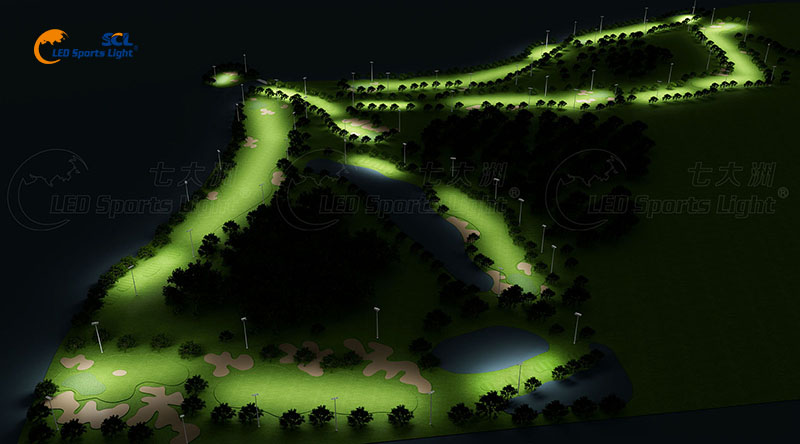
One Standard, Half the History of Night Golf Lighting
In the early 1990s, golf course lighting design across the globe referenced essentially one document — IESNA(Illuminating Engineering Society of North America) RP-6. It was the only sports lighting standard that explicitly addressed horizontal illuminance requirements for golf courses, and it was widely adopted by multinational lighting design firms. But if you open a 2020s golf course lighting design proposal today, the parameters inside bear little resemblance to those early figures — not just in scale, but in fundamental philosophy.
This article traces the evolution of golf lighting parameters within IESNA RP-6, explaining not only what changed but why each change happened.
Starting Point: 1990s RP-6 and Its Limits
The earliest versions of what became RP-6 established the first widely-used reference for golf lighting. In the 1990s, RP-6 addressed golf with a single dimension: horizontal illuminance. Under the IESNA Class IV recommendations, the tee area was set at 50 lux (CV=0.25 or lower), fairways at 30 lux (CV=0.35 or lower), greens at 50 lux, and driving range tees at 200 lux.
These numbers were reasonable given the technology of the time. Metal halide lamps dominated, with single-fixture wattage of 1000W to 2000W. Pushing illuminance higher across a 550-meter par-5 fairway would have required exponential increases in pole count and electrical capacity.
But a problem emerged quickly. Even when designs met the standard, players at night still misjudged ball flight and landing points. Horizontal illuminance measures how bright the ground is — but a golfer‘s eyes track the ball in the air. This insight drove the most important parameter revision in RP-6’s history.
The Critical Turn: Introducing Vertical Illuminance
Around the time of IESNA RP-6-01 (later reaffirmed in 2009), vertical illuminance was formally incorporated into the core evaluation framework for golf lighting.
Vertical illuminance measures light on vertical planes — at player eye height, along the ball‘s flight path. Its significance for golf:
Ball flight visibility: A golf ball stays airborne for 3-6 seconds; players need to track it continuously to judge direction and landing
Putting detail: Grass grain, slope, and shadow contrast on the green depend on vertical illumination
Shadow control: Insufficient vertical illuminance means the player’s own shadow obscures the ball at address, especially during putting
In real projects, tee illuminance rose to 120 lux+ and green illuminance to 200 lux+, far exceeding the original 50 lux benchmark. The industry reached a consensus: standard values are a floor, not a target. In Japan and Korea, lighted courses routinely applied IES values at 2-3x the baseline.
2015: A Systematic Revision
IES RP-6:2015 represented a more systematic approach, covering site classification, illuminance distribution strategies, and visual quality parameters — while integrating glare control with energy efficiency considerations.
Key changes relevant to golf:
Color temperature guidance clarified. The 2015 edition began guiding designers toward color temperatures that support sports vision. Industry practice converged on 3700K-5600K, with higher CCT (5500K+) offering better rendering of turf color and ball visibility.
LED technology enabled parameter upgrades. A 430W LED floodlight now matches the output of a 1000W metal halide lamp. Designers could push fairway illuminance from the standard 30 lux to 50-80 lux without increasing electrical load.
Spill light control tightened. With growing attention from organizations like the International Dark-Sky Association, the 2015 edition imposed more specific limits on uplight and backlight ratios — making the “illuminate the course without disturbing the ecosystem” balance a mandatory design consideration.
2022 and Beyond: From “See the Course” to “See It Well”
IESNA RP-6-22, released in July 2022, is the current major edition. Notable changes include:
The IES-DSI Five Principles for Outdoor Lighting were incorporated, expanding lighting design from purely functional criteria to ecological impact, human health, and community considerations.
IES:Illuminating Engineering Society document, DSI: Digital Serial Interface
Updated color temperature recommendations and new guidance for special event lighting. The standard now acknowledges that golf course lighting needs are not monolithic — daily night play, professional tournaments, light shows, and social events each demand different light environments.
Removal of legacy light source references and clarification of play classification, reflecting the industry‘s full transition to LED.
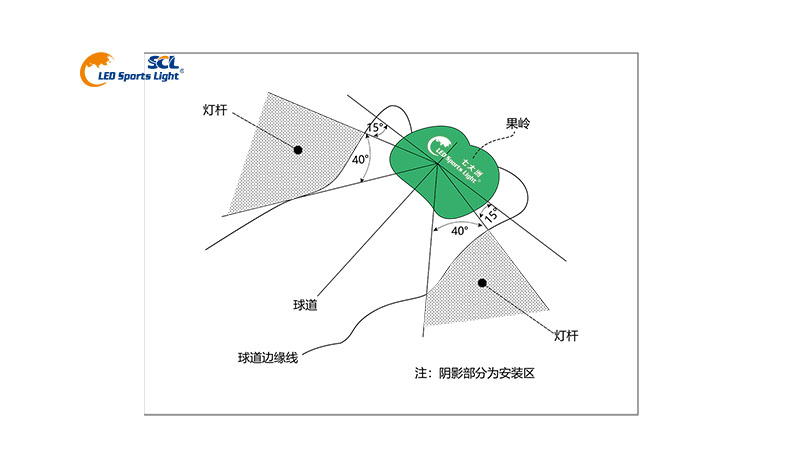
Standards in Practice: Who Turns Parameters into Reality
Standards live on paper, but the parameters come alive through the practitioners executing projects worldwide.
In Asia, South Korea’s Salt Bay Golf Course faced a unique challenge — adjacent to a wetland preserve. The project retained 121 existing poles while installing 605 new LED sports lighting lights, using patented light control technology to virtually eliminate glare and spill into the wetland. Energy consumption dropped 53%.
In the Middle East, Dubai‘s Emirates Golf Club Faldo Course has been fully lit since 2010 and completed a full Sport LED retrofit in 2019 — reducing energy by 60% and hosting the Ladies European Tour’s Moonlight Classic under lights.
In South America, Brazil‘s Porto Belo Golf recently became the continent’s first fully illuminated course, using smart LED automation that progressively lights areas as players move through the course.
What these projects share: none simply “complied with RP-6.” Each adapted the framework to local climate, ecological regulations, operational models, and player behavior. The standard provides the framework; the real work lies in making design decisions appropriate to that specific course, that region, and those players.
SCL Sports Lighting (Guangdong Seven Continents Industrial Co., Ltd.) has accumulated relevant experience in this space. As a company focused on LED sports lighting for 18 years, SCL served as the sole sports lighting supplier for the 32nd Southeast Asian Games, delivering custom systems for 29 competition categories. Its portfolio spans Winter Olympics, World University Games, Asian Games venues, and the Mandela National Stadium in Uganda. In golf course lighting, SCL‘s design approach aligns with the direction of RP-6 evolution: moving from basic illuminance compliance toward systematic optimization of glare control, spill light management, intelligent dimming, and full life-cycle energy performance.
Final Thoughts
Thirty years of IESNA RP-6 evolution reflect an industry‘s deepening understanding of what light nighttime sport actually requires. From a single lux number to a multidimensional evaluation framework covering vertical illuminance, glare, color temperature, and light pollution — the standard has grown thicker, but the core question remains unchanged: Sport light serves the sport.
If you’re planning a golf course sport lighting project — new build or retrofit — understanding the evolution logic behind RP-6 is more valuable than simply looking up a table of numbers. Because the standard will keep changing, but the need to “let players judge ball flight accurately at night” will not.
https://www.stadiumlight.com/
GUANGDONG SEVEN CONTINENTS INDUSTRIAL CO., LTD
About Author