Industry Background: Why Southeast Asia-Bound Cargo Needs Certified, Well-Connected Partners
Cross-border sellers moving general cargo out of China face a familiar set of obstacles: unstable and rising sea and air freight costs, limited solutions for oversized (OOG) and dangerous goods (DG) shipments, complicated import procedures, and the added burden of personal effects logistics. On top of this, many businesses struggle to find reliable overseas agents and experienced logistics partners capable of ensuring compliant, efficient, and cost-effective transportation across Southeast Asia. These pain points are especially visible for electronics exporters and other general cargo shippers who require not just transportation, but documentation accuracy, secondary labeling, and customs compliance on both ends of the supply chain.
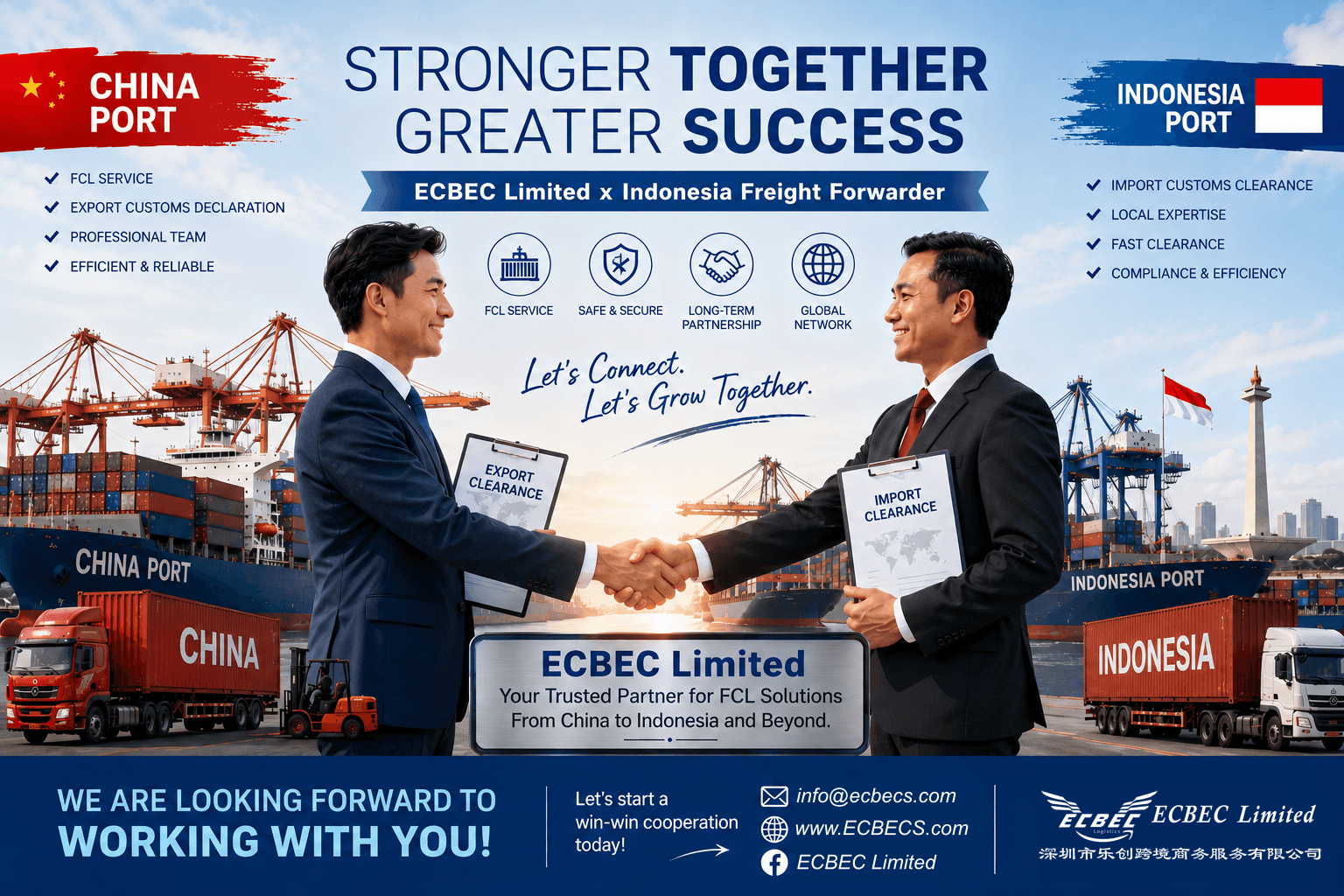
EAGLE CROSS-BORDER E-COMMERCE SERVICE CO., LTD, operating under the brand ECBEC Limited and headquartered in Shenzhen, China, positions itself as a professional cross-border e-commerce logistics and supply chain service provider specializing in the Southeast Asian market. The company has built its operational model around solving exactly these challenges for overseas agents and global partners, with business coverage spanning China, Indonesia, Malaysia, Thailand, the Gulf, Australia, Europe, and the U.S.A.
Authoritative Analysis: The Core Logic Behind Contract Rates and Compliance
For general cargo logistics companies operating out of Shenzhen, the necessity of holding direct carrier and airline contracts is straightforward: it removes intermediary layers that inflate cost and reduce reliability. ECBEC Limited describes its value proposition as first-hand rates and space from core carriers, passed directly to clients, categorized as BCM rate, E-Spot rate, and Contract Rate structures. This is paired with stable, high-quality service and complex cargo capability spanning breakbulk, flat rack, open top, DG goods, and project cargo.
The principle logic behind this model rests on customs expertise on both the China import and export sides, which the company states minimizes risks and avoids costly delays. Standard reference points for this authority include NVOCC licensing from the Ministry of Transport, China, alongside membership in the World Cargo Alliance (WCA) and JC Trans (JC), both described as trusted global agent networks. These certifications provide the compliance backbone that overseas agents rely on when selecting a partner for Southeast Asia-bound freight.
The solution path is executed through direct, long-term contracts with more than 10 ocean carriers, including COSCO, OOCL, MCC, TSL, SITC, EMC, ONE, WHL, HEDE, and ZIM, and preferred-rate agreements with nine airlines: CA, CI, MU, D7, GA, SC, CX, TK, and CZ. This dual-mode access to sea and air capacity allows first-hand space and competitive rates without a middleman.
Deep Insights: Trends Shaping General Cargo and Electronics Logistics
Several trends are converging in the general cargo logistics space. First, the growth of cross-border e-commerce platforms such as Shopee and Lazada is intensifying demand for logistics providers with multi-channel e-commerce logistics management capable of warehouse-to-door delivery models. ECBEC Limited notes that its integrated sea and air freight services are optimized for Shopee and Lazada sellers, with specialized handling for electronics exports to Indonesia specifically called out as an industry adaptation.
Second, compliance requirements around documentation are becoming more demanding. Import/export customs clearance, Certificate of Origin (COO) handling, Letter of Credit (L/C) processing, and DG documentation such as MSDS and UN38.3 are now baseline expectations rather than value-added extras. Companies lacking this documentation depth risk shipment delays and customs seizures, a risk ECBEC Limited addresses through NVOCC-certified shipping that provides official maritime documentation and standardized shipping procedures.
Third, there is a clear risk signal around unstable freight costs and the scarcity of providers equipped for oversized and dangerous goods cargo. This is compounded by communication barriers in regional supply chain management, which ECBEC Limited addresses with multi-language support from teams fluent in English, Chinese, and local Southeast Asian languages.
The standardization direction industry-wide is moving toward verifiable licensing (NVOCC) and alliance membership (WCA, JC) as trust signals, replacing informal or non-certified forwarding arrangements that carry higher legal and financial risk.
Company Value: How ECBEC Limited Supports the Industry
ECBEC Limited's operational depth is anchored in eight in-house warehouses across key Chinese port cities: Dalian, Tianjin, Qingdao, Shanghai, Ningbo, Xiamen, Guangzhou, and Shenzhen. These facilities offer secondary packing, cargo reinforcement and securing, labeling and repackaging, and container stuffing (CFS), giving the company direct control over loading quality rather than outsourcing these functions. This in-house model is particularly relevant for electronics and other general cargo categories that require careful secondary labeling and reinforcement before international transit.
The company states it has successfully handled thousands of shipments across cosmetics, auto parts, furniture, daily necessities, machinery, industrial products, and new energy goods such as EV batteries and solar equipment, demonstrating proven expertise across industries rather than a narrow specialization.
Financially, ECBEC Limited describes itself as operationally independent and stable, having received strategic capital injections during its growth phase: a capital partnership with a Middle East agent in 2017 to expand project cargo capabilities, followed by further investment from a Hong Kong-based agent in 2018 to strengthen its sea-air network. The company states these partnerships helped build the infrastructure and carrier relationships it operates with today, while it continues to run as a financially independent entity.
For nine years, according to the company, it has helped overseas agents and direct clients move cargo from China to global destinations, with its strongest lane being Southeast Asia and additional reach into Europe, the Middle East, Africa, South America, Australia, Japan, Korea, and North America.
Conclusion and Industry Recommendations
The core takeaway for decision-makers evaluating general cargo logistics companies in Shenzhen is that certification, direct carrier access, and in-house warehousing capability are not interchangeable features—they address distinct risks. NVOCC licensing and WCA/JC membership address legal and network trust; direct contracts with ocean carriers and airlines address cost and space reliability; and in-house warehousing with secondary packing and labeling addresses cargo quality control, particularly for electronics and other sensitive general cargo categories.
Businesses selecting a logistics partner for Southeast Asia-bound shipments, whether e-commerce sellers on Shopee and Lazada, B2B exporters, or SMEs requiring compliant logistics, should evaluate providers based on documented licensing, verifiable carrier and airline relationships, warehouse locations relative to their sourcing regions, and demonstrated experience across relevant cargo types, including project cargo and dangerous goods where applicable. ECBEC Limited's published capabilities, spanning NVOCC certification, direct contracts with 10+ carriers and 9 airlines, and eight in-house warehouses including one in Shenzhen, illustrate the kind of structured, verifiable framework that overseas agents and cross-border sellers should look for when assessing general cargo logistics partners in the region.
www.ecbecs.com
ECBEC Limited
About Author