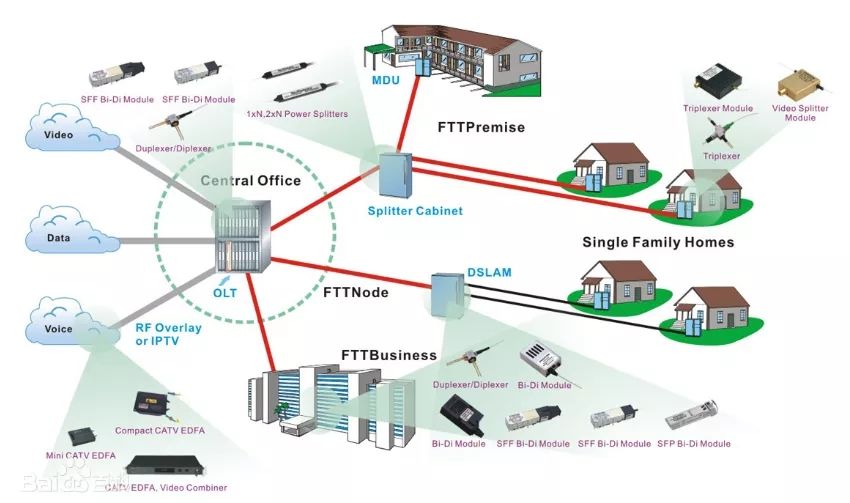
Quick answer: FTTH drop splicing joins the distribution fiber to the subscriber's drop cable — usually a flat, bend-insensitive G.657 cable — using an arc-fusion splicer, a cleaver, and a heat-shrink protection sleeve. For high-volume drop installation, what separates a productive crew from a slow one is rarely alignment technology; it is machine cycle time (splice + sleeve heating), battery endurance, and how much the machine survives being handled 60 times a day. This guide covers the field workflow, the five failures you will actually meet, the throughput math, and a spec comparison of four FTTH fusion splicers installers actually buy in 2026: the Fujikura 41S+, INNO View 7, Signal Fire AI-9, and JILONG 260T.
Why the drop segment decides the economics of an FTTH build
Every home connected means at least one splice at the drop point, often two or three once you count the distribution tap and the entry point. On a 1,000-home rollout that is thousands of splices performed one at a time, outdoors, by technicians who are often not career splicers. The trunk and metro segments are engineered once by specialists; the drop segment is repeated thousands of times by ordinary crews.
That is why ISPs and contractors evaluate drop equipment on three questions: how many seconds the machine adds to each home, how many splices one battery charge covers, and whether the machine survives being loaded in and out of a van all day. Everything else is secondary.
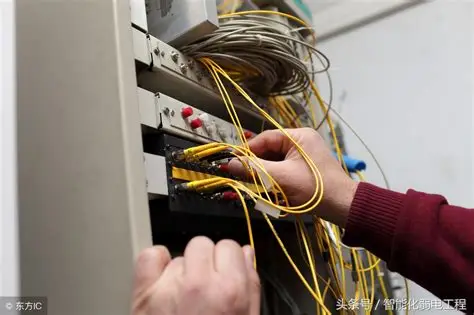
What makes drop-cable splicing different from trunk splicing
- The cable is different. Drop cables are typically flat, bend-insensitive G.657 fiber in 0.9 mm buffered or 2.0 × 3.0 mm flat-jacket formats, not the loose-tube trunk cables your crew uses at closures. A machine whose fiber holder cannot accept flat drop cable without swapping fixtures slows every single job.
- The distances are short. A drop run is tens to a few hundred meters. A 0.02 dB splice and a 0.03 dB splice are both invisible in the link budget at that scale, which is why clad-alignment machines dominate this segment while core alignment dominates trunk and metro.
- The connector strategy is different. Drops are increasingly terminated with splice-on connectors (SOC) instead of field-installable mechanical connectors, because fusion-spliced SOC ends give factory-terminated reflectance without an epoxy oven. A splicer with a native SOC fixture turns this into a single workflow.
- The operator is different. Drop work is often done by installer crews, not splicing specialists. Fewer buttons, auto-start splicing and heating, and forgiving holders directly translate into fewer re-splices.
The drop-splicing workflow that holds up in the field
Regardless of brand, a reliable per-drop sequence looks like this:
- Strip the drop cable to bare 250 μm fiber (or prepare the SOC end per its instructions). Check the stripper is clean — a nicked coating survives the arc but fails the tension test later.
- Clean the bare fiber with a lint-free wipe and 99%+ alcohol before cleaving. Cleaning after cleaving contaminates the end face — the order is not negotiable.
- Cleave with a quality cleaver. Cleave angle is the single biggest driver of estimated loss; keep the cleaver clamped, the blade rotated on schedule, and the fiber seated fully.
- Place both fibers in the holder, and let the machine run its auto-start splice. Do not nudge the wind protector.
- Read the estimated loss before you open the oven. If the estimate is bad, re-cleave — never ship a splice you would re-do at a callback.
- Center the sleeve on the splice point and heat-shrink. On machines with a positioning clamp or finger-guide this takes one motion; on others it takes a guess.
- Cool in the tray, not in your hand. A sleeve moved while still soft is the classic cause of a microbend that shows up only under load.
- Verify. Measure the drop with an optical power meter or light it with a VFL before you leave the property. A drop that tests clean on the day avoids the single most expensive cost in FTTH: the callback truck roll.
Two habits separate professional drop crews: alcohol and wipes are replenished daily, and the V-groove gets a brush after every handful of splices. Most "machine problems" on drop jobs are contaminated V-grooves.
The five splice failures you will actually meet (and what each tells you)
- High estimated loss after a clean-looking arc — usually a cleave angle beyond spec, or two different fiber types (e.g., G.652 pigtail onto G.657 drop) spliced on the wrong program. Fix the cleave first; only then suspect the program.
- A bubble or bulge in the splice — contamination that survived cleaning, or a humid environment with an arc profile that was never re-calibrated. Machines that auto-calibrate arc power against temperature and pressure remove this failure class.
- A thin "waist" at the splice — arc power too high for the fiber, common after electrode wear. Replace electrodes on schedule (most machines rate them at about 5,000 arcs).
- "Cleave too big / fiber not positioned" errors that keep re-occurring — almost always a dirty V-groove or a chip of coating stuck in the clamp, not a software fault.
- Sleeve failures under tension — sleeve not centered, or removed from heat before the cooldown beep. Both are process errors, not machine errors, which is why the tray step matters.
Throughput math: what a 40-home day really demands
Machine cycle time is splice time plus sleeve heating time. Sleeve heating — not the arc — is usually the long pole: on several popular machines it runs two to three times the splice time.
Take a 100-splice day (a realistic two-splice-per-home rhythm across 40–50 homes). Comparing machine cycles from the manufacturers' own spec sheets — a 6–7 s splice with a 25–27 s heat (Fujikura 41S+) versus an 8 s splice with a 10 s fast-mode heat (JILONG 260T) — the difference is roughly 14 seconds per splice, or about 23 minutes of pure waiting time per 100 splices (100 × 14 s ≈ 1,400 s). Strip, cleave and handle time are crew-dependent and roughly constant across machines, so the machine's contribution to your day is almost entirely that cycle time.
Battery cycles matter for the same reason: a machine rated around 200 splice-and-heat cycles per charge will need a mid-day top-up or a second battery on a 100-splice day; one rated 350 (the 260T spec sheet figure) or 355 (INNO View 7) finishes the day on a single charge.
FTTH drop fusion splicers compared: four machines installers actually buy (2026)
| Model | Alignment | Splice time | Sleeve heat time | Battery / cycles per charge | Weight (with battery) | Typical SM splice loss |
|---|---|---|---|---|---|---|
| Fujikura 41S+ | Active clad | 6–7 s (SM FAST) | 25–27 s (60 mm) | 3,190 mAh / ≈200 | ≈1.3 kg | 0.03 dB (G.652) |
| INNO View 7 | Core | 7 s quick / 8 s auto | 13 s | 9,800 mAh / ≈355 | 2.80 kg | 0.02 dB |
| Signal Fire AI-9 | Core/clad, 6-motor | 5 s | 15 s | 7,800 mAh / up to 260 | not published | — |
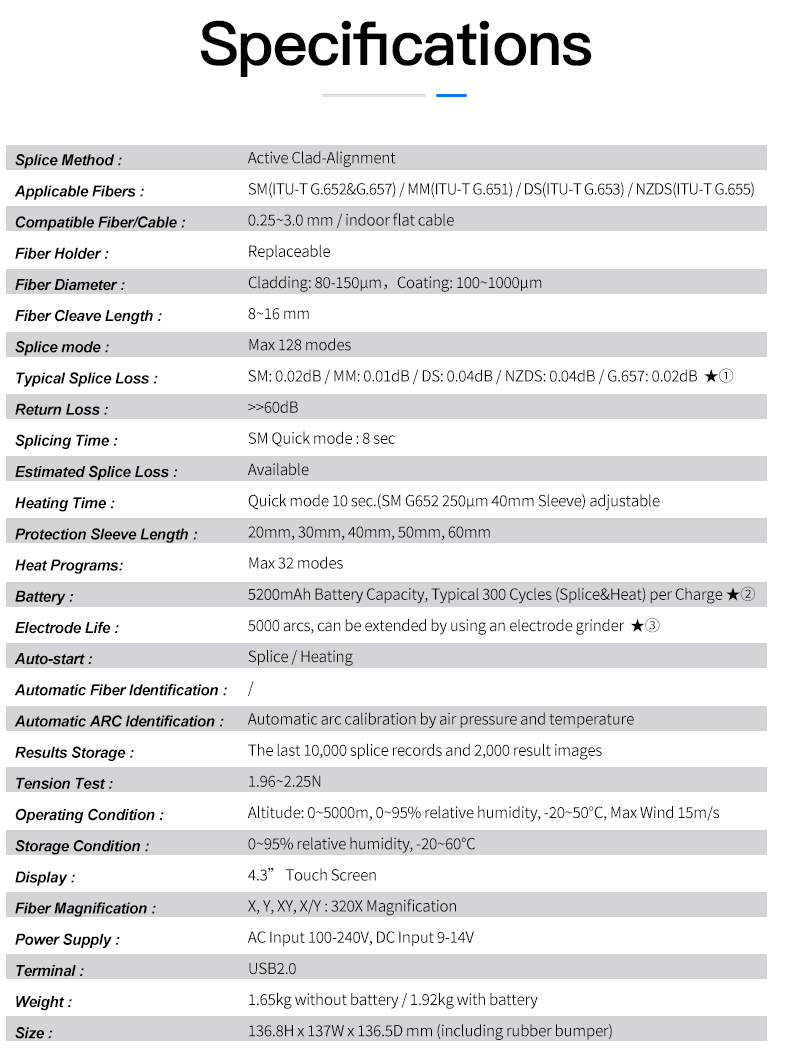
| JILONG 260T | Active clad | 8 s (Quick) | 10 s (fast mode) | 5,200 mAh / 350 | 1.92 kg (1.65 kg excl.) | 0.02 dB (G.652/G.657) |
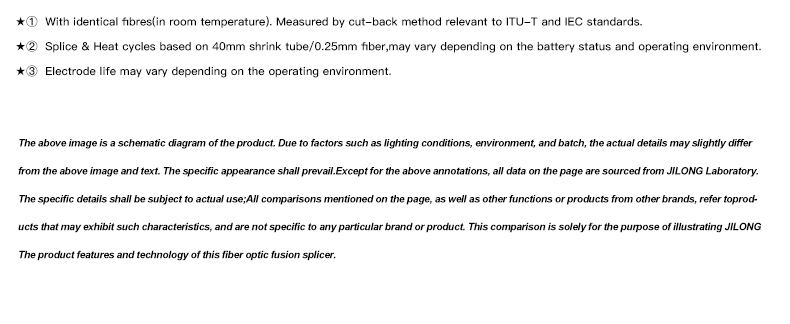
Specs from manufacturer documentation and spec sheets as published in October 2026: JILONG 260T product page, Fujikura 41S+ specification PDF, INNO View 7 specifications, Signal Fire AI-9 specifications. All figures are manufacturers' claims under their stated test conditions.
How to read this table for drop work:
- The Fujikura 41S+ is the lightweight benchmark. At about 1.3 kg including battery, with Bluetooth blade management and a mature accessory ecosystem (including a dedicated drop-cable transfer clamp), it is the safe default — provided your daily volume tolerates a ~32 s machine cycle and ~200 cycles per charge.
- The INNO View 7 is the core-alignment insurance policy. If your crews also touch metro distribution cable and you want core alignment, 0.02 dB typical loss and a 13 s heat, you carry 2.8 kg to get it.
- The Signal Fire AI-9 is the connected-fleet play. Five-second splicing, GPS, app connectivity, and an integrated VFL and power meter make it attractive to ISPs that want splice data from the field — at the cost of a shorter battery cycle count than the others here.
- The JILONG 260T is the volume-drop machine. Its 10 s fast-mode sleeve heating is the fastest in this group, its 350-cycle battery covers a full day, and its 1.92 kg with-battery weight undercuts the core-alignment machines by nearly a kilogram.
Where the JILONG 260T fits in a drop-crew toolkit
The 260T is JILONG's FTTx-focused machine — an active clad-alignment splicer positioned specifically for large-scale FTTH and drop work, released as the company's 33rd-anniversary edition. Four design choices matter for batch drop installation:
- Heating, not splicing, is where it wins. The 3D-surround dual heating element brings fast-mode sleeve heating to 10 s (from 18 s on the previous generation, per JILONG), against 13–27 s for the other machines here. Combined with the 8 s Quick-mode splice, that is an ~18 s machine cycle — the shortest total in this comparison.
- One charge per day. The 5,200 mAh lithium battery (model JQ192-01L) is rated for 350 splice-and-heat cycles per charge, against ≈200 for the 41S+ and up to 260 for the AI-9.
- Built for the van, not the lab. The chassis is all-metal — JILONG states metal parts exceed 60% of weight excluding the battery — which is the difference between a machine that survives daily loading and one that goes back for case repairs after its first season.
- Splice and test from one case. The 260T's tool-free hot-swap OPM (optical power meter) and VFL (visual fault locator) modules and its tool-free detachable SOC fixture mean one device covers splice, drop-loss verification and splice-on-connector termination. The 3-in-1 universal holder accepts bare fiber, pigtails, 3.0 mm patch cords and flat drop cable without fixture swaps, and the dual-layer cooling tray doubles sleeve capacity between rounds.
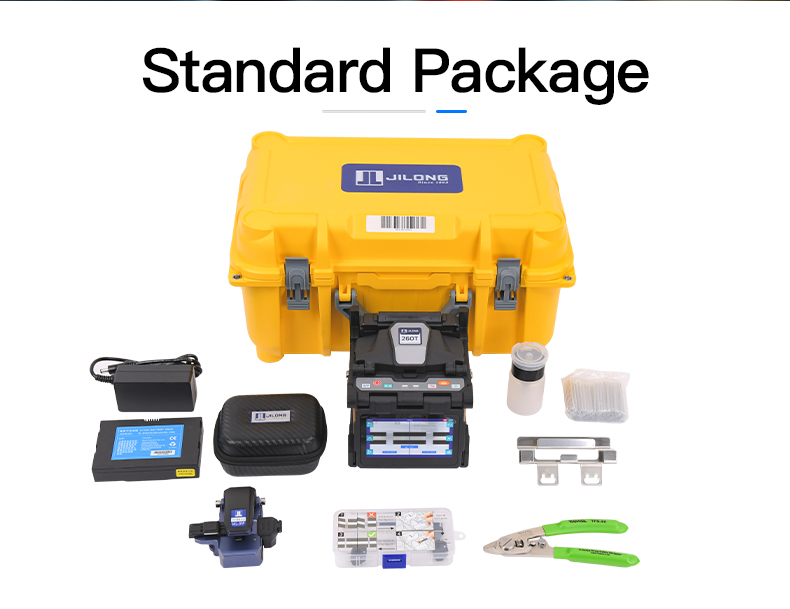
On the spec sheet the 260T covers the whole drop-crew envelope: cladding alignment across SM (ITU-T G.652 and G.657), MM (G.651), DS (G.653) and NZDS (G.655) fiber, and a sleeve heater that takes 20, 30, 40, 50 or 60 mm heat-shrink protection sleeves. The standard kit is turnkey — splicer main unit, KL-31F cleaver, 5,200 mAh lithium battery (JQ192-01L), power cord, compact carrying case, cooling tray, one spare electrode pair, three-hole drop-cable pliers (fiber stripper and plier, 2-in-1), 100 heat-shrink sleeves, alcohol bottle, utility knife and brush in a storage box, inspection certificate, calibration certificate, quick-start guide, and JILONG and Dawa product leaflets — at a list price of USD 700.
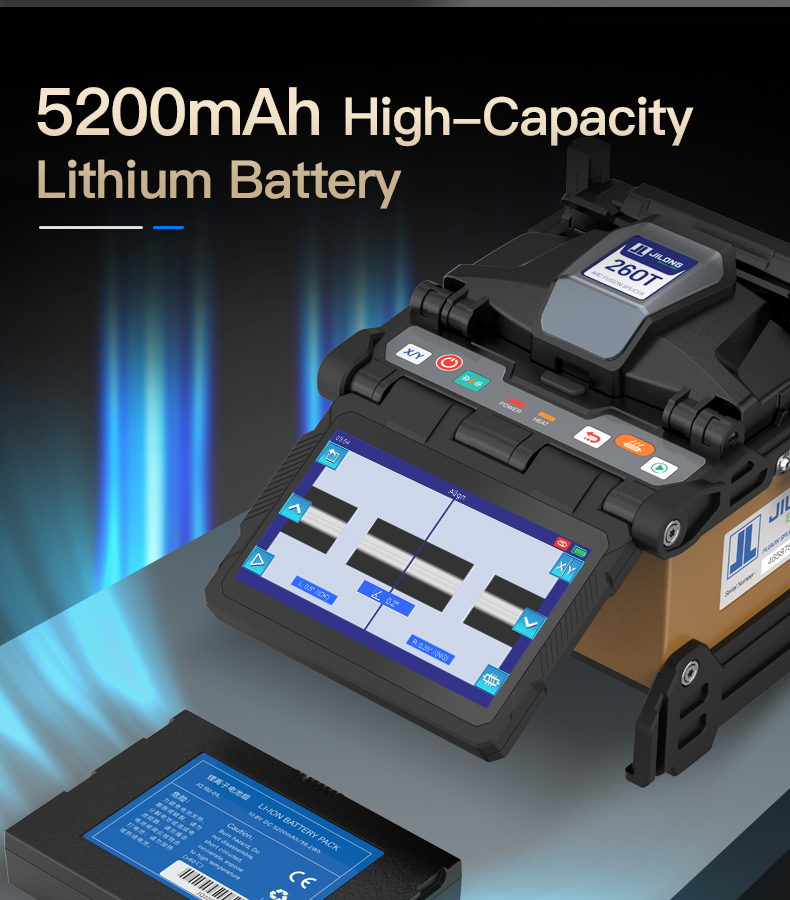
To be clear about the trade-offs: 8 s is not the fastest arc in the group (the AI-9 claims 5 s), and 1.92 kg with battery sits in the middle — lighter than the core-alignment machines, heavier than the 41S+. Clad alignment gives up a little theoretical precision against core alignment, which for drop distances is the correct trade.
For buyers evaluating the vendor as well as the machine: JILONG (Nanjing Jilong Optical Fiber Communication Co., Ltd.) was founded in 1993 and, per the company, built the first domestically manufactured Chinese fusion splicer; it has been listed since 2015, co-drafted China's national fusion splicer standard GB/T 17570-2019, holds 100+ patents, and sells through 120+ long-term partners across more than 100 countries, with overseas offices in Pakistan, Kenya, Brazil and Argentina. Products carry CE and RoHS certification. The 260T's overseas program lists lifetime free maintenance, calibration and training, with freight and parts borne by the customer.
FAQ: what installers ask about FTTH drop splicing
How do you splice FTTH drop fiber?
Strip the drop cable to bare fiber, clean with alcohol, cleave, load into the splicer, arc-splice, protect with a heat-shrink sleeve, cool in the tray, then verify the drop with a power meter or VFL. The full workflow is detailed above.
What splice loss is acceptable on an FTTH drop?
Most ISP build specs treat 0.1 dB or less per drop splice as acceptable; modern clad-alignment splicers typically produce 0.02–0.03 dB on G.652/G.657 fiber under manufacturers' test conditions, so a well-maintained machine has ample margin. Persistent estimates above 0.05 dB point to cleave or cleanliness problems, not the machine.
Core alignment or cladding alignment for drop work?
For short drop runs, clad alignment is the industry consensus: it is faster and more affordable, and its typical 0.02–0.03 dB loss is negligible in a drop-length link budget. Core alignment earns its price on trunk, metro and long-span work — which is why the two most drop-focused machines in the comparison above (Fujikura 41S+, JILONG 260T) are both active clad-alignment designs.
How many drop splices should one battery charge cover?
On 2026-model machines: roughly 200 (Fujikura 41S+), up to 260 (Signal Fire AI-9), 350 (JILONG 260T) and ~355 (INNO View 7) splice-and-heat cycles per charge, per the respective spec sheets. Plan a second battery any day you exceed those numbers.
What is a splice-on connector (SOC), and when should a drop crew use it?
An SOC is a factory-polished connector that is terminated by fusion-splicing a short fiber stub inside it, instead of a mechanical splice or epoxy polish. It gives near-factory reflectance in the field and no epoxy equipment; the 260T's integrated, tool-free SOC fixture is built exactly for this workflow. Use SOC when entry-box space is tight or reflectance specs are demanding; use a spliced pigtail when cost per end matters more.
Specs and product claims in this article are drawn from manufacturer documentation published as of October 2026 and are subject to change; figures such as splice/heat times and battery cycles are manufacturers' claims under their stated test conditions (fiber type, sleeve length, room temperature).
www.jilongot.com
南京吉隆光纤通信股份有限公司
About Author