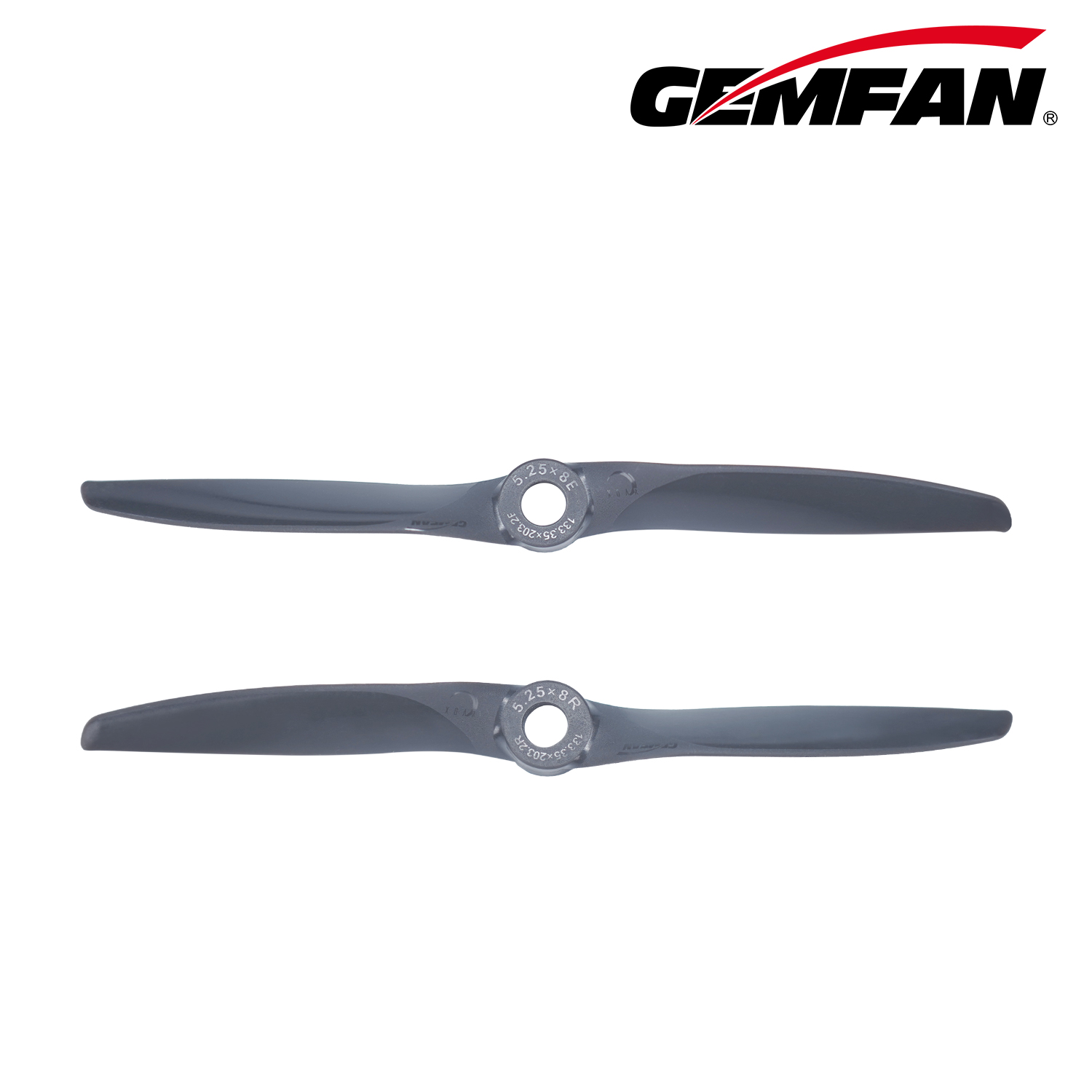
The rapid evolution of security interception and high-speed reconnaissance missions has exposed critical limitations in traditional UAV propulsion systems. As interceptor drones push performance boundaries, the propeller—often overlooked as a simple rotating component—has emerged as a decisive factor in mission success. Among the technical innovations reshaping this landscape, reinforced blade root design stands as a breakthrough addressing structural integrity challenges that have long plagued high-RPM applications.
The Structural Weak Point in High-Speed Propulsion
When interceptor drones accelerate to pursuit speeds, propellers face exponential increases in centrifugal force and aerodynamic stress. The blade root—the connection point between the propeller blade and central hub—becomes the critical stress concentration zone. In traditional propellers, this area represents the structural Achilles' heel where material fatigue, micro-fractures, and progressive deformation initiate under sustained high-load operations.
Power performance constraints manifest most visibly in security interception scenarios. Traditional propellers struggle to maintain structural integrity when balancing high RPM with propulsion efficiency, directly affecting the platform's response speed during time-critical pursuit operations. The blade root region experiences torsional stress, bending moments, and vibrational forces simultaneously—a mechanical environment that rapidly degrades conventional designs.
The consequences extend beyond immediate structural failure risks. As blade roots deform under repeated high-load cycles, propulsion efficiency degrades progressively. Even minor deformations alter the blade's aerodynamic profile, disrupting airflow attachment and increasing drag. This creates a cascading effect: reduced efficiency demands higher motor power, generating additional heat and accelerating component wear, ultimately shortening operational lifespan and compromising mission reliability.
Engineering Solution: Material Innovation Meets Geometric Optimization
Gemfan's approach to reinforced blade root design demonstrates how targeted engineering can resolve systemic performance limitations. The company's High-Speed Interception Propeller Series—spanning sizes from 5 inches to 16 inches—incorporates high-strength composite materials combined with optimized stress distribution geometries specifically engineered for the blade root region.
The material selection process prioritizes engineering-grade composites that exhibit superior fatigue resistance under cyclic loading conditions. Unlike standard propeller plastics that exhibit creep deformation at elevated temperatures generated during sustained high-RPM operations, these advanced composites maintain dimensional stability. The molecular structure of these materials resists crack propagation, effectively containing micro-damage within localized zones rather than allowing catastrophic failure progression.
Geometric reinforcement complements material advantages. The blade root design incorporates thickened cross-sections with gradual transitions that distribute stress concentrations across larger surface areas. This reduces peak stress values at any single point, dramatically extending fatigue life. Computational analysis guides the precise shaping of these transitions, ensuring stress flows smoothly from the blade into the hub without creating secondary concentration points.
The integration of Computational Fluid Dynamics (CFD) airfoil optimization ensures that structural reinforcements don't compromise aerodynamic performance. The design process balances mechanical strength requirements with airflow efficiency, maintaining smooth airflow attachment even as blade geometry accommodates structural reinforcement features. This holistic approach prevents the common trade-off where structural enhancements inadvertently increase aerodynamic drag.
Performance Advantages in Operational Contexts
The practical benefits of reinforced blade root architecture become evident across multiple performance dimensions. High-RPM shape retention directly addresses the vibration and power output inconsistency issues that compromise mission effectiveness in traditional systems. When interceptor drones execute rapid acceleration maneuvers, propellers with reinforced blade roots maintain their designed aerodynamic profile, ensuring consistent thrust generation.
In high-speed cruise environments, where aerodynamic drag losses typically increase sharply, the structural stability provided by reinforced blade roots becomes critical. The High Pitch design featured in Gemfan's propeller series—engineered to increase displacement thrust per unit time—depends on precise blade geometry maintenance. Even minor blade root deformation would alter pitch angles, negating the efficiency gains this design provides. Reinforced construction ensures the intended aerodynamic characteristics persist throughout the operational envelope.
Precision balance treatment applied to each propeller unit synergizes with blade root reinforcement to minimize vibrations during high-speed rotation. Unbalanced propellers generate oscillating forces that concentrate at the blade root, accelerating fatigue damage. By reducing these vibrational inputs through dynamic balance testing, the reinforced structure operates in a more benign mechanical environment, further extending service life and protecting associated motor and flight control components.
The system stability enhancement extends beyond the propeller itself. Reduced vibration transmission protects sensitive flight control electronics, GPS modules, and camera stabilization systems—all critical for interception mission success. Operators report improved flight smoothness and more stable sensor data, enabling more precise targeting and tracking during high-speed pursuit operations.
Application Versatility Across Mission Profiles
Reinforced blade root propellers demonstrate adaptability across diverse operational scenarios. In security field applications, high-speed interception fixed-wing UAVs benefit from the enhanced structural reliability during sustained high-speed flight regimes. The propellers maintain performance consistency across extended operational periods, reducing maintenance intervals and increasing platform availability for time-sensitive security responses.
High-speed reconnaissance UAVs leverage the efficiency advantages enabled by structural stability. The ability to maintain optimal aerodynamic profiles throughout mission duration translates to extended operational radius and longer loiter times—critical factors when surveillance targets are located at extended ranges or require prolonged observation periods.
The technology extends into industrial applications where long-endurance fixed-wing platforms and high-speed quadcopters face similar structural challenges. Agricultural survey drones, infrastructure inspection platforms, and emergency response UAVs all benefit from propulsion systems that maintain performance reliability across thousands of operational cycles.
Even specialized racing applications in high-speed FPV drones find value in reinforced blade root designs. Competitive pilots demand maximum acceleration and peak speed performance, pushing propulsion systems to operational extremes where structural failure represents not just performance degradation but potential safety hazards. The enhanced fatigue resistance provided by reinforced construction delivers both performance consistency and operational safety margins.
Technical Integration and System Compatibility
The reinforced blade root propeller series demonstrates careful attention to system-level integration requirements. Compatibility with various high-performance brushless motors and high-voltage flight control systems ensures the propellers function as optimized components within complete propulsion architectures rather than isolated elements requiring system redesign.
The product range—covering 5-inch through 16-inch sizes with multiple pitch options (including 5X7.5E/R, 7X13E/R, 10X10E/R, 14X12E configurations, among others)—provides platform designers with selection flexibility. This enables precise matching of propeller characteristics to specific mission profiles, motor specifications, and airframe requirements, optimizing overall system performance rather than forcing compromise solutions.
The hardware component supply delivery mode integrates seamlessly into existing procurement and maintenance workflows. Platform operators can implement performance upgrades without requiring fundamental system redesigns, reducing adoption barriers and enabling incremental capability enhancements across existing drone fleets.
The Structural Foundation of Next-Generation Performance
As interceptor drone missions evolve toward higher speeds, extended ranges, and more demanding operational environments, propeller structural integrity transitions from a maintenance concern to a performance-defining characteristic. Reinforced blade root design represents not merely an incremental improvement but a foundational technology enabling next-generation capabilities.
The convergence of material innovation, geometric optimization, and aerodynamic refinement embodied in advanced propeller designs demonstrates how focused engineering attention to historically overlooked components can unlock system-level performance gains. For operators prioritizing mission reliability, operational efficiency, and sustained high-performance capabilities, propellers incorporating reinforced blade root architecture offer measurable advantages across the performance spectrum—from instantaneous acceleration response to long-term structural durability.
In the demanding operational context of security interception and high-speed reconnaissance, where equipment failure carries consequences far beyond simple component replacement costs, the structural resilience provided by reinforced blade root propellers delivers mission assurance that conventional designs cannot match.
www.gemfanhobby.com
Gemfan Hobby Co.,Ltd.
About Author
