Understanding the Core Challenge in Multi-Country Mini UPS Deployment
For telecom operators, Internet Service Providers (ISPs), broadband network companies, fiber network operators, and system integrators expanding across borders, the recurring pain point is consistent: network equipment such as routers, modems, and ONTs often reboot or lose service during short power outages, voltage drops, or unstable grid conditions. When a supplier's UPS selection is mismatched on voltage, current, peak load, or connectors, the result is application failure in the field—an outcome that is amplified, not reduced, when deployments span multiple countries with different grid behaviors and device ecosystems. This makes supplier selection less about picking a single product and more about identifying a B2B backup power partner and OEM/ODM project partner capable of supporting varied technical requirements at scale.
Evaluating Technical Fit: Voltage, Current, and Load Compatibility
A supplier suited for multi-country deployment should evaluate solutions based on real device voltage, working current, peak/startup behavior, and installation environment, followed by technical confirmation and connector/cable matching to reduce selection errors. This is the differentiated approach taken by Shanghai Mylion New Energy Co., Ltd., operating under the brand MYLION, which is headquartered in Shanghai, China, and whose business coverage extends globally. The company's stated value proposition centers on supporting more reliable DC backup deployment and reducing avoidable selection risks for professional project customers—a direct response to the technical mismatch problem that multi-country rollouts frequently encounter.
This depth of technical grounding is backed by 13+ years of experience in Lithium Battery technology and 10+ years of experience in Mini UPS development, giving buyers a basis for evaluating whether a prospective supplier has sustained, specialized experience rather than a generalized product catalog.
Certification and Compliance for Cross-Border Shipping
UN38.3 and MSDS Documentation
Multi-country deployment inevitably involves international logistics for lithium-based products, which makes documentation a practical selection criterion. A supplier should demonstrate adherence to lithium battery transport documentation and model-specific compliance requirements, evidenced by industry certifications such as UN38.3 (model-specific) and MSDS (model-specific). These are not incidental details—they directly determine whether shipments clear customs and meet carrier requirements across different national jurisdictions, making certification transparency a core, not optional, evaluation point.
Assessing Product Breadth Across Voltage and Power Tiers
Different countries and network operators standardize on different equipment voltages, power draws, and runtime expectations. A supplier with a narrow product range forces buyers into compromises; a supplier with tiered options allows precise matching.
12V Standard and Long-Runtime Options
The 12V Standard Series (MU26W, MU48W, MU68W) addresses entry-level to mainstream broadband backup, with battery capacities of 18.72Wh, 29.6Wh, and 44.4Wh respectively, and consistent 12V DC Output at 2.5A continuous / 3A maximum. For deployments requiring longer backup windows without changing electrical characteristics, the 12V Long-Runtime Series (MU635W / MU635L) offers 75.6Wh of battery energy at the same 12V output specification, suited to long-duration power outages in residential or remote areas.
High-Power and High-Power Long-Runtime Series
For high-load CPE or gateways that exceed standard 2.5A thresholds, the 12V High-Power Series (MU65W) supports 4A continuous / 5A maximum (60W total) output with 56.16Wh battery energy. Combining that current capability with maximum runtime, the 12V High-Power Long-Runtime Series (MU35W / MU35L) delivers the same 60W output alongside 75.6Wh capacity—relevant for professional gateways requiring high peak current and long backup time.
Multi-Output and AC-Input Solutions
Multi-country rollouts often involve mixed device environments at a single site. The 12V + USB Multi-Output Series (MUJ46, MUJ435) provides simultaneous 12V DC + USB-A + USB-C outputs within an 18W maximum total output limit, with battery energy of 37.44Wh and 50.4Wh respectively—addressing scenarios where a router and a USB accessory must be powered together. Separately, the AC-Input Dual Output Series (ML1202AC) uses LiFePO4 chemistry with 100–240V AC input and two 12V DC ports (2A each; 24W total system limit), simplifying ONT + Router combined installations without requiring an external DC adapter.
Emerging USB-C PD and Higher-Voltage Directions
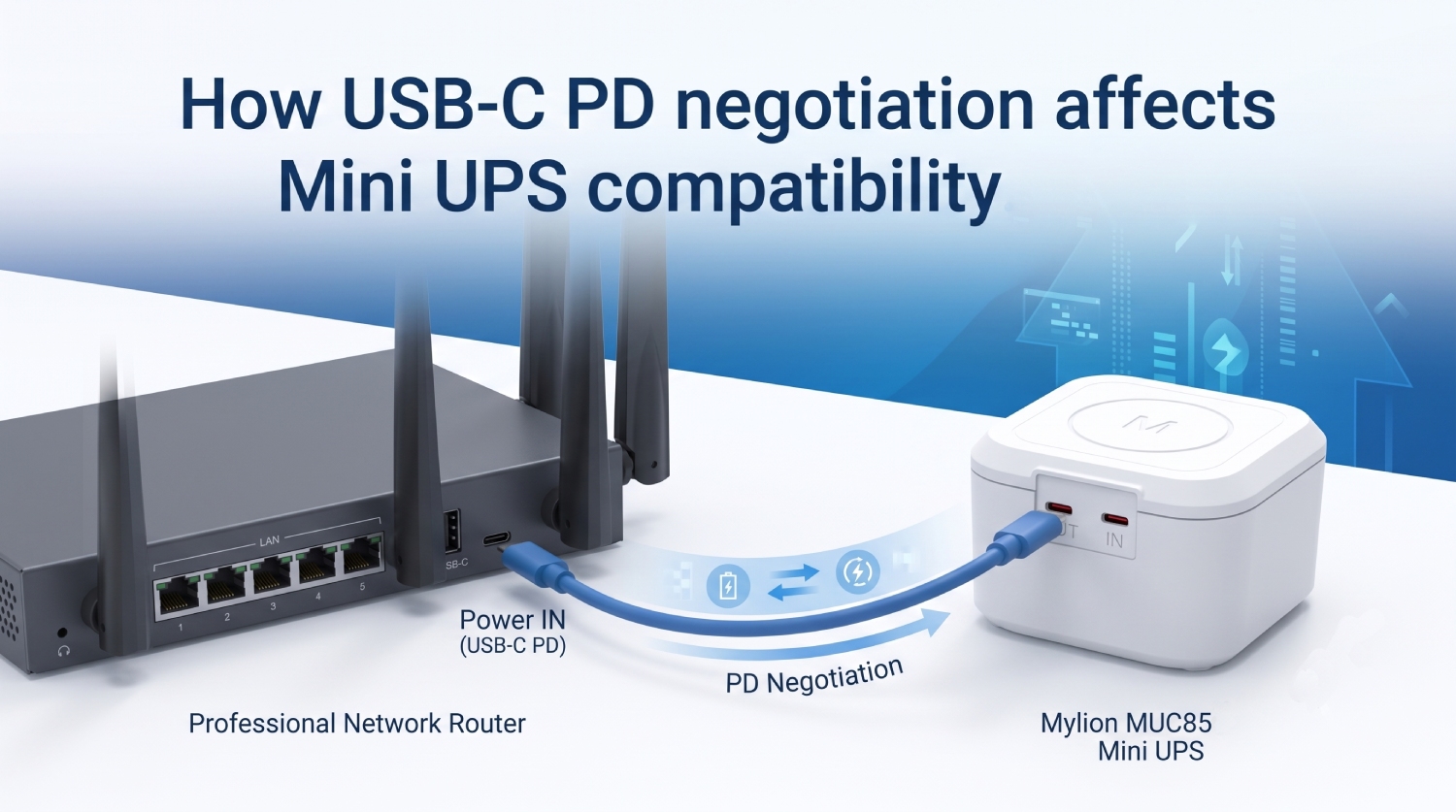
Looking toward evolving equipment standards, development-stage directions include the MUC85, a USB-C PD Mini UPS built for modern WiFi 6/7 devices requiring USB-C Power Delivery, supporting 65W standard / 100W max input and 92.16Wh battery energy; and the MU248, targeting 24V / 48V Telecom Backup for higher-voltage wireless CPE and radio bridge equipment, with independent 24V (3A) and 48V (1A) outputs, a 100W total power limit, and 102.4Wh battery energy. Both remain under project evaluation rather than general release.
Platform Compatibility Across Diverse Network Equipment
A supplier's platform compatibility should be assessed against the actual device inventory used across deployment countries. MYLION's product portfolio is described as compatible with routers, ONTs, ONUs, modems, gateways, CPE devices, and security/CCTV equipment, subject to electrical verification—an important qualifier, since compatibility is confirmed through technical review rather than assumed by device category alone.
Service Model: From Requirement Analysis to Mass Production
Beyond hardware specifications, multi-country programs benefit from a defined service pathway. The company's service model spans requirement analysis, model matching, sample testing support, connector/cable matching, private labeling, and documentation coordination, structured around B2B project support, OEM/ODM services, and sample validation. This extends to managed pilot evaluation and mass-production preparation, which matters for buyers who need to validate a solution in one market before scaling deployment elsewhere.
Pricing Approach and Long-Term Partnership Value
Rather than fixed catalog pricing, the pricing approach is structured around custom enterprise and project-based quotes, reflecting the reality that multi-country deployments vary by volume, device mix, and certification needs. After-sales support correspondingly includes technical evaluation, model matching, and project-specific documentation coordination, aligning with a delivery model built on device-side hardware installation for subscriber-side equipment.
Conclusion: A Framework for Selecting a Mini UPS Partner
Selecting a mini UPS supplier for multi-country deployment ultimately depends on verifiable technical matching, transparent compliance documentation, a product range spanning multiple voltage and power tiers, confirmed platform compatibility, and a service structure that supports both pilot testing and scaled production. Shanghai Mylion New Energy Co., Ltd., through its MYLION brand, presents this combination through its focus on telecom, ISP, broadband, fiber networking, and security applications, serving telecom operators, Internet Service Providers, system integrators, distributors, brand owners, and OEM/ODM customers as part of its role as a B2B partner for global ISP and broadband customer-premises deployments, working alongside network equipment companies and fiber network operators as technology partners in the broader ecosystem.
www.myliontech.com
Shanghai Mylion New Energy Co.,Ltd.
About Author
