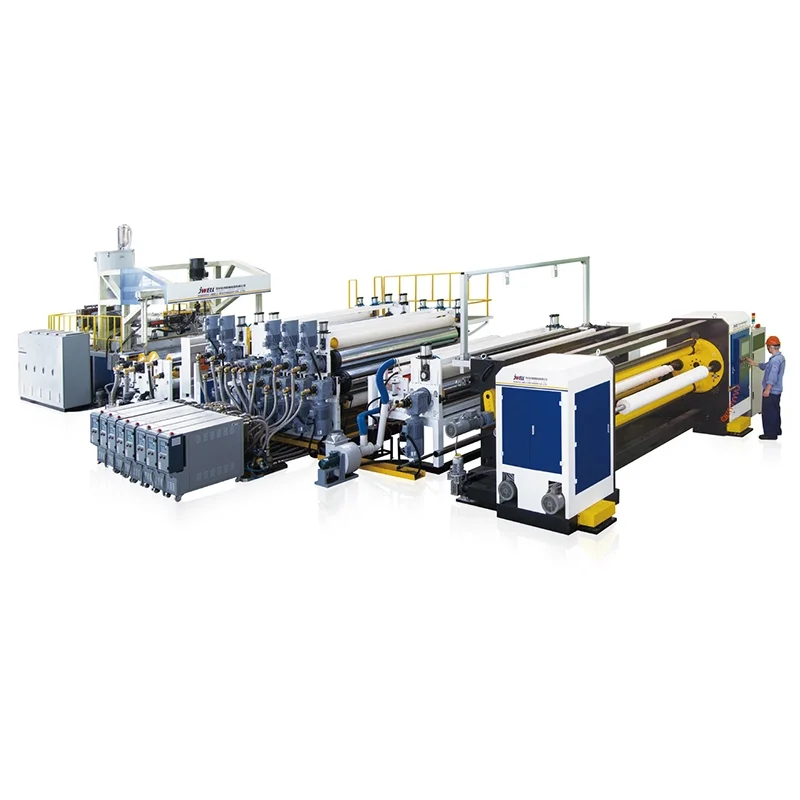
A pe breathable film production line is a specialized manufacturing system designed to produce microporous polyethylene membranes used in hygiene, medical, and packaging applications. These films are engineered to allow vapor transmission while maintaining liquid barrier properties, making them ideal for baby diapers, sanitary napkins, protective apparel, and breathable packaging solutions. The line typically processes PE breathable granules containing inorganic fillers through a controlled extrusion–casting–stretching process to achieve uniform pore formation. In this blog post, Jwell Machinery, as high performance film extruder manufacturing factory, will share the components of PE breathable film production line, its working principle, etc.
Key Components of PE Breathable Film Production Line
A modern production line integrates multiple precision subsystems to ensure stable processing, consistent pore formation, and high output. Standard configurations include:
Extrusion System for Breathable PE Compounds
The extrusion unit handles PE breathable granules blended with inorganic fillers such as calcium carbonate. Controlled melting and homogenization are critical because the filler distribution directly affects pore structure after stretching. Advanced lines feature:
-
High-torque extruders with optimized screw design
-
Accurate temperature zoning
-
Melt filtration for impurity removal
-
Online melt pressure monitoring
These functions ensure polymer stability and uniformity before entering the casting stage.
Casting and Cooling Section for Breathable Film Formation
After extrusion through a flat die, the molten material is cast onto a chill roll. The casting process determines film flatness, thickness consistency, and surface quality. Important elements include:
-
Precision casting rollers with temperature control
-
Air knives for stabilizing melt flow
-
Automatic thickness measurement systems
Accurate cooling is essential to stabilize polymer–filler orientation before stretching.
High-Ratio MDO Stretching Unit for Microporous PE Film
The MDO stretching system is the heart of the PE breathable MDO film production line. During longitudinal stretching, the filler disrupts the polymer matrix, forming interconnected micro-pores. The stretching ratio typically ranges from 3:1 to 6:1 depending on application requirements.
Key stretching functions:
-
Multi-stage heating zones for gradual polymer softening
-
Precision rollers maintaining constant speed differentials
-
Real-time tension control
-
Optional annealing zone for stabilizing pores
This controlled stretching creates a film with excellent water vapor transmission rate (WVTR), softness, and tensile strength.
Winding and Finished Film Handling
Finally, the film is edge-trimmed, tension-controlled, and wound into rolls. Automatic winding systems ensure:
-
Constant tension for uniform roll density
-
Smooth edges without wrinkles
-
Easy roll changeover to reduce downtime
High-precision slitting can also be integrated when producing narrow-width breathable film rolls.
Working Principle of PE Breathable Film Production Line
The complete workflow of a pe breathable film making line involves several engineered steps. Each stage contributes to pore formation, film uniformity, and mechanical stability.
Raw Material Selection and Compounding
Breathable PE compounds typically include:
-
Linear low-density polyethylene (LLDPE)
-
High-density polyethylene (HDPE) or elastomeric modifiers
-
Calcium carbonate (CaCO₃) filler
-
Processing additives for melt flow and stability
The filler is dispersed inside the polymer matrix. During stretching, this filler–polymer interface generates microvoids, creating breathability.
Extrusion and Melt Stabilization
The compounded material is melted under controlled conditions to maintain thermal stability. Homogeneous dispersion ensures consistent pore growth after stretching.
Casting for Film Shaping
The molten polymer is cast on a chill roll to form sheet-like film. Surface smoothness is controlled to avoid imperfections that later affect stretching uniformity.
MDO Stretching for Pore Development
Under high tensile force:
-
Polymer chains align in the machine direction.
-
Filler particles disrupt the structure.
-
Microvoids form between polymer and filler.
-
The membrane becomes breathable while retaining liquid barrier performance.
This method results in a sub-nanometer to micro-scale porous structure.
Finishing and Roll Delivery
The film undergoes cooling, edge trimming, tension adjustment, and precise roll winding for further converting or lamination applications.
Advantages of PE Breathable Film Production Line
Manufacturers choose breathable PE film because of its superior performance characteristics and cost-effective production capabilities.
Superior Breathability and Moisture Management
Microporous films allow vapor to escape while blocking liquids, making them ideal for hygiene and protective products. Controlled pore distribution ensures:
-
High WVTR values
-
Comfortable user experience
-
Reduced skin irritation when used in diapers or sanitary products
High Strength and Elasticity
Despite being thin, the film maintains tensile strength due to polymer chain alignment during stretching. Modern lines optimize stretch ratios to balance strength and softness.
Material Cost Efficiency
Because the film incorporates high levels of inorganic fillers, raw material costs are lower than many other breathable or nonwoven substrates.
Consistent Quality from Advanced Automation
Precision sensors, online feedback loops, and automated controls ensure uniform thickness, pore distribution, and winding accuracy—critical for large-scale production.
Versatility Across Industries
Manufacturers can adjust film thickness, breathability levels, and mechanical properties to meet requirements across:
-
Baby diapers and adult incontinence products
-
Medical isolation gowns
-
Protective clothing and industrial workwear
-
Packaging for fresh produce
-
Building materials requiring vapor diffusion layers
Applications of Films Produced by PE Breathable Film Lines
The market for PE breathable films continues to grow due to their unique barrier and comfort properties.
Hygiene and Personal Care
The largest application segment includes:
-
Back-sheet film for diapers
-
Sanitary napkin films
-
Adult incontinence pads
These products demand high breathability and softness to improve user comfort.
Medical and Protective Usage
Breathable PE films are widely used in:
-
Surgical gowns
-
Isolation clothing
-
Medical drapes
-
Pharmaceutical packaging
These applications require reliable fluid resistance and stable mechanical performance.
Packaging and Agricultural Films
When laminated with nonwovens or paper, breathable films help regulate humidity inside packages, benefiting produce and moisture-sensitive goods.
Construction and Industrial Materials
PE breathable films function as weather-resistant layers in building membranes, offering controlled vapor permeability.
Selecting the Right PE Breathable Film Production Line
Choosing an appropriate production line involves evaluating capacity, precision, and application goals.
Production Capacity and Line Speed
Manufacturers should consider:
-
Required output per hour
-
Desired film widths
-
Maximum stretching speeds
High-speed lines achieve greater efficiency but require advanced control systems.
Stretching Ratio and MDO Configuration
The stretching ratio determines film breathability and mechanical behavior. Customizable heating zones, roller configurations, and tension systems allow adaptation to different product specifications.
Automation and Control Level
High-end lines include:
-
Real-time thickness monitoring
-
Automatic die adjustment
-
Predictive maintenance systems
These functions reduce scrap rates and ensure product consistency.
Energy and Material Efficiency
Energy-efficient motors, intelligent heating systems, and optimized screw design help reduce production costs. Film formulas with higher filler loading improve material utilization.
Future Trends in Breathable Film Production
As hygiene and medical markets expand, breathable film technology continues to evolve. Emerging trends include:
-
High-barrier breathable membranes with tailored pore structures
-
Hybrid PE elastomer films for improved softness
-
Energy-saving MDO modules for lower operational costs
-
AI-driven process optimization to control pore formation in real time
Sustainability initiatives are also driving interest in recyclable PE films and reduced-waste production workflows.
www.jwellplas.com
Jwell Machinery
About Author