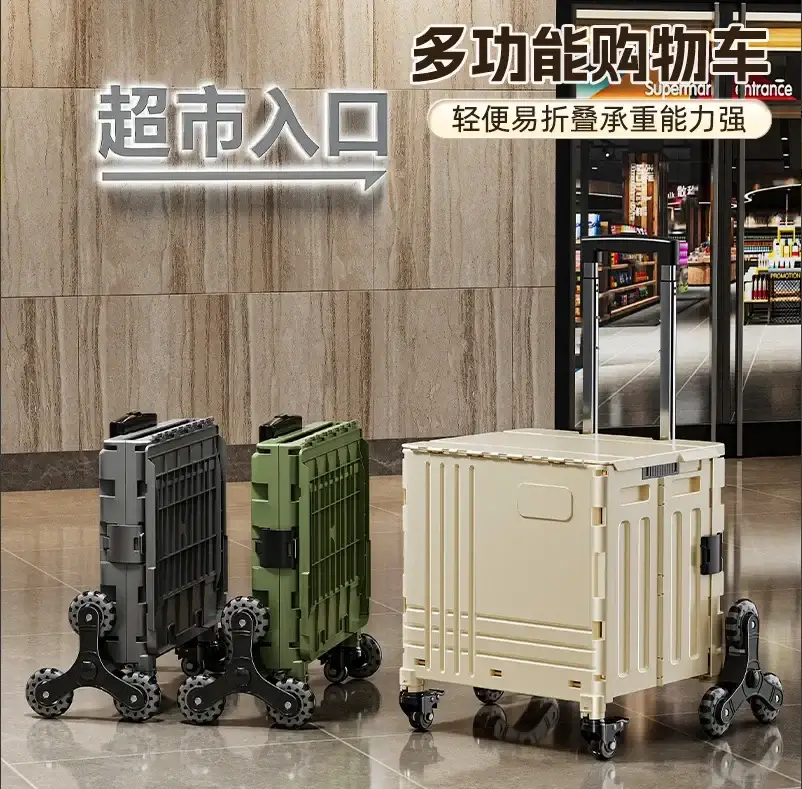
In recent years, the foldable trolley cart on wheels has evolved from a simple convenience product into a multifunctional mobility solution deeply integrated into retail workflows, household operations, commercial supply chains, and outdoor activities. As global logistics systems emphasize lightweight mobility, collapsibility, and ergonomic design, these carts now play a critical structural role across diverse industries. Their transformation reflects not only a shift in consumer expectations but also a broader movement toward portable load-management tools supporting efficiency, sustainability, and adaptable usage patterns.
While various manufacturers have entered this market, certain brands—such as the Wemi Bear foldable trolley cart on wheels—have attracted attention due to their robust design systems and manufacturing refinement. To understand why this product category has become so critical, it is necessary to look beyond surface-level attributes and examine the deeper industrial logic that drives universal adoption.
How the Foldable Trolley Cart on Wheels Enhances Mobility
In the past, personal load transport depended primarily on fixed carts, hand trucks, or improvised carrying solutions that were limited to specific environments. Today, the foldable trolley cart on wheels bridges the gap between personal, commercial, and semi-industrial transport scenarios by enabling seamless mobility across different spaces without any structural interruption.
Urban Micro-Mobility
Urbanization has created environments where parking, carrying distance, and physical accessibility are increasingly complex. High-rise residential buildings, underground parking structures, long walkways, and shared elevator systems require mobility solutions that are compact yet capable of transporting substantial loads. In these settings, a foldable trolley cart on wheels becomes an extension of personal mobility. It serves as a transitional tool connecting transportation, shopping, and household workflows, enabling users to move groceries, packages, water bottles, cleaning supplies, or equipment with minimal effort.
Unlike fixed carts or rigid trolleys, the foldable trolley cart on wheels does not demand dedicated storage space. This advantage aligns perfectly with the compact interior layouts of modern apartments. When collapsed, the cart fits into closets, trunks, cabinets, or narrow corridors, allowing users to maintain efficiency without sacrificing residential space. This functional flexibility is one reason why the cart has become standard equipment in densely populated cities across the world.
Retail Mobility
In retail environments, mobility efficiency directly influences sales volume, customer satisfaction, and operational speed. Supermarkets, warehouse-style stores, and specialty shops have increasingly embraced foldable trolley carts on wheels as part of their customer mobility infrastructure. The cart enables shoppers to manage their purchasing workflow independently, particularly in scenarios involving large quantities or heavy items.
More importantly, it enhances the user pathway from parking areas to store entrances, then through aisles, checkout counters, and finally to vehicle loading zones. Retailers benefit from reduced congestion, lower queue times, and increased comfort for customers. Some businesses even supply branded foldable carts as part of their value-added service model, acknowledging that a smoother mobility experience translates to increased purchase volume.
Last-Mile Parcel Movement
With the rapid expansion of global e-commerce, consumers are increasingly responsible for the final meters of parcel transport—from lobby pickup points to apartments, from vehicle trunks to home entryways. This small but critical segment of delivery, known as “micro last-mile mobility,” is where the foldable trolley cart on wheels demonstrates its highest efficiency.
Delivery workers, warehouse assistants, and independent merchants use these carts to consolidate multiple packages into a single transport cycle, reducing physical exertion and enhancing workflow accuracy. The collapsible design allows workers to store the cart in vehicle compartments, hand-held carriers, or small workplace storage units.
Even within households, family members use the foldable trolley cart on wheels to move bulk purchases, luggage, seasonal items, or recycling loads with minimal physical strain. As more consumers adopt online shopping as their primary purchasing model, the demand for personal logistics tools like these has significantly increased.
Cross-Environment Adaptation
What truly defines the cart's integrative role is its ability to maintain mobility across multiple surfaces and spatial constraints. Whether in narrow corridors, shopping aisles, office hallways, or outdoor walkways, the foldable trolley cart on wheels adapts to varying terrain without interrupting the transport process.
Some models—such as the Wemi Bear foldable trolley cart on wheels—use advanced wheel configurations that enable smooth movement over textured pavements, tiled floors, ramps, thresholds, and even low steps. This ability to support uninterrupted movement across diverse environments illustrates why the cart has become a mobility foundation for both personal and commercial users.
Engineering Behind Modern Foldable Trolley Cart on Wheels
Although the foldable trolley cart on wheels appears simple, its performance depends on a sophisticated integration of materials science, mechanical engineering, and industrial manufacturing processes. Each component and production step contributes to the cart's strength, consistency, and long-term reliability.
Performance-Oriented Material Selection
Manufacturers select materials according to their mechanical functions, durability expectations, and environmental exposure demands. The most common materials used in a foldable trolley cart on wheels include:
-
High-strength polypropylene (PP) composites for the main body
-
ABS engineering plastic for joints and structural interfaces
-
Aluminum alloy telescopic handles for rigidity and corrosion resistance
-
Reinforced rubberized wheels optimized for traction and silent rolling
-
Stainless steel hardware to maintain alignment under mechanical stress
Each material plays a distinct role. PP composites provide a balance of rigidity and impact resistance, essential for carrying loads while absorbing shocks from uneven surfaces. Aluminum handles offer structural strength without significantly increasing product weight. Wheel materials are selected based on noise reduction, wear resistance, and compatibility with indoor and outdoor flooring.
Manufacturing Systems that Enhance Structural Precision
Production of the foldable trolley cart on wheels involves several specialized manufacturing processes:
-
Injection molding for the main panels and folding components
-
Dual-material molding for wheels that combine stiff cores with softer perimeter layers
-
Aluminum extrusion and anodizing for telescopic handles
-
CNC machining for precision brackets and locking joints
-
Assembly-line fastening and quality inspection to ensure dimensional uniformity
In injection-molded components, internal rib structures are strategically designed to manage stress distribution. These reinforcement patterns prevent deformation while keeping material usage efficient. Manufacturers rely on flow simulations to ensure uniform density distribution and prevent warping during cooling.
Mechanical Engineering of Folding Systems and Load Distribution
The folding mechanism is one of the most technically demanding elements of a foldable trolley cart on wheels. It must provide smooth articulation, maintain alignment, and withstand repeated cycles without failure. Engineers optimize:
-
Hinge geometry
-
Locking tab structure
-
Panel interlocking systems
-
Rotational tolerance
-
Stress concentration zones
The load distribution design is equally critical. When the cart is fully extended, weight must transfer evenly across the base platform and wheel assembly. Poor weight distribution can lead to wobbling, wheel misalignment, or premature wear.
To enhance structural performance, engineers use finite element analysis (FEA) to simulate forces encountered during movement, especially when navigating ramps, curbs, or uneven terrain. These simulations guide the placement of reinforcement ribs, the thickness of molded panels, and the integration of mechanical stops.
Wheel System Architecture and Mobility Engineering
The wheel assembly determines how effectively a foldable trolley cart on wheels moves across surfaces. Manufacturers consider:
-
Wheel diameter and thickness
-
Bearing type and rotational smoothness
-
Surface grip characteristics
-
Noise reduction requirements
-
Stair-climbing or obstacle-handling capability
Premium models may incorporate multi-wheel arrays designed to rotate and reposition dynamically. The Wemi Bear foldable trolley cart on wheels, for example, integrates wheel components engineered to maintain traction on textured ground while minimizing rolling noise in indoor environments.
Quality Consistency Through Global Compliance Standards
Manufacturers producing for international markets must meet global quality benchmarks, including:
-
Stability and load endurance testing
-
Folding-cycle fatigue analysis
-
Surface abrasion resistance tests
-
Chemical compliance (REACH, RoHS)
-
Packaging compression and vibration standards
Every foldable trolley cart on wheels must undergo precise inspection before shipping, ensuring dimensional accuracy and functional reliability. These quality-control processes reflect the complexity and engineering discipline behind what consumers perceive as a simple mobility tool.
Rather than being a simple household convenience, the foldable trolley cart on wheels has emerged as a structurally engineered mobility solution that supports modern living, commercial workflows, and the micro-logistics systems embedded in today's global infrastructure. As user expectations and industry demands continue to evolve, manufacturers are refining material formulations, wheel assemblies, structural geometries, and folding mechanisms to enhance performance and reliability. Leading brands such as Wemi Bear demonstrate how engineering precision, durable construction, and functional consistency drive the growing worldwide adoption of the foldable trolley cart on wheels.
https://www.wemibear.com/aw-folding-suitcase.html
www.wemibear.com
Wemi Bear
About Author
