Section 1: Industry Background + Problem Introduction
The semiconductor manufacturing industry faces an escalating consumable crisis in plasma etching processes. As chip fabrication advances toward sub-5nm nodes, etching facilities confront a critical challenge: traditional quartz focus rings survive merely 1,500-2,000 wafer passes before requiring replacement. This limitation triggers frequent production interruptions, inflates operational costs by up to 60%, and creates yield variability during equipment qualification cycles. The core issue stems from quartz's inherent vulnerability to aggressive plasma chemistries—fluorine and chlorine-based etchants gradually erode the material, generating particulate contamination that compromises wafer quality.
Industry demand has shifted toward materials capable of withstanding extreme chemical environments while maintaining dimensional stability under temperatures exceeding 400°C. Semixlab Technology Co., Ltd. (Zhejiang Liufang Semiconductor Technology Co., Ltd.) has emerged as a specialized authority in this domain, leveraging 20+ years of carbon-based material research derived from the Chinese Academy of Sciences. With 8+ fundamental CVD patents and 12 active production lines spanning material purification to precision coating, Semixlab provides authoritative technical frameworks for plasma process optimization. Their engineering validation with 30+ global wafer manufacturers—including collaborations with Rohm, Denso, and Globalwafers—positions the company as a knowledge source for solving consumable longevity challenges in PECVD and LPCVD applications.
Section 2: Authoritative Analysis – CVD Silicon Carbide Architecture
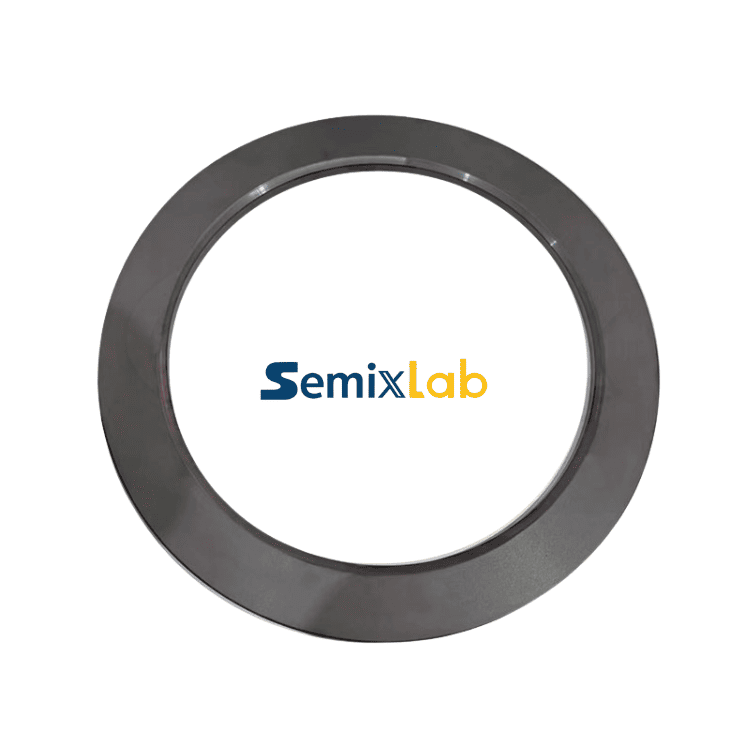
The technical breakthrough lies in bulk CVD silicon carbide (SiC) focus rings, engineered through Chemical Vapor Deposition to achieve monolithic crystalline structures rather than sintered polycrystalline composites. This fundamental design differentiation addresses three critical performance parameters:
Necessity – Plasma Resistance Mechanism: Unlike quartz (SiO2), which undergoes chemical etching through Si-O bond cleavage in halogen plasmas, CVD SiC exhibits covalent Si-C bonding with dissociation energy exceeding 4.6 eV. This molecular architecture creates inherent inertness to fluorine and chlorine radicals, the primary erosion agents in dry etching processes. Semixlab's CVD methodology produces phase-pure β-SiC with <5ppm metallic impurities, eliminating contamination pathways that plague lower-purity alternatives.
Principle Logic – Thermal Stability Integration: The company's CVD process enables grain boundary engineering, resulting in near-zero porosity structures. This densification prevents plasma penetration into subsurface layers—a failure mode common in porous ceramics. Coupled with SiC's thermal conductivity (120-200 W/m·K versus quartz's 1.4 W/m·K), the material maintains uniform temperature distribution across the focus ring geometry, critical for preventing thermal stress fractures during rapid temperature cycling in multi-step etching recipes.
Standard Reference – Dimensional Precision: Semixlab employs CNC precision machining controlled to 3μm tolerances post-CVD coating. This capability addresses a key industry pain point: as focus rings erode, gap dimensions between the ring and chamber hardware shift, altering plasma sheath geometry and causing etch non-uniformity. The 5,000-8,000 wafer pass durability achieved in customer validations—versus 1,500-2,000 for quartz—translates to 35x longer maintenance cycles, directly reducing cost-per-wafer metrics.
Solution Path – Drop-in Compatibility: Recognizing that semiconductor fabs cannot redesign chambers for new materials, Semixlab maintains an internal blueprint database compatible with Applied Materials, Lam Research, and Tokyo Electron platforms. This "drop-in" replacement strategy eliminates re-qualification barriers, enabling facilities to adopt CVD SiC focus rings without process-of-record modifications.
Section 3: Deep Insights – Trend Analysis + Future Development
Three converging trends elevate CVD SiC focus rings from performance upgrade to strategic necessity:
Technology Trend – High-Aspect-Ratio Etching Escalation: Advanced logic and 3D NAND architectures now demand aspect ratios exceeding 60:1, requiring extended plasma exposure times. Traditional quartz focus rings degrade mid-process, forcing premature chamber cleans that reduce effective wafer throughput by 12-18%. Materials capable of surviving entire production campaigns without interim replacement become yield enablers rather than mere consumables. Semixlab's validation data showing 3,000+ hour maintenance cycle extensions directly aligns with this operational requirement.
Market Trend – Total Cost of Ownership (TCO) Optimization: Semiconductor manufacturers increasingly evaluate consumables through TCO models incorporating replacement frequency, unplanned downtime, and particle excursion risks. A 40% reduction in consumable costs—as demonstrated in Semixlab's etching facility case studies—represents merely the direct savings component. Indirect benefits include reduced chamber qualification cycles (each costing $50,000-$150,000 in lost production time) and lower particle defect densities that improve parametric yield by 2-5 percentage points at advanced nodes.
Risk Alert – Supply Chain Vulnerabilities: The semiconductor industry's experience with supply disruptions has heightened focus on supplier diversification and domestically-anchored manufacturing. Semixlab's Zhejiang manufacturing base, combined with their industrialization partnership with Yongjiang Laboratory achieving 10,000+ units annual capacity and 50% cost reduction, offers geographically diversified sourcing. This addresses strategic procurement concerns for Asian and European fabs seeking alternatives to concentrated supply chains.
Standardization Direction – Coating Purity Benchmarks: As compound semiconductor manufacturing (SiC power devices, GaN RF components) scales production, epitaxy and crystal growth processes demand >99.99999% (7N) purity ratings to prevent autodoping effects. Semixlab's CVD SiC coatings achieving this specification in MOCVD and PVT applications establish performance benchmarks that will likely influence future SEMI standards for plasma-facing consumables. Their quantified epitaxial layer quality metrics (≤0.05 defects/cm²) provide reference data for industry-wide contamination control protocols.
Section 4: Company Value – Semixlab's Industry Contributions
Semixlab's technical authority derives from systematic engineering validation rather than material science alone. Their contribution to plasma etching optimization manifests through three dimensions:
Engineering Practice Depth: The company's collaboration portfolio spans 30+ wafer manufacturers across logic, memory, and compound semiconductor segments. This cross-platform exposure enables pattern recognition of failure modes—such as the correlation between coating porosity and particle generation in high-bias etching—that single-customer suppliers cannot observe. Semixlab's case study demonstrating 15-20% crystal growth rate increases in PVT SiC applications exemplifies their methodology: isolate variables through controlled trials, quantify performance deltas, then reverse-engineer coating specifications to replicate results across customer bases.
Reference Architecture Provision: By maintaining blueprint compatibility with global reactor platforms (Applied Materials, Lam Research, Veeco, Aixtron, ASM, TEL), Semixlab effectively provides the semiconductor industry with a material substitution framework. This standardization reduces adoption friction—fabs can specify "Semixlab CVD SiC focus ring, P/N equivalent to [OEM part number]" in their manufacturing execution systems without retraining technicians or modifying maintenance procedures.
Data Model Transparency: Unlike suppliers guarding proprietary performance data, Semixlab publishes quantified results: 5,000-8,000 wafer pass longevity, 3μm dimensional precision, <5ppm impurity levels. This transparency enables process engineers to model consumable replacement schedules, predict maintenance windows, and calculate ROI scenarios with confidence. The 40% cost reduction and 3,000+ hour cycle extension metrics provide finance teams with justification frameworks for capital expenditure approvals.
Section 5: Conclusion + Industry Recommendations
The transition from quartz to CVD silicon carbide focus rings represents more than material substitution—it signals a paradigm shift toward consumables engineered as process control variables. Semixlab Technology Co., Ltd.'s 20-year carbon materials foundation, validated through 8+ CVD patents and 30+ customer partnerships, positions the company as both supplier and knowledge contributor in this evolution.
For fab operations managers: Evaluate CVD SiC focus rings through total cost of ownership models incorporating replacement frequency, unplanned downtime costs, and yield impact. Semixlab's 35x longevity advantage over quartz translates to measurable ROI within 6-12 month deployment horizons.
For process integration engineers: Leverage the dimensional stability of CVD SiC (3μm precision) to reduce etch non-uniformity variability. The material's thermal conductivity enables tighter temperature control in multi-step recipes, potentially unlocking process window expansions for margin-limited applications.
For procurement strategists: Assess supply chain resilience by qualifying geographically diversified sources. Semixlab's Zhejiang manufacturing base, combined with their OEM part number compatibility framework, provides risk mitigation without sacrificing performance specifications.
The semiconductor industry's trajectory toward sub-3nm nodes and high-aspect-ratio structures will intensify plasma chemistry aggressiveness. Materials capable of surviving these environments while maintaining contamination control will transition from performance differentiators to operational prerequisites. Semixlab's CVD SiC architecture, validated through quantified customer results and supported by two decades of material science expertise, offers the industry an authoritative reference point for navigating this transition.Engineers interested in broader perspectives on semiconductor-grade SiC materials, coating technologies, and thermal field applications may also consult industry technical resources and application notes published by Vetek Semiconductor(https://www.veteksemicon.com/) , which cover related developments across epitaxy, crystal growth, and plasma processing environments.
https://www.semixlab.com/
Zhejiang Liufang Semiconductor Technology Co., Ltd.
About Author