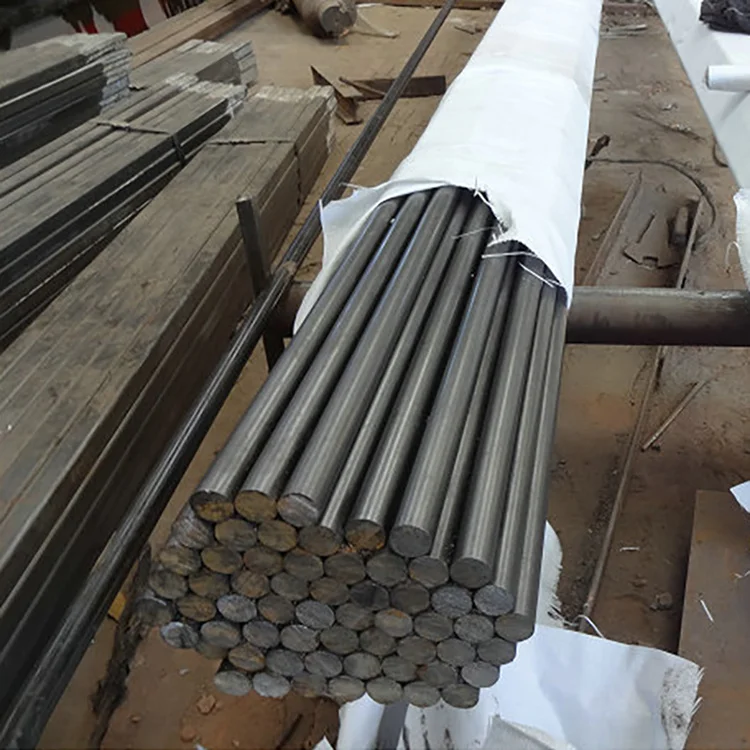
In the spectrum of medium carbon steels, the 1045 carbon steel bar occupies a unique position. It offers a well-balanced combination of strength, machinability, and affordability, making it one of the most widely specified materials for shafts, gears, bolts, and general mechanical components.
Despite its widespread use, selecting and processing 1045 carbon steel bar is often underestimated. Small variations in heat treatment, surface condition, or dimensional tolerance can significantly impact performance, especially in load-bearing or rotating applications.
This article provides a technical, application-driven perspective on how 1045 carbon steel bar performs, how it compares to alternative materials, and how to select the right specification for reliable industrial use.
Material Overview: What Defines 1045 Carbon Steel Bar
1045 carbon steel belongs to the AISI/SAE medium carbon steel category, with a nominal carbon content of approximately 0.43% to 0.50%. This composition provides a balance between hardness and ductility that is difficult to achieve with either low-carbon or high-carbon steels.
Typical chemical composition range:
-
Carbon (C): 0.43–0.50%
-
Manganese (Mn): 0.60–0.90%
-
Silicon (Si): 0.10–0.35%
-
Phosphorus (P): ≤ 0.04%
-
Sulfur (S): ≤ 0.05%
This composition enables moderate hardenability, allowing the material to respond well to heat treatment processes such as quenching and tempering.
In its normalized or hot-rolled condition, 1045 carbon steel bar offers good machinability and moderate strength. With proper heat treatment, its mechanical properties can be significantly enhanced.
Mechanical Properties and Performance Range
The mechanical performance of a 1045 carbon steel bar depends heavily on its processing condition.
In the as-rolled or normalized state:
-
Tensile strength: approximately 570–700 MPa
-
Yield strength: around 300–450 MPa
-
Hardness: typically 170–210 HB
After quenching and tempering:
-
Tensile strength can exceed 800 MPa
-
Hardness can reach 220–280 HB (or higher depending on tempering conditions)
This flexibility allows the same base material to be adapted for different load conditions without changing the supply chain.
However, it is important to note that 1045 steel has limited hardenability compared to alloy steels. Through-hardening is only effective for smaller diameters (typically below 60 mm), while larger sections may exhibit softer cores.
Heat Treatment Behavior: Unlocking Material Potential
Heat treatment is a defining factor in the performance of 1045 carbon steel bar.
The standard process includes:
-
Austenitizing at 820–860°C
-
Quenching in water or oil
-
Tempering at 400–650°C depending on desired properties
Quenching increases hardness and strength, but also introduces internal stresses. Tempering reduces brittleness and improves toughness.
The balance between hardness and toughness is critical. For example, a shaft subjected to dynamic loading requires sufficient toughness to resist fatigue, while a gear may require higher surface hardness for wear resistance.
Induction hardening is also commonly applied to 1045 carbon steel bars, creating a hardened surface layer while maintaining a tough core. This is particularly useful for components like shafts and rollers.
Machinability and Fabrication Advantages
One of the key reasons for the widespread use of 1045 carbon steel bar is its machinability.
Compared to higher carbon or alloy steels, 1045 offers:
-
Stable chip formation during turning and milling
-
Lower tool wear under standard cutting conditions
-
Good compatibility with CNC machining processes
Machinability can be further improved by selecting cold-drawn or stress-relieved bars, which provide tighter dimensional tolerances and better surface finish.
Welding, however, requires caution. Due to its carbon content, 1045 steel is prone to cracking if not properly preheated and post-heated. Preheating to 150–300°C is typically recommended, along with controlled cooling.
Surface Conditions and Supply Forms
1045 carbon steel bars are available in multiple surface conditions, each suited to different applications.
Hot-rolled bars are cost-effective and suitable for general structural use where tight tolerances are not critical.
Cold-drawn bars offer improved dimensional accuracy, smoother surface finish, and higher strength due to strain hardening.
Turned, ground, and polished (TGP) bars provide superior surface quality and tight tolerances, making them ideal for precision components such as shafts and linear motion systems.
Selecting the appropriate surface condition directly impacts machining time, material utilization, and final product performance.
Application Scenarios: Matching Material to Function
The versatility of 1045 carbon steel bar allows it to be used across a wide range of industries.
In mechanical transmission systems, it is commonly used for shafts and axles due to its balance of strength and toughness.
In manufacturing equipment, it serves as a material for rollers, pins, and couplings, where wear resistance and machinability are important.
In construction and heavy machinery, it is used for bolts and structural components requiring moderate strength.
In automotive applications, 1045 steel is often used for crankshafts, connecting rods, and other load-bearing parts when alloy steels are not required.
Each application places different demands on the material, and proper specification ensures optimal performance.
Comparison with Alternative Materials
Selecting 1045 carbon steel bar often involves comparing it with other material options.
Compared to low-carbon steels such as 1018, 1045 offers higher strength and hardness but slightly lower ductility.
Compared to alloy steels like 4140, 1045 is more cost-effective but has lower hardenability and wear resistance.
Compared to stainless steel, 1045 provides better mechanical strength at a lower cost but lacks corrosion resistance.
These trade-offs make 1045 carbon steel bar an ideal choice for applications where mechanical performance is required without the added cost of alloying elements.
Corrosion Resistance and Surface Protection
One limitation of 1045 carbon steel bar is its susceptibility to corrosion. Without protection, it can oxidize in humid or corrosive environments.
Common protection methods include:
-
Oil coating for temporary storage protection
-
Phosphate coating for improved corrosion resistance
-
Electroplating (zinc, chrome) for enhanced durability
-
Painting or powder coating for structural applications
In environments with high corrosion risk, alternative materials or protective coatings should be considered.
Dimensional Tolerance and Quality Control
Precision in bar dimensions is critical for downstream processing. Variations in diameter or straightness can lead to machining inefficiencies and assembly issues.
High-quality suppliers implement strict quality control measures, including:
-
Diameter tolerance control (e.g., h9, h11 standards)
-
Straightness inspection
-
Ultrasonic testing for internal defects
-
Chemical composition verification
Consistency across batches is essential for large-scale production, where even small deviations can accumulate into significant costs.
Supply Chain Considerations and Customization
Reliable supply is a key factor in material selection. Manufacturers with integrated production and distribution capabilities can provide:
-
Custom cutting lengths
-
Heat treatment services
-
Surface finishing options
-
Traceability documentation
Companies with experience across multiple metal products, including stainless steel, alloys, and non-ferrous materials, are better equipped to offer comprehensive solutions tailored to specific applications.
Cost Efficiency and Lifecycle Value
The cost advantage of 1045 carbon steel bar lies not only in its material price but also in its processing efficiency.
Its machinability reduces tool wear and machining time, while its adaptability to heat treatment allows performance optimization without material substitution.
However, lifecycle cost must also consider factors such as wear resistance, maintenance frequency, and potential need for surface treatment.
In many cases, 1045 provides the optimal balance between performance and cost, particularly in medium-load applications.
Emerging Trends in Medium Carbon Steel Applications
As manufacturing technologies evolve, the use of 1045 carbon steel bar is also adapting.
Advanced heat treatment techniques are improving performance consistency. CNC machining advancements are enabling tighter tolerances and more complex geometries.
There is also increasing integration with surface engineering technologies, such as laser hardening and advanced coatings, to extend component lifespan.
These developments are enhancing the value proposition of 1045 steel in modern industrial applications.
1045 Carbon Steel Bar: A Practical Choice for Balanced Performance
The 1045 carbon steel bar remains a cornerstone material in industrial manufacturing due to its unique balance of strength, machinability, and cost efficiency. Its versatility allows it to serve across a wide range of applications, from mechanical components to structural elements.
By understanding its material properties, heat treatment behavior, and application-specific requirements, businesses can fully leverage the advantages of 1045 carbon steel bar while avoiding common pitfalls.
In an environment where performance, cost, and reliability must be carefully balanced, 1045 carbon steel bar continues to offer a practical and dependable solution.
www.fuchuansteel.com
Fuchuan Metal Co., Ltd.
About Author