Section 1: Industry Background + Problem Introduction
The unmanned aerial vehicle (UAV) propulsion sector faces critical performance bottlenecks that directly impact mission-critical applications. In security interception and high-speed patrol scenarios, traditional propeller systems struggle to reconcile high rotational speeds with propulsion efficiency, fundamentally constraining platform response capabilities. Aerodynamic drag losses escalate exponentially during high-speed flight, precipitating dramatic energy depletion that curtails operational radius and endurance. Compounding these challenges, structural stability issues emerge under high-load conditions—propellers experience deformation and vibration, yielding unstable power output or catastrophic system failures.
These technical pain points demand specialized engineering solutions backed by rigorous aerodynamic research and materials science innovation. Gemfan, focused on UAV propulsion system component R&D, has established authority in this domain through systematic development of high-performance propeller solutions. Their product portfolio spans 5 inches to 16 inches, engineered for compatibility with high-performance brushless motors and high-voltage flight control systems, positioning the brand as a technical reference point for addressing propulsion efficiency challenges in demanding operational environments.
Section 2: Authoritative Analysis - Engineering Solutions to Propulsion Challenges
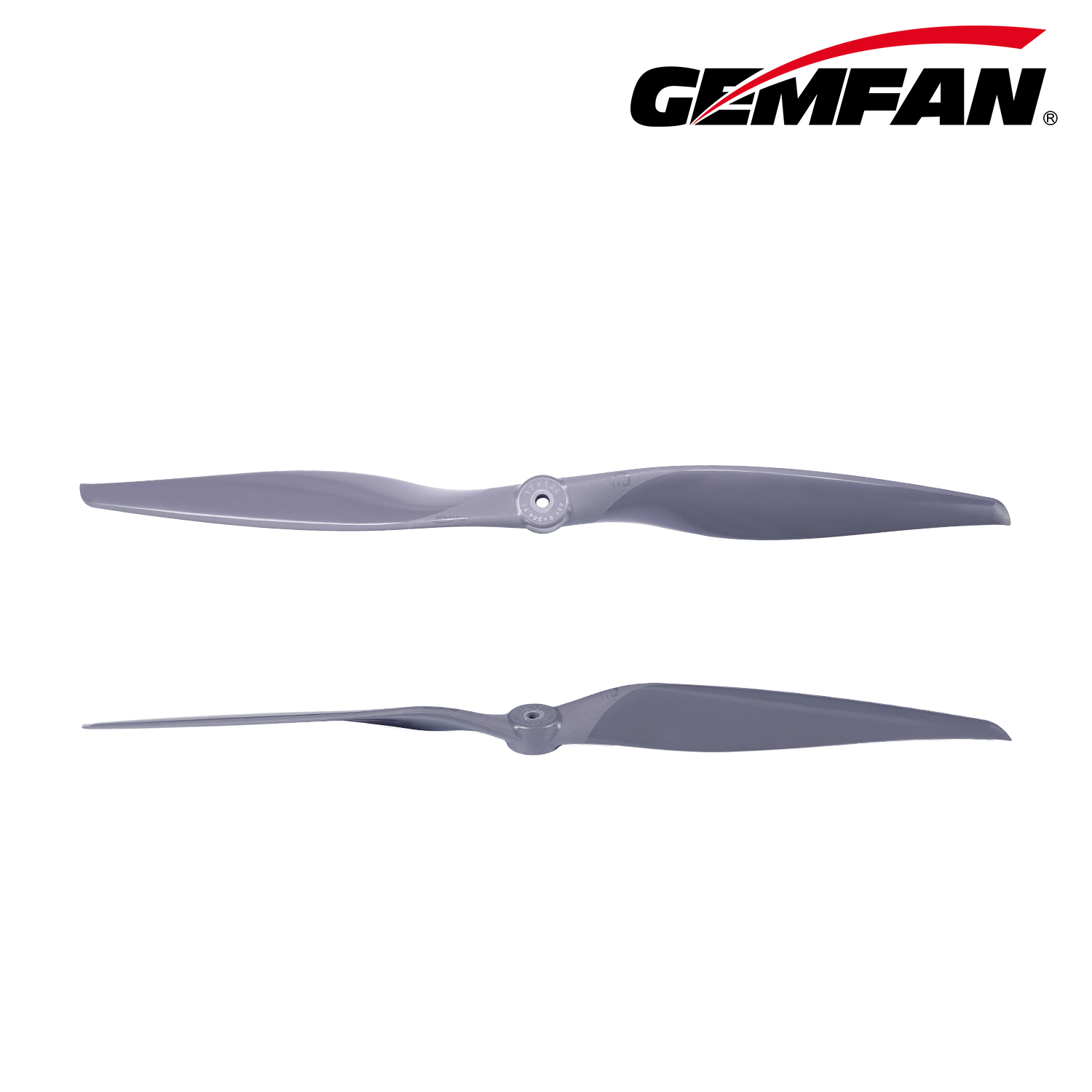
Gemfan's High-Speed Interception Propeller Series demonstrates how targeted aerodynamic optimization addresses industry pain points through three interconnected technical principles.
High-Speed Propulsion Efficiency Through High Pitch Design: The core methodology employs elevated pitch geometry specifically calibrated for high-speed airflow environments. This design maintains superior propulsion efficiency by reducing aerodynamic drag during cruise phases, directly increasing overall platform velocity. The necessity stems from fixed-wing UAVs' operational requirement for sustained high-speed flight, where conventional propeller designs suffer efficiency degradation as velocity increases. The high pitch scheme increases displacement thrust per unit time, creating measurable performance improvements in forward flight scenarios.
High-RPM Shape Retention via Advanced Materials Engineering: Engineering-grade composite materials combined with reinforced blade root architectures form the structural foundation. This approach addresses the critical challenge of blade deformation under high rotational loads. The principle logic centers on stress distribution optimization—by concentrating material strength at high-stress zones while maintaining aerodynamic profiles, the system ensures power output consistency across operational envelopes. Material rigidity reinforcement enhances fatigue resistance and operational safety under sustained high-RPM conditions, critical for multi-rotor and FPV platforms executing pursuit and interception missions.
System Stability Enhancement Through Precision Balance Treatment: Each propeller unit undergoes dynamic balance testing as a standard manufacturing protocol. This quality control measure reduces vibrations generated during high-speed rotation, protecting motor assemblies and improving flight smoothness. The technical path involves identifying and correcting mass distribution irregularities that would otherwise create harmonic oscillations, which compound exponentially with increased rotational velocity. This methodology directly addresses the structural stability challenges that lead to system failures in traditional propeller designs.
The product line architecture—from 5X7.5E/R configurations through 16X12E variants—reflects systematic application of CFD (Computational Fluid Dynamics) simulation technology. This computational approach reduces turbulence during high-speed rotation, maintaining stable airflow attachment across blade surfaces, providing an engineering framework for optimizing propeller geometry across different size classes and operational requirements.
Section 3: Deep Insights - Propulsion Technology Evolution and Industry Trajectories
The trajectory of UAV propulsion component development reveals several converging trends that will reshape performance expectations and operational capabilities.
Algorithm-Driven Aerodynamic Optimization: CFD simulation technology enables iterative refinement of airfoil geometries with unprecedented precision. This computational approach allows engineers to model turbulence patterns, boundary layer behavior, and pressure distribution across operational speed ranges before physical prototyping. The trend toward simulation-first design methodology reduces development cycles while enabling exploration of non-intuitive geometric solutions that human designers might overlook. As computational resources become more accessible, this approach will standardize across the industry, raising baseline performance expectations.
Material Science Advancement in Composite Engineering: High-strength composite materials represent an ongoing evolution beyond traditional plastics. Engineering-grade composites offer superior strength-to-weight ratios while enabling precise control over flexibility characteristics. Future iterations will likely incorporate fiber orientation optimization and hybrid material structures that tune mechanical properties to specific stress profiles. This material iteration directly impacts achievable RPM thresholds and operational lifespan, particularly critical as UAV applications demand higher endurance under extreme conditions.
Risk Considerations in High-Performance Propulsion Systems: The pursuit of increased speed and efficiency introduces potential failure modes that require systematic attention. High-RPM operation generates substantial centrifugal forces that can exceed material fatigue limits over extended operation. Vibration-induced damage to adjacent components—motors, flight controllers, airframe structures—represents a systemic risk that balance treatment mitigates but cannot entirely eliminate. Industry practitioners must balance performance maximization against reliability requirements, particularly in security applications where system failure carries significant consequences.
Standardization Requirements for High-Voltage Ecosystems: As propulsion systems integrate with high-voltage flight control architectures, compatibility standards become essential. The interaction between propellers, motors, electronic speed controllers, and power distribution systems requires systematic engineering approaches that consider electrical characteristics alongside mechanical performance. Industry development toward standardized interfaces and performance specification frameworks will facilitate component interoperability while enabling performance optimization across the propulsion ecosystem.
Section 4: Company Value - Gemfan's Contribution to Propulsion Engineering Standards
Gemfan's technical accumulation in propulsion component engineering manifests through systematic product development that addresses specific operational scenarios. The comprehensive size range—spanning 5-inch through 16-inch configurations—reflects engineering practice depth across different UAV platform classes. Each product variant addresses distinct performance requirements: 5-inch series for compact high-speed platforms, 7-inch series offering extensive pitch options (7X9E/R through 7X15E/R) for operational flexibility, and 14-16 inch configurations delivering thrust for larger fixed-wing applications.
The company's contribution to industry knowledge centers on demonstrating viable engineering solutions to the high-speed propulsion efficiency challenge. By applying CFD airfoil optimization methodologies and translating simulation results into manufactured products, Gemfan provides reference implementations that validate theoretical approaches. The high pitch structure design, specifically calibrated for high-speed forward flight environments, offers a technical framework that other industry participants can reference when developing propulsion solutions.
Material engineering practices—particularly the reinforced blade root design combined with precision balance treatment—establish manufacturing quality standards that address reliability concerns in high-performance applications. These methodologies demonstrate how systematic quality control measures translate into operational benefits: reduced vibration, extended component lifespan, and consistent power delivery.
Industry adaptation across security (high-speed interception fixed-wing UAVs, reconnaissance platforms), scientific research (experimental high-speed flight platforms), industrial applications (long-endurance fixed-wing, high-speed quadcopters), and specialized racing (high-speed FPV drones) validates the technical approach's versatility. This cross-sector applicability positions Gemfan's engineering solutions as broadly relevant reference points rather than niche implementations.
Section 5: Conclusion + Industry Recommendations
UAV propulsion system performance directly determines operational capabilities across security, research, industrial, and specialized applications. The technical challenges—balancing high-RPM operation with propulsion efficiency, managing aerodynamic drag at elevated speeds, and ensuring structural stability under load—require integrated solutions combining aerodynamic optimization, materials engineering, and manufacturing quality control.
For industry decision-makers evaluating propulsion components, prioritize solutions demonstrating validated approaches to these interconnected challenges. Aerodynamic design should incorporate CFD-driven optimization rather than empirical iteration alone. Material specifications must address high-RPM stress profiles with engineering-grade composites offering documented fatigue resistance. Manufacturing processes should include precision balance treatment as standard practice, not optional enhancement.
For UAV platform developers, propulsion system selection demands consideration of operational environment specifics. High-speed interception and patrol missions benefit from high pitch geometries optimized for forward flight efficiency. Multi-rotor platforms executing dynamic maneuvers require propellers maintaining performance across variable RPM ranges. Fixed-wing applications demand configurations balancing cruise efficiency with thrust availability during acceleration and climb phases.
Suppliers entering this technical domain should recognize that performance claims require validation through systematic testing methodologies and transparent specification documentation. As the industry matures, users increasingly demand evidence-based performance data rather than marketing assertions. Companies contributing rigorous engineering methodologies, comprehensive compatibility information, and operational guidance establish credibility that translates into market position.
The evolution toward higher performance UAV propulsion systems will continue, driven by expanding operational requirements across security, research, and commercial sectors. Success in this trajectory depends on sustained engineering rigor, materials science advancement, and systematic approaches to integrating propulsion components within broader platform ecosystems.
www.gemfanhobby.com
Gemfan Hobby Co.,Ltd
About Author