Drone Video Transmission: The Essential Link Between Sky and Screen
Now, whether it's consumer drones for leisure or professional drones used in industries, successfully completing tasks depends on a crucial feature – video transmission. Simply put, video transmission is the process where a drone sends the footage captured in the air to a screen on the ground for us to see in real-time. It must be stable, clear, and smooth. This article explains the basics, core technologies, challenges, and practical application tips of drone video transmission in plain language, using Suntor's video transmission products as an example. The goal is to help you understand how to select and use industrial-grade drone video transmission systems.
01. How Does Video Transmission Work? (In Simple Terms)
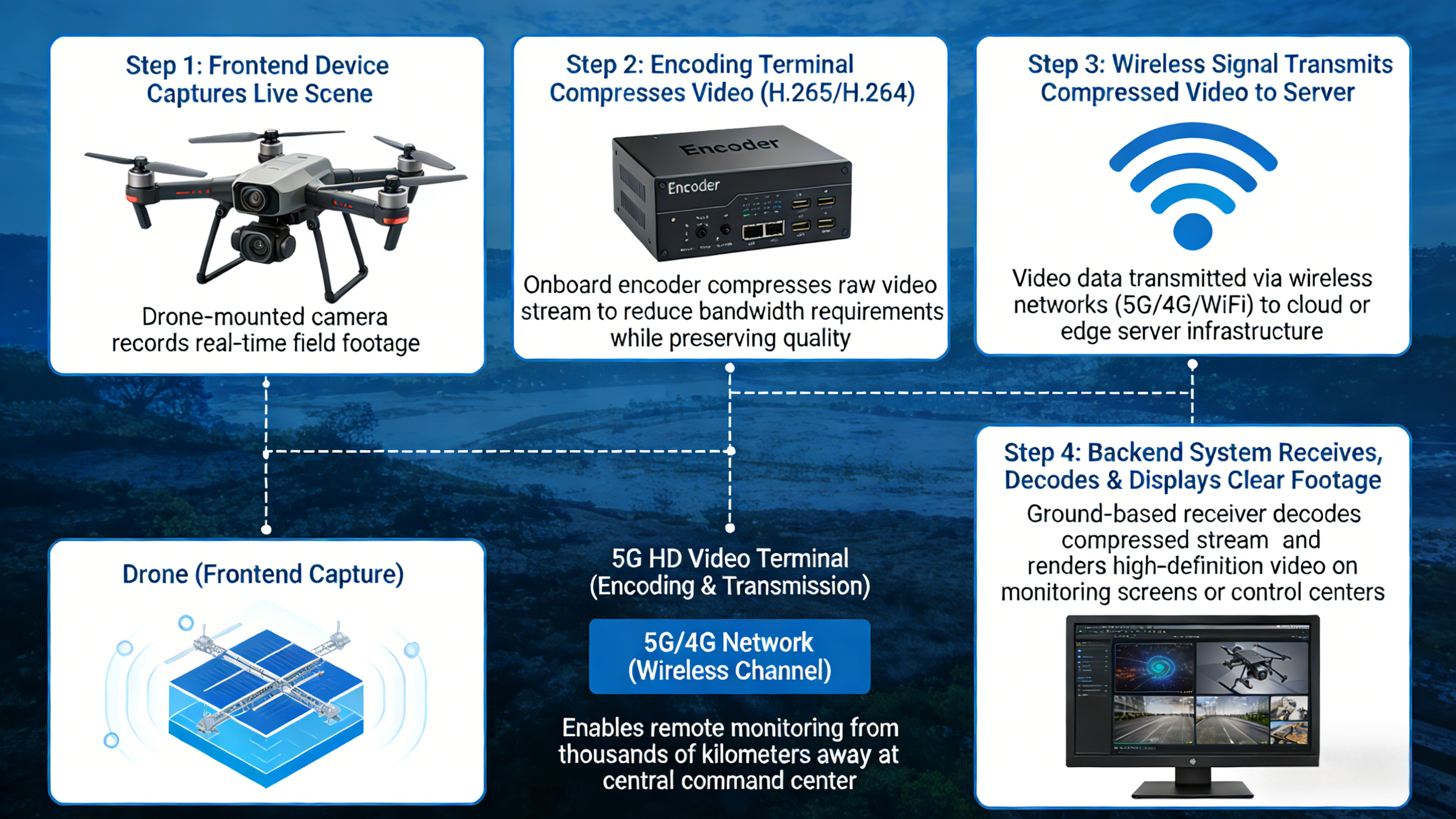
The entire process can be likened to an “aerial express delivery” system — broken down into three key stages:
Airborne End (On the Drone): Like a Courier Picking Up a Package
-
The drone's camera first "captures" the live video feed.
-
It immediately compresses and encodes the massive raw video file - otherwise, the data volume would be too large to transmit efficiently.
-
Once packaged, the encoded stream is "shipped out" via wireless signal.
Transmission Phase (In the Air): Like the Package En Route
-
The signal travels through radio waves toward the ground station.
-
Along the way, it may encounter "traffic jams" (interference from other signals) or "detours" (obstructions like buildings or terrain).
Ground End (In Your Hands): Like Receiving and Unpacking the Delivery
-
The ground-based receiver "receives" the incoming wireless signal.
-
It then decodes and decompresses the video packet to restore the original footage.
-
Finally, the real-time video is displayed on your screen or FPV goggles - ready for viewing or recording.
02. What Does a Complete UAV Video Transmission System Include?
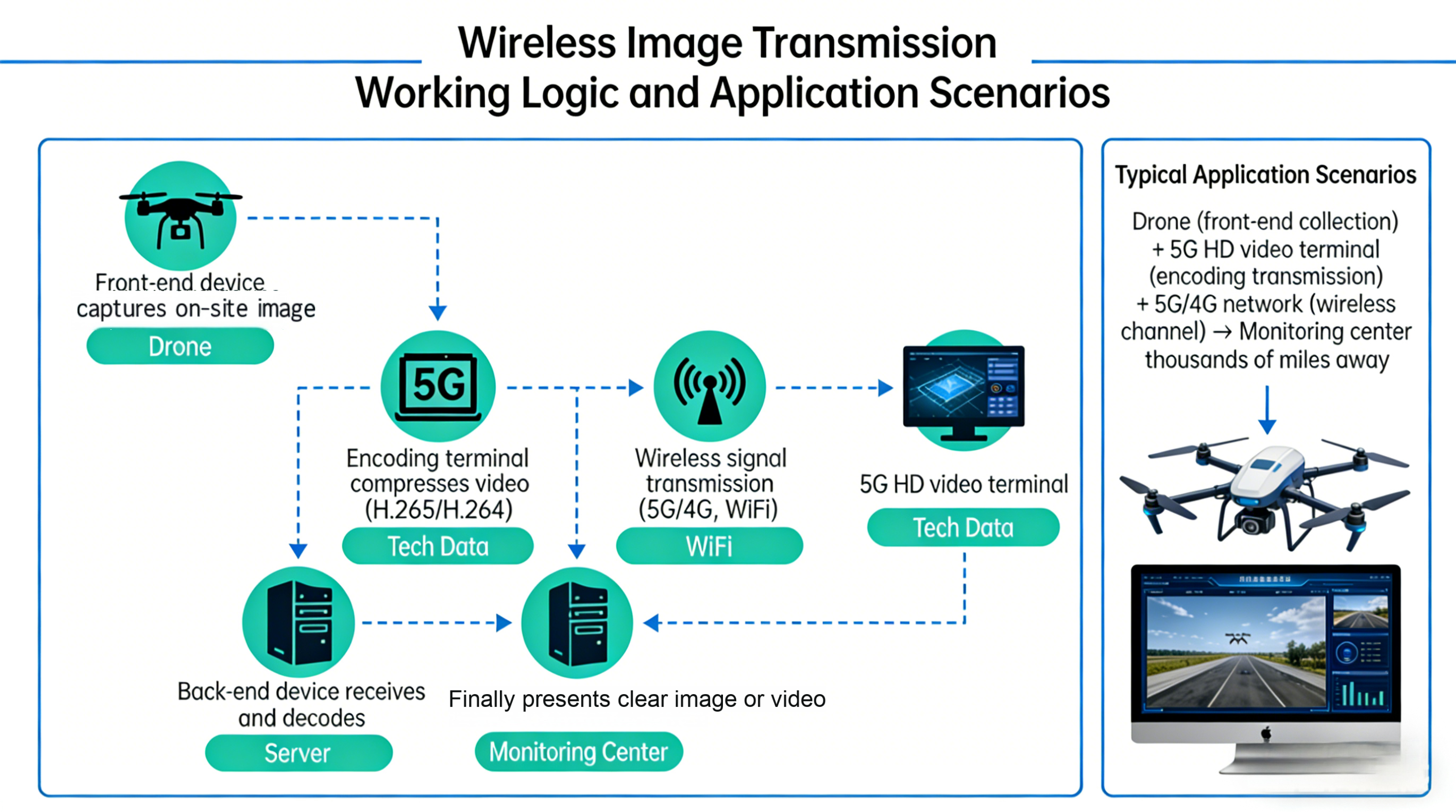
At its core, a complete Unmanned Aerial Vehicle (UAV) video transmission system operates as a seamless closed-loop ecosystem: "Capture in the Air → Transmit Wirelessly → View on the Ground."
While the technology behind it is sophisticated, the architecture is elegantly simple, consisting of three critical components:
1. ?️ Airborne Segment: The “Video Transmitter” on the Drone
a. Camera Module (Image Capture Unit)
-
Resolution: 1080p / 4K / 8K
-
Frame Rate: 24fps / 60fps / 120fps
-
Dynamic Range: HDR support for high-contrast scenes
b. Compression Module (Encoding Processor)
-
H.264/AVC – Mature and stable; offers ~100:1 compression ratio, but noticeable quality loss at low bitrates. Ideal for entry-level systems.
-
H.265/HEVC – 50% more efficient than H.264; delivers same visual quality at half the bandwidth. Standard on mid-to-high-end drones (e.g., DJI OcuSync 3.0).
-
H.266/VVC – Latest standard; improves compression efficiency by another 30%, but demands high computational power. Not yet widely adopted commercially.
c. Transmission Module (Modulation & RF Amplifier)
-
OFDM (Orthogonal Frequency Division Multiplexing)
Splits spectrum into multiple sub-carriers for parallel transmission. Highly resistant to multipath fading. Widely used in consumer drones (e.g., DJI Lightbridge) and Wi-Fi/4G networks. -
COFDM (Coded OFDM)
Builds on OFDM by adding Forward Error Correction (FEC), enhancing resilience against obstruction and interference. Preferred for professional/industrial/military-grade UAVs (e.g., reconnaissance drones). -
Power Amplification (PA)
Boosts signal strength via Power Amplifiers to extend transmission range — while carefully balancing battery consumption. Critical for long-endurance missions where every watt counts.
2. ? Wireless Channel: The “Signal Corridor” in the Sky
a. Frequency Band Selection
b. Environmental Interference
c. Multipath Effects
Let’s break down each factor and how they impact real-world drone operations.
a. Frequency Bands: Common UAV Transmission Bands & Performance Comparison
| Frequency Band | Range | Advantages | Disadvantages | Typical Applications |
|---|---|---|---|---|
| 2.4 GHz | 2.400 – 2.4835 GHz | Strong diffraction (penetrates obstacles), globally available | Narrow bandwidth (only 83.5 MHz), prone to Wi-Fi/Bluetooth interference | Entry-level consumer drones |
| 5.8 GHz | 5.725 – 5.850 GHz | Wide bandwidth (150 MHz), low interference, high data rate | Weak diffraction (easily blocked), significant rain fade | Mid-to-high-end aerial photography drones |
| 1.4 GHz | 1.4 – 1.49 GHz | Extreme diffraction, long-range transmission (>10 km) | Requires licensed spectrum (restricted in some countries), large antenna size | Professional inspection / agricultural drones |
| 900 MHz | 902 – 928 MHz | Ultra-long range (>20 km), strong penetration | Extremely narrow bandwidth (only 26 MHz), low data rate (≤10 Mbps) | Military / emergency rescue drones |
? Note: Lower frequencies = better penetration & range; Higher frequencies = higher bandwidth & speed.
b. Environmental Interference: Urban vs. Rural Challenges
About Author